

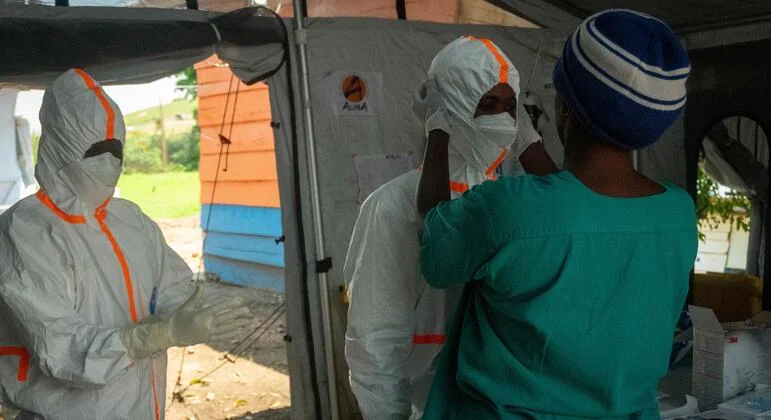
BUNIA, Ituri – The humanitarian landscape in the Democratic Republic of the Congo (DRC) has reached a precarious tipping point. As the nation grapples with the largest and deadliest Ebola outbreak in its history, a surge in armed insecurity in the northeastern province of Ituri is threatening to undo years of painstaking public health progress. With the total number of confirmed infections surpassing 8,000, international aid agencies are issuing desperate calls for the restoration of humanitarian access to displacement sites, warning that the forced dispersal of vulnerable families could ignite a secondary wave of transmission.
The Fragile Frontline: A Crisis of Security and Health
The latest escalation began on September 20, when security forces entered the Kigonze displacement camp in Bunia. Reports from the ground describe a chaotic scene: soldiers raided the site, allegedly searching for weapons and individuals suspected of affiliation with non-State armed groups. The sound of gunfire, which shattered the relative sanctuary of the camp, triggered a mass exodus of terrified families.
Kigonze has long served as a vital node for humanitarian aid, housing nearly 19,000 internally displaced persons (IDPs) who have already been stripped of their livelihoods by years of regional conflict. The recent incursion has transformed this shelter into a symbol of the compounding crises facing the DRC. UN aid coordination office (OCHA) reports indicate that residents have been subjected to a litany of abuses, including threats, intimidation, arrests, and the deliberate destruction of rudimentary shelters.
For the medical teams tasked with containing the Bundibugyo virus—the strain responsible for this outbreak—the loss of contact with these 19,000 individuals is a catastrophic development. Disease surveillance relies heavily on the stability of these populations. When families flee into the unknown, they carry with them the potential for silent transmission, making the task of contact tracing nearly impossible.
A Statistical Overview: The Weight of the Epidemic
The epidemiological data released by health authorities on Monday paints a grim picture. The current outbreak has officially breached the 8,000-case threshold, a sobering milestone that underscores the virulence of the pathogen and the difficulty of the containment effort.
- Total Confirmed Cases: 8,067
- Total Deaths: 3,901
- Case Fatality Rate: 48.4%
To put these figures into perspective, this outbreak has now surpassed the 2018–2020 emergency, which was previously the most significant health crisis in the nation’s modern history. It now stands as the second-largest Ebola epidemic ever recorded, trailing only the devastating 2014–2016 outbreak in West Africa, which claimed over 11,000 lives across Guinea, Liberia, and Sierra Leone. The 48.4% fatality rate indicates that nearly one in every two people who contract the virus will perish, a testament to the limited access to advanced therapeutic interventions in conflict-ridden zones.
Chronology of the Current Conflict and Outbreak
The current crisis is not a sudden occurrence but rather the result of months of simmering instability intersecting with a persistent biological threat.
- Mid-August: The Ebola outbreak reached its peak intensity in the Ituri province, putting severe strain on local healthcare facilities and prompting a surge in international assistance.
- Early September: A brief, fragile period of stabilization began to emerge as public health measures appeared to yield a gradual decline in new infections across the Ituri region.
- Mid-September: While Ituri showed signs of improvement, the neighboring province of North Kivu experienced a sudden, dramatic spike in cases, reaching record highs before a recent slight decline.
- September 20: Security incidents at the Kigonze displacement camp caused a mass departure of civilians, effectively severing the link between health workers and a high-risk population.
- Present: Humanitarian organizations are attempting to navigate a landscape where they are forced to choose between the safety of their staff and the imperative of providing life-saving medical care.
Official Responses: Calls for Neutrality and Access
Damien Mama, the UN Humanitarian Coordinator in the DRC, has been at the forefront of the diplomatic effort to stabilize the situation. In a firm statement, Mr. Mama emphasized that the civilian nature of displacement sites must be respected under international humanitarian law.
"These are families who have already lost everything," Mama stated. "They must be able to find safety and dignity wherever they seek refuge." He warned that the forced dispersal of these populations is not merely a human rights violation; it is a public health hazard that risks undoing months of progress.
The World Health Organization (WHO) has echoed these concerns, highlighting that the broader insecurity in Ituri—where more than 1.1 million people remain displaced—is the primary driver of the current epidemiological failure. "The backdrop of conflict, insecurity, and limited access to basic services undermines every pillar of the Ebola response," a WHO spokesperson noted. "When you cannot guarantee the safety of your personnel or the mobility of your patients, surveillance, case detection, and contact tracing all collapse."
The Implications: A "Perfect Storm" for Disease
The implications of the current insecurity are far-reaching and potentially permanent. In a normal setting, Ebola is controlled through a combination of ring vaccination, rapid testing, and rigorous contact tracing. However, these tools are rendered useless when the population is in constant flux.
The Breakdown of Surveillance
Contact tracing requires a stable population. If a person is exposed to the virus, health workers must monitor them for 21 days. If that person flees a camp to seek refuge with a host family in an unknown location, the "ring" of protection is broken. This creates "hidden chains of transmission" that can smolder in the community for weeks before being detected, often when it is too late to prevent a cluster of new infections.
The Strain on Healthcare Infrastructure
The conflict in Ituri has not only displaced people; it has damaged the very infrastructure needed to treat them. Clinics that once served as Ebola treatment centers (ETCs) are now struggling to maintain basic services. With security forces occupying or raiding areas near these facilities, the "neutral" space required for healthcare is effectively erased. Patients, fearing both the disease and the armed actors, are increasingly avoiding formal medical help in favor of traditional remedies or, worse, staying home and exposing their families to the virus.
Regional Contagion Risks
The disparity between the trends in Ituri and North Kivu serves as a stark warning. While Ituri has seen a decline in cases, the surge in North Kivu proves that the virus is opportunistic and highly mobile. If the security situation causes a massive movement of people from Ituri into North Kivu—or across porous provincial borders—the virus could find a new, susceptible population in which to thrive.
Conclusion: The Path Forward
The situation in the Democratic Republic of the Congo serves as a grim reminder that health security is inseparable from human security. As long as 1.1 million people in Ituri remain displaced and vulnerable to the whims of armed groups, the prospect of eradicating Ebola remains a distant hope rather than an attainable goal.
The international community, in partnership with the Congolese government, faces a dual mandate: first, to restore the civilian character of displacement camps and ensure safe, unimpeded access for humanitarian actors; and second, to intensify the public health response in a way that is sensitive to the volatile security environment.
Without a cessation of hostilities and a commitment to protecting the most vulnerable, the number of lives lost to this Ebola outbreak will continue to climb, leaving a legacy of tragedy in a region already defined by its resilience in the face of impossible odds. The coming weeks will be critical; if the dispersal of the Kigonze population is not managed through safe and voluntary re-integration, the current crisis could evolve into an unmanageable public health emergency that transcends provincial and national boundaries.
 Lina Hope
 Asro
Asro
