

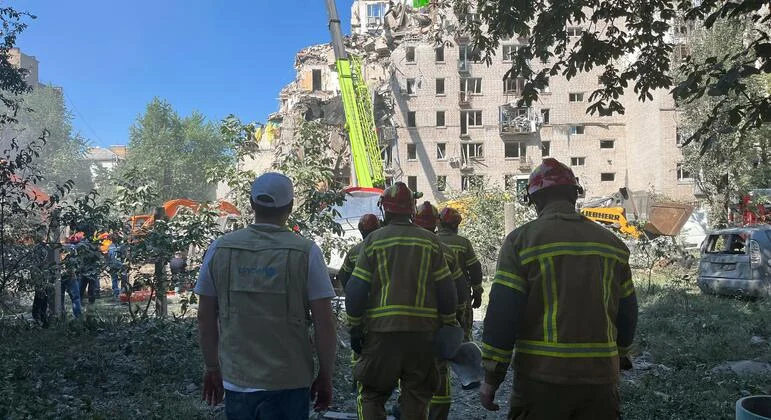
KYIV – The United Nations has issued a stern condemnation following a ferocious and large-scale Russian aerial assault on the Ukrainian capital of Kyiv, an attack that has left at least one person dead and a dozen more injured. The bombardment, which occurred overnight on July 19, 2026, serves as a grim escalation in a conflict that continues to exact a heavy toll on civilian life, infrastructure, and the fragile stability of the region.
The latest wave of violence, characterized by a rapid-fire sequence of missile strikes, has drawn sharp rebukes from international humanitarian agencies, who warn that the deliberate targeting of urban centers is a flagrant violation of international law.
Main Facts: A City Under Siege
The assault on Kyiv began in the pre-dawn hours, shattering the relative calm of the capital. According to local officials and UN monitors, the scale of the attack was unprecedented in recent weeks. Within a span of just 40 minutes, approximately 41 missiles were launched against the Kyiv region.
The destruction was widespread. Residential apartment blocks, local businesses, and critical transportation infrastructure—including a major metro station—were severely damaged or destroyed. Matthias Schmale, the UN Humanitarian Coordinator in Ukraine, confirmed the severity of the incident on Sunday, highlighting that the strikes were not isolated but part of a systematic campaign of destruction.
"The increasing toll of these attacks on civilians across the country is devastating, including in urban centers far from the frontline," Mr. Schmale stated. He emphasized that the fundamental principles of international humanitarian law—which demand the protection of civilians and non-military infrastructure—are being disregarded with alarming frequency.
Chronology of the Escalation
To understand the severity of the July 19 attack, it is essential to view it within the context of the preceding 48 hours of conflict:
- July 18: A deadly strike hit the Odesa region, targeting an area frequented by families. The attack on an amusement park resulted in several casualties, including children, sparking international outrage.
- July 19 (Pre-dawn): The assault on Kyiv commenced. Authorities reported a high-intensity barrage of 41 missiles within a 40-minute window. The Lukianivska district, a bustling area of the capital, suffered some of the most significant damage.
- July 19 (Morning): Emergency services were deployed across the city to clear debris and provide aid. Despite the immediate danger, market sellers in the Lukianivska district returned to their stalls shortly after the air raid sirens subsided, showcasing a grim resilience.
- July 19 (Afternoon): The United Nations Office for the Coordination of Humanitarian Affairs (OCHA) arrived on the scene to distribute meals, shelter materials, and psychological support to those whose homes were destroyed.
- July 20: Official statements were issued by the UN, WHO, and UN Women, condemning the targeting of civilian areas and the destruction of humanitarian facilities.
Supporting Data: The Human and Material Cost
The statistical reality of the war in Ukraine continues to trend in a harrowing direction. The attack on Kyiv destroyed livelihoods, with the Lukianivska market—a vital hub for local trade—left in ruins.
The Gendered Impact of War
UN Women has drawn particular attention to the disproportionate burden placed on Ukrainian women. Data analyzed between January and May 2026 shows a 34 percent increase in civilian casualties among women and girls compared to the same period in 2025.
The image of women returning to their market stalls amid the wreckage of the Lukianivska district has become a poignant symbol of the war. While the international community praises this resilience, aid agencies argue that it is a forced resilience, born of economic necessity and the collapse of traditional support systems. UN Women has called for "gender-responsive humanitarian assistance," noting that women are not only primary caregivers but are increasingly the primary economic drivers in families where men are mobilized or have been killed.
Infrastructure and Aid Facilities
The damage was not limited to residential properties. A warehouse operated by the World Health Organization (WHO) in the Kyiv region was also struck. While the agency confirmed that all staff were safe and that no medical supplies were stored at the facility at the time of the blast, the strategic impact remains high.
"Such attacks make it harder to support health systems," the WHO stated via social media. The destruction of logistics hubs directly hinders the delivery of life-saving equipment, vaccines, and surgical supplies to hospitals that are already overwhelmed by the influx of wounded civilians.
Official Responses and International Law
The response from the United Nations has been unequivocal. By targeting urban centers, the attackers are violating the Geneva Conventions, which mandate the protection of non-combatants.
The UN’s Stance
Matthias Schmale’s message was a reminder of the "non-negotiable" nature of civilian protection. "Civilians, their homes, and life-saving humanitarian assistance must never be a target," he asserted. His statement was echoed by OCHA, which has pivoted its focus to providing legal and psychological support, recognizing that the trauma inflicted by such large-scale aerial attacks is as damaging as the physical injuries.
The Regional Context
The back-to-back strikes on Odesa and Kyiv suggest a tactical shift, moving away from front-line military engagements toward a strategy of domestic attrition. By striking civilian entertainment venues and city centers, the attackers aim to erode the morale of the Ukrainian populace and strain the resources of the government and international aid organizations.
Implications: The Long-Term Humanitarian Crisis
The events of July 19 have significant implications for the future of humanitarian operations in Ukraine.
1. The Fragility of Aid Logistics
The hit on the WHO warehouse highlights the vulnerability of the humanitarian corridor. As aid agencies become targets—even if indirectly—the cost and risk of operating in Ukraine escalate. This inevitably leads to delays in aid delivery, further exacerbating the suffering of the most vulnerable populations.
2. The Economic Destruction
The destruction of marketplaces and small businesses is a deliberate blow to the Ukrainian economy. By targeting the livelihoods of civilians, the conflict forces a greater dependency on international aid, creating a cycle of poverty that will take decades to remediate even after a ceasefire is reached.
3. The Psychological Toll
Beyond the 34 percent increase in physical casualties among women, the mental health crisis is reaching a breaking point. The constant threat of overnight missile strikes prevents long-term recovery. The UN is now prioritizing "psychological and legal support" as a core pillar of their response, acknowledging that the trauma of 2026 is creating a "lost generation" of children and adults living in a state of perpetual flight-or-fight.
4. Need for Accountability
International legal bodies are monitoring the situation closely. While the UN continues to provide aid, there is a growing consensus among human rights observers that the pattern of strikes on civilian infrastructure constitutes evidence for potential future war crimes tribunals. The systematic nature of the strikes—hitting both the south (Odesa) and the north (Kyiv) in rapid succession—suggests a coordinated effort to paralyze the country’s civilian life.
Conclusion: A Call for Protection
As the smoke clears in Kyiv, the international community remains at a crossroads. The resilience of the Ukrainian people, exemplified by the market workers in Lukianivska, is undeniable. However, resilience alone cannot stop missiles.
The United Nations’ condemnation serves as more than just a diplomatic gesture; it is an urgent appeal for the enforcement of international norms. Until the safety of homes, schools, markets, and aid warehouses is guaranteed, the humanitarian crisis in Ukraine will continue to deepen, requiring ever-increasing levels of international support and intervention to prevent a total collapse of civilian society.
The world watches as the people of Kyiv rebuild, yet the shadow of the next siren remains. For the UN and its partners, the mission is clear: to maintain the flow of aid, protect the vulnerable, and ensure that the world does not look away from the devastating toll of this ongoing war.
 Lina Hope
 Asro
Asro
 Layla Zulfa
