

By Global Sports & Culture Desk
Published: September 2024
Main Facts: The Deli-Inspired Lexicon Taking Over Football Culture
As the crisp autumn air heralds the long-awaited return of both college football and the National Football League (NFL), fans have once again proven that the most entertaining part of the sport isn’t always what happens between the hash marks—it’s what happens on the timeline.
In the high-stakes, hyper-critical arena of online sports discourse, a new culinary-themed lexicon has taken root. Across X (formerly Twitter), TikTok, and Reddit, sports fans have abandoned traditional statistical analysis in favor of a far more creative, highly specific form of athletic slander: comparing a quarterback’s disastrous interception to a completely unserious, overly complicated deli sandwich.
The trend has transformed football commentary into a virtual artisanal sandwich shop. When a signal-caller makes a catastrophic read and gift-wraps an interception for the opposing secondary, the online community doesn’t just call it a turnover. Instead, they elevate the blunder to a culinary disaster.
An ill-advised throw into double coverage is no longer just a bad pass; it is "a fully loaded shrimp po’boy," an "early pastrami on pumpernickel," or, most popularly, a "meatball sub."
While sports memes and internet slang evolve at a breakneck pace—ranging from the satirical critique of "football terrorism" to the NBA’s classic "Get ready to learn Chinese, buddy" copypastas—the 2024 NFL season has firmly established that football, at least in the eyes of the internet, is truly for food.
Chronology: The Evolution of Sandwich Slander
To understand how high-end deli meats became the ultimate insult for elite athletes, one must trace the timeline of this linguistic phenomenon. While the trend exploded into the mainstream consciousness during Week 1 of the current NFL season, its roots stretch back through the digital archives of sports Twitter.
1. The Baseball Precedent: The Original "Meatball"
For decades, the term "meatball" has held a very specific definition in the lexicon of American sports, though it was historically exclusive to baseball. In baseball culture, a "meatball" describes an easy-to-hit pitch thrown right down the heart of the plate—a pitch so inviting that even a struggling hitter can smash it out of the park.
Because the geometric shape of an American football is oblong rather than spherical, the classic baseball term never quite translated cleanly to the gridiron. However, as sports humorists on Baseball and NFL Twitter began cross-pollinating their jokes, the terminology expanded. Recognizing that an oblong ball sailing into the chest of a defensive back looks remarkably out of place, the community humorously upgraded the simple "meatball" to a fully constructed "meatball sub sandwich"—and from there, the floodgates of deli-based creativity opened wide.
2. The 2023 Catalyst: The New Orleans Origin
Though the meme reached peak saturation in late 2024, digital historians have traced the earliest iteration of the sandwich interception back to the 2023 NFL season.
A viral post from November 2023 immortalized New Orleans Saints quarterback Derek Carr with a stroke of regional culinary genius. Spotting a particularly egregious turnover, a user tweeted: "They got Carr in 4K throwing a fully loaded shrimp po’boy."
The joke was layered, marrying the local culinary heritage of New Orleans with the painful visual of a poorly executed offensive play. It planted the seed for what would eventually become a league-wide phenomenon.
3. Week 1, 2024: The Explosion of the Deli Menu
The meme transitioned from a niche viral joke into a dominant cultural wave during the opening week of the 2024–2025 NFL season.
During a gritty matchup between the Cleveland Browns and the Jacksonville Jaguars, a fantasy football group chat member immortalized a Deshaun Watson mistake with a new classic: "Watson with the early pastrami on pumpernickel."
Simultaneously, games across the league yielded an array of custom, improvised sandwich orders. Commentators and fans alike began treating interception highlights like bespoke orders at a local deli counter, rating quarterbacks not just on their passer rating, but on their ability to avoid serving up a multi-course lunch to the opposing defense.
Supporting Data: The Anatomy of a Modern NFL Meme
To measure the scale of this trend, one must look at the mechanics of sports "slander culture" in the digital age. Unlike traditional sports journalism, which relies on game tape, coach interviews, and analytics, online fan culture thrives on hyperbole, schadenfreude, and visual association.
The Drake Maye Factor
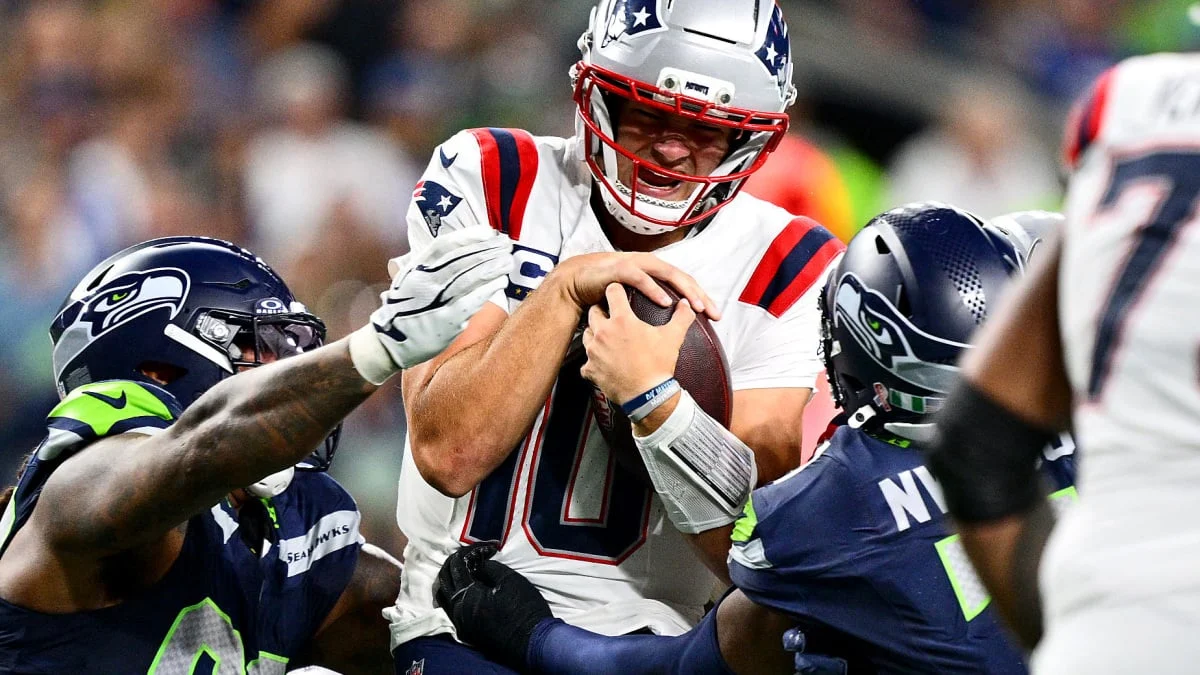
A significant catalyst for the sandwich meme’s Week 1 dominance was New England Patriots quarterback Drake Maye. Following a tumultuous offseason that saw him land at #2 in early MVP voting conversations during just his second year in the league—combined with lingering fan resentment regarding the Patriots’ historic dynastic success under Tom Brady and Bill Belichick—Maye was already a primary target for "hate-watchers" across the country.
Complicating matters further, Maye had spent portions of the prior year making community appearances at local Jersey Mike’s locations in the Boston area in support of the "Best Buddies" charity.
When Maye and the Patriots took the field against the Seattle Seahawks in a high-profile early-season matchup and proceeded to struggle—throwing multiple interceptions—the internet did what the internet does best. The intersection of Maye’s charity sandwich-shop appearances and his on-field struggles created a narrative goldmine. Within hours, timelines were flooded with images of makeshift deli receipts, fast-food job applications, and meticulously detailed sub-sandwich breakdowns corresponding to each of his turnovers.
The Fast-Food Pipeline
In professional basketball, when a player flames out of the NBA, the running joke involves shipping them overseas to international leagues, prompting variations of the "Welcome to the Shanghai Sharks" copypastas.
Because football lacks a major, widely watched international developmental equivalent that carries the same cultural weight, flaming out of the NFL carries a different comedic destination: the service industry.
When a quarterback starts throwing multi-interception games, the digital consensus dictates that it is time for them to dust off their resume and prepare for a career pivot behind a deli counter. The sandwich metaphor serves as a dual-layer insult: it mocks both the physical trajectory of the errant football (resembling a dropped sandwich wrapper or a clumsily handled sub) and hints at the player’s hypothetical post-football employment future.
Official Responses and Social Media Reactions
Unsurprisingly, the mainstream sports media and the athletes themselves have had varying reactions to the sudden transformation of the NFL into a deli-counter roleplay session.
While traditional analysts on Sunday morning pre-game shows have largely ignored the meme—preferring to stick to zone coverages, blitz packages, and completion percentages—players and digital media teams have occasionally leaned into the absurd nature of modern fandom.
Fan Fatigue vs. Viral Longevity
As with any internet trend, saturation has brought early signs of pushback. By the end of Week 1, community sentiment was already experiencing a minor schism. While casual fans and meme accounts revelled in the creativity of pairing obscure deli meats with specific defensive schemes, other users expressed mild exhaustion, noting that the joke risks running out of steam if every single interception is automatically labeled a sandwich.
Nevertheless, digital culture experts predict that the trend has secured its place in football lore. Even if the day-to-day frequency of the jokes tapers off as the season progresses, the sandwich slander is all but guaranteed a prominent spot in the inevitable "This season was GENERATIONAL" TikTok and Instagram reel compilations that drop at the conclusion of the Super Bowl.
Implications: The Future of Fan Discourse and Sports Satire
The rise of the "meatball sub" and "pastrami on pumpernickel" interception metrics highlights a broader, permanent shift in how younger generations consume and interact with legacy sports.
- Gamification of Commentary: Fans no longer consume sports as passive viewers; they participate in a collective, real-time creative writing exercise. The ability to craft a clever, unexpected simile for a blown play carries social currency within digital communities.
- The Blurring of Brands and Memes: The synergy between real-world corporate sponsorships (such as players appearing at sandwich chains for charity) and organic internet trolling demonstrates how modern culture loops corporate entities directly into grassroots humor.
- The Humanization of Athletes: While "slander" can occasionally cross the line into toxicity, surrealist humor like sandwich-based interception ratings often diffuses raw anger. It replaces bitter sports rage with absurdism, reminding everyone involved that, at the end of the day, it’s just a game—even if it occasionally leaves a bad taste in your mouth.
As the 2024 NFL season rolls on, one thing is certain: defensive coordinators aren’t the only ones studying the playbook. Somewhere out there, a frustrated fan is watching game film, waiting to see which quarterback is going to order the next disaster on rye.
 Nana Wu
 Neng Nana
 Reynand Wu
