

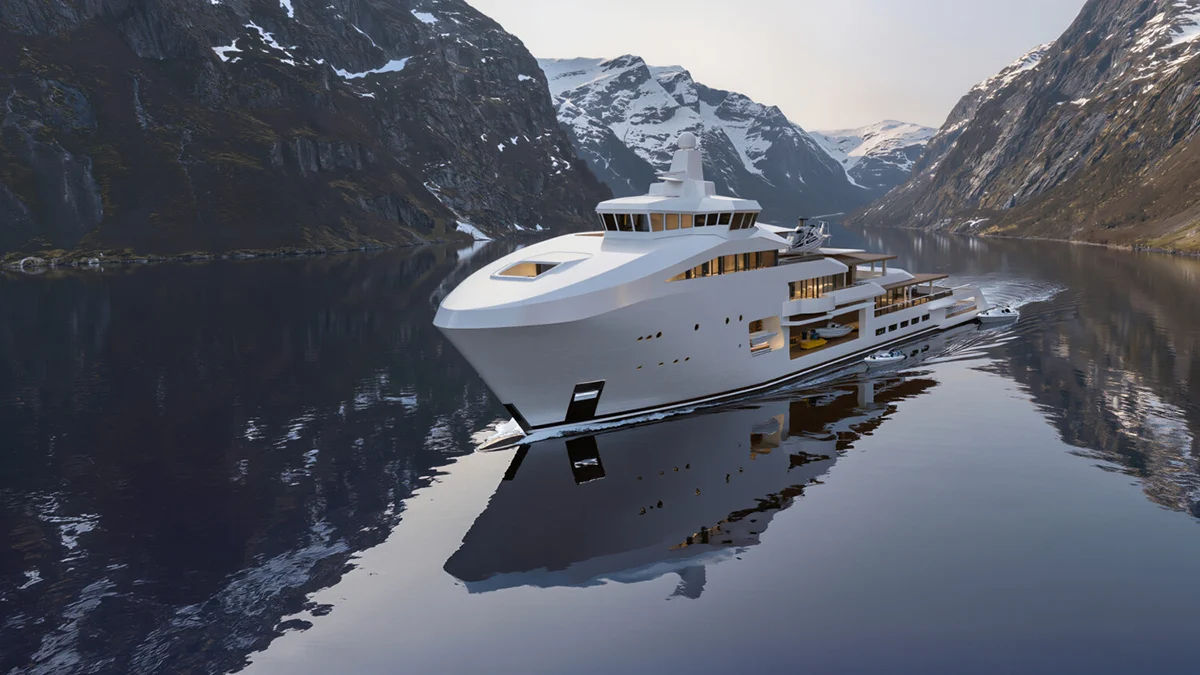
The maritime industry has long operated in silos: the utilitarian world of offshore support vessels and the gilded, exclusive realm of luxury superyachts. However, a visionary movement led by Italian designer Stefano Pastrovich is bridge-building between these two disparate worlds, turning the remnants of the global oil crisis into the future of high-end expedition travel.
Back in 2015, a Norwegian seafarer approached Pastrovich with a unique challenge: to reimagine his two 289-foot Platform Supply Vessels (PSVs) as private explorer yachts. That singular request ignited a design evolution that has resulted in three distinct, ambitious concepts. These designs do not merely offer a cosmetic makeover; they propose a total structural and functional metamorphosis, turning retired offshore workhorses into sophisticated vessels capable of traversing the most inhospitable corners of the globe.
The Genesis: A Solution Born from Market Volatility
To understand the genius of these conversions, one must look at the economic landscape of the mid-2010s. Platform Supply Vessels are the workhorses of the energy sector, designed for the singular purpose of transporting fuel, drilling mud, food, and equipment to and from offshore oil rigs and wind farms. They are built for endurance, stability, and raw power.
Between 2014 and 2016, the global oil market plummeted, leading to a catastrophic decline in exploration and production activity. Shipyards and owners found themselves with fleets of specialized, highly durable vessels that were suddenly redundant. This presented a significant financial crisis for the owners, who were left with expensive assets idling in ports.

Pastrovich’s intervention was not just an aesthetic whim; it was a pragmatic response to a systemic market failure. By repurposing these vessels, owners could salvage their investment and pivot toward the burgeoning demand for high-end expedition chartering. "The project started from a real owner, a real platform, and a real market problem," Pastrovich stated. "That is precisely why its logic remains so relevant today."
Chronology of the Transformation
2015: The Prototype
The initial project centered on the 289-foot PSV. The transformation process involved stripping the vessel to its steel bones. The goal was to retain the "sea-kindly" hull and robust mechanical systems while introducing the refined interior architecture of a superyacht.
2016–2018: Expansion into Expedition Concepts
Following the success of the initial designs, Pastrovich expanded his portfolio to include two larger 328-foot expedition vessels. These concepts were designed with a more specific mission in mind: deep-sea exploration. The designs were tailored to meet the growing demand for "boutique" expedition cruising, where travelers seek to explore Antarctica, Patagonia, and Greenland without the massive scale of traditional cruise ships.
2020–Present: Refinement and Engineering Partnerships
In recent years, the concepts have been further refined through collaborations with technical experts like Meccano Engineering and Wärtsilä. These partnerships have moved the designs from "concept art" toward "technically viable blueprints," focusing on guest safety, passenger comfort, and advanced propulsion systems that align with modern environmental standards.

Engineering the Impossible: Merging Utility and Luxury
The technical challenge of converting a PSV lies in the fundamental difference in design philosophy. A PSV is designed for cargo; a yacht is designed for leisure.
The 289-Foot Explorer
The base 289-foot model demonstrates the efficiency of this conversion. It offers accommodation for up to 30 guests, featuring two expansive owner’s apartments, VIP suites, and multiple guest cabins. Despite the luxurious interior, the exterior remains unmistakably utilitarian, retaining the high freeboard and wide, flat decks necessary for maneuvering in rough seas.
The 328-Foot Expedition Vessels
The two larger successors push the limits of the platform further. One version is designed to carry up to 116 passengers, functioning as a high-end boutique cruise ship. The second version, configured for 64 guests, prioritizes space-to-passenger ratios, creating a more intimate, ultra-luxe experience.
Working with Meccano Engineering, the team successfully re-engineered the offshore platform to accommodate modern passenger needs, such as noise reduction, vibration dampening, and sophisticated waste management systems—features that are standard on yachts but rare on industrial vessels.

Supporting Data: Why the Conversion Model Succeeds
The logic behind the conversion model is supported by three primary pillars:
- Redundancy and Reliability: PSVs are built to be "bulletproof." They feature multiple engines and backup systems designed for continuous operation in the North Sea, arguably one of the most punishing marine environments on Earth. This inherent redundancy makes them the perfect candidates for remote, off-the-grid exploration.
- Structural Robustness: Unlike luxury yachts, which are often built for aesthetics and speed, PSVs have thick steel hulls designed to take heavy loads and impact. They are effectively "explorer-ready" from the moment they leave the shipyard.
- Economic Viability: The cost of building a 300-foot superyacht from scratch is astronomical. By utilizing an existing hull and drivetrain, owners can save significant capital and time in the construction phase, shortening the path to generating charter revenue.
Official Perspectives: The Philosophy of the "Fusion"
Stefano Pastrovich is clear that his vision is not about hiding the vessel’s past, but about integrating it into a new, more elegant narrative.
"The studies explore how the structural robustness, autonomy, and redundancy of a North Sea offshore vessel can be integrated with owner and guest areas conceived to superyacht standards," Pastrovich notes. "The objective is not a cosmetic refit, but a coherent fusion of engineering, architecture, hospitality, and operations."
This philosophy acknowledges that the modern explorer is no longer satisfied with mere opulence. They want the security of an expedition ship combined with the service and amenities of a five-star hotel. By teaming up with industry leaders like Wärtsilä, Pastrovich is ensuring that these vessels are equipped with the latest in power management, crucial for maintaining luxury services while navigating in sensitive, remote ecosystems.

Implications for the Future of Maritime Travel
The work of Pastrovich Studio represents a significant shift in the luxury market. As the world becomes more interconnected, the "discovery" of new, remote places has become the ultimate luxury.
Sustainability and the Circular Economy
Repurposing existing vessels is, in its own right, a form of sustainable maritime practice. By extending the lifecycle of a ship that would otherwise be scrapped or left to rust, these conversions represent a circular economy approach to yachting. It avoids the massive carbon footprint associated with sourcing raw materials and constructing a new hull from scratch.
The Rise of "Boutique" Expedition Travel
The success of these concepts suggests a shift in demand. The era of the "floating palace" in the Mediterranean is being challenged by a desire for meaningful experiences. Guests want to wake up in the Arctic Circle or navigate the fjords of Patagonia. These PSV-to-yacht conversions provide the perfect vehicle for this new era of tourism—one that is rugged enough for the wild, yet refined enough for the discerning traveler.
A Template for Other Industries
Pastrovich’s work could serve as a template for other sectors. Whether it is turning old research vessels into private residences or converting decommissioned naval craft into eco-lodges, the marriage of industrial-grade engineering and high-end design is proving to be a fertile ground for innovation.

Conclusion
The evolution of Stefano Pastrovich’s PSV conversion projects is a testament to the idea that a "market problem" is often just a "design opportunity" in disguise. While these vessels are currently in the conceptual phase, their logic is indisputable. They offer a marriage of substance and style, reliability and luxury, and past utility with future adventure. As the maritime world looks toward a future defined by both environmental responsibility and a desire for deeper connection with the natural world, the humble supply vessel may just be the next icon of the high seas.
 Evan Lee Salim
 Laily UPN
