

More than three years after the explosive launch of ChatGPT brought generative AI into the global spotlight, OpenAI is signaling a major strategic evolution. No longer content to simply dominate the workspace or individual productivity sectors, the company is pivoting toward the living room.
In a move that underscores the normalization of artificial intelligence in daily life, OpenAI is actively recruiting a dedicated product manager in San Francisco to oversee "family-centric" experiences. This role, which explicitly calls for experience in building "trust-sensitive consumer experiences," marks a definitive shift in how the industry leader views its relationship with the end user—moving from a solitary, tool-based utility to a multifaceted, household-integrated platform.
The Strategic Shift: Building for the Home
For much of its early history, OpenAI’s development cycle was dictated by the needs of knowledge workers, developers, and early adopters. However, as AI tools become embedded in the fabric of everyday life, the demographics of the user base have shifted dramatically.
The new product manager role is tasked with building features specifically for families, caregivers, and older adults. According to the job posting, the ideal candidate will have a deep background in designing interfaces for parents and families—an admission that the "one-size-fits-all" approach to LLM (Large Language Model) interaction is no longer sufficient.
Ben Bajarin, chief executive of the technology consultancy Creative Strategies, views this as a historical turning point. "This is similar to the path Google, Apple, and Meta eventually followed as their platforms became embedded in everyday life," Bajarin told TechCrunch. "But AI raises the stakes because the assistant is not just mediating content or devices; it is actively engaging in human-like reasoning and conversation."
Chronology of a Demographic Evolution
To understand why OpenAI is making this shift now, one must look at the rapid maturation of its user base.
- 2022-2023 (The Early Adopter Phase): ChatGPT’s initial surge was driven by younger demographics, students, and tech-savvy professionals. During this period, the product was positioned as an experimental chatbot.
- 2024 (The Mainstream Expansion): The product began to penetrate the household, with parents increasingly using the tool for educational support, meal planning, and personal organization.
- 2025 (The Crisis and Regulation Phase): As usage among minors climbed, so did public concern. A series of high-profile lawsuits—alleging that AI interactions contributed to severe mental health crises among teens—forced the industry to rethink its safety protocols.
- 2026 (The Redesign Phase): OpenAI began deploying structural safety changes, including parental controls and "Trusted Contact" features, culminating in the current push to institutionalize "family-first" product management.
Supporting Data: Who is Using AI?
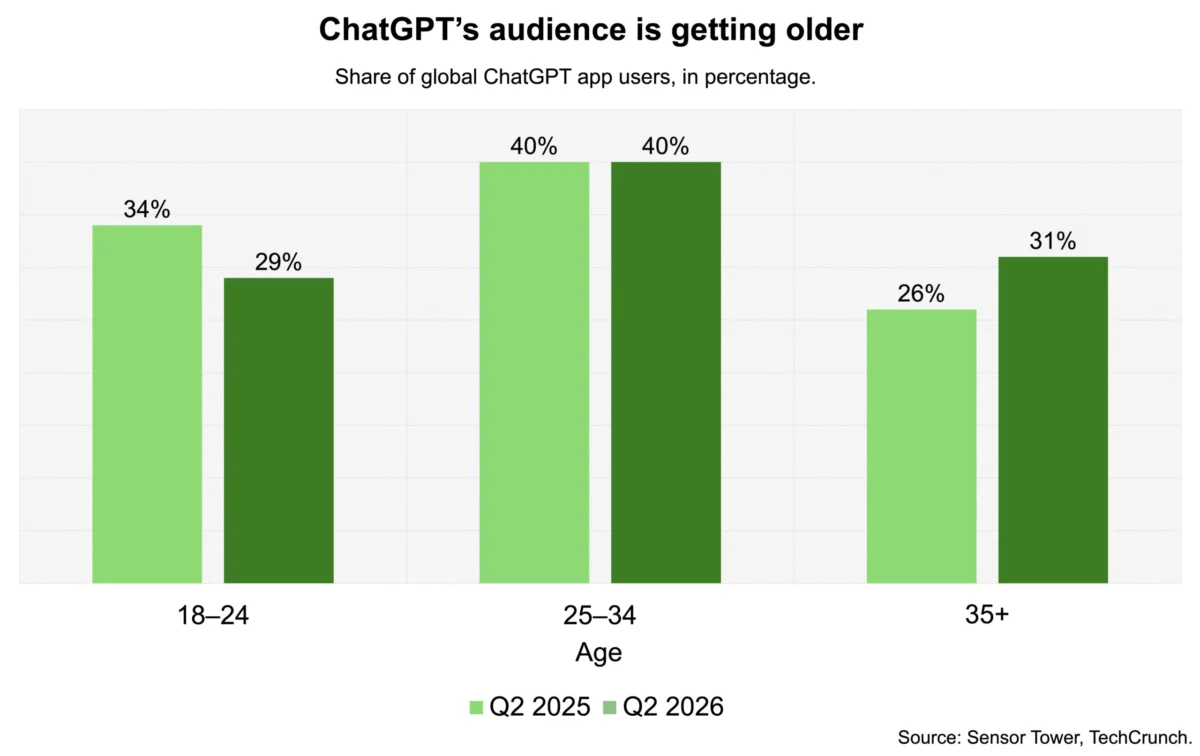
Data from Sensor Tower highlights a clear demographic drift. While younger users (ages 18 to 24) once dominated the platform, their share of the ChatGPT audience dropped from 34% to 29% over the past year. Simultaneously, the share of users aged 35 and older has climbed to 31%.
Perhaps most telling is the adoption rate among parents. In the United States, nearly one in four smartphone-using parents reported using ChatGPT during the second quarter of this year, a significant jump from 16% just 12 months prior.
While competitors like Google’s Gemini and Anthropic’s Claude also cater to these age groups—with roughly 40% of their global audience falling in the 25-to-34 range—ChatGPT is unique in how quickly it is capturing the 45-and-older demographic. While older users still represent a smaller slice of the pie compared to rivals like Microsoft’s Copilot, ChatGPT is adding them at a faster rate than any of its competitors, suggesting that the brand’s reach is expanding horizontally across generations.
The Safety Imperative: "Safety by Redesign"
The move toward family-oriented products is not merely a marketing pivot; it is a defensive and ethical necessity. OpenAI has faced intense scrutiny following multiple lawsuits from parents claiming that the company’s AI models failed to prevent—or actively contributed to—harms suffered by their children.

Stephen Balkam, CEO of the Family Online Safety Institute (FOSI), believes that the hiring reflects a maturation of the industry. "I see this as safety by redesign," Balkam noted. "You take the initial product or service that was released, not really with kids in mind, and you realize you have to go back to the drawing board. This is a much-needed reaction."
Balkam emphasizes that the "move fast and break things" philosophy that characterized the early tech industry is incompatible with the nuances of child development. He advocates for:
- Stronger Content Controls: Filtering mechanisms that evolve based on the user’s maturity level.
- Age-Appropriate Experiences: Interfaces that do not mimic human relationships in ways that could lead to emotional dependency.
- Explicit AI Disclosure: Constant, unobtrusive reminders that the user is interacting with a machine, not a sentient human.
Research by FOSI supports the urgency of these measures. Their recent study of over 4,000 families in the U.S. and Australia revealed a significant "visibility gap": while only 27% of parents believed their children had used generative AI in the last week, 38% of children reported doing so. This discrepancy suggests that parents are largely unaware of the extent to which AI is already being used in their children’s lives for homework, social interaction, and entertainment.
Official Responses and Corporate Strategy
OpenAI has remained largely tight-lipped regarding the specific roadmap for its "family" division, declining to comment on the internal job posting. However, the company’s recent actions provide a roadmap of their priorities.
In late 2025, OpenAI introduced a tiered safety system. This included routing sensitive conversations—such as those involving potential mental health distress—to more advanced, reasoning-heavy models capable of flagging danger. The introduction of the "Trusted Contact" feature allows for a fail-safe mechanism, where designated family members can be alerted if the AI detects signs of self-harm.
Furthermore, the company is engaging in "community impact" workshops, such as those held in collaboration with the San Antonio Spurs and the Positive Coaching Alliance. These sessions aim to frame AI as a constructive tool for coaching and education, attempting to shift the public narrative from "AI as a risk" to "AI as a supportive household partner."
Implications: The Future of the "Smart Home"
If Ben Bajarin’s predictions hold true, we are on the precipice of a new category of consumer technology. The "individual chatbot" model is likely to give way to the "household AI assistant."
What might this look like?
- Shared Household Memory: AI models that remember the collective preferences, schedules, and allergies of a family unit.
- Parental Dashboards: Sophisticated interfaces that allow parents to monitor usage patterns, set boundaries, and receive reports on their child’s AI interactions.
- Educational Integration: AI-driven tutoring that aligns with school curriculums while maintaining strict age-gating.
- Caregiver Tools: AI tools designed specifically for the elderly, focusing on companionship, medication management, and daily task assistance.
However, the transition is fraught with challenges. Privacy advocates warn that creating "family profiles" creates massive troves of sensitive data regarding children and vulnerable adults. As OpenAI pivots to the home, it will be subject to the same regulatory pressures that hampered social media giants—pressures regarding data harvesting, algorithmic bias, and the psychological impact of screen time.
Ultimately, OpenAI’s attempt to formalize its presence in the family unit is a recognition of reality: ChatGPT is no longer a niche tool for coders or writers. It is a digital citizen. Whether the company can successfully navigate the complexities of protecting that citizen while maintaining its growth remains the defining question of the next phase of the AI revolution. As the industry learns from the mistakes of the social media era, the goal of "safety by design" will be the ultimate test of OpenAI’s long-term viability as a trusted household name.
 Asep Darmawan
 Siti Muinah
 Ali Ikhwan
