

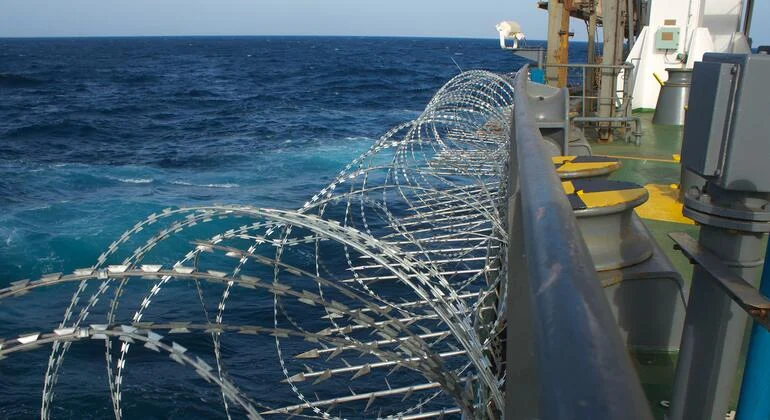
In an era defined by rapid technological shifts and geopolitical volatility, the international community is currently grappling with three distinct yet interconnected crises. From the perilous waters of the Strait of Hormuz to the stifled halls of government in Managua, and into the digital battlegrounds where history itself is being contested, the fundamental pillars of human rights, economic stability, and objective truth are under unprecedented strain.
This report provides an in-depth analysis of these critical developments, drawing on data from the International Maritime Organization (IMO), the United Nations Office of the High Commissioner for Human Rights (OHCHR), and the UN Human Rights Council.
I. The Maritime Crisis: A Global Supply Chain Under Siege
The world’s maritime corridors, the lifelines of the global economy, have become increasingly lethal. According to the International Maritime Organization (IMO), international shipping is facing an era of insecurity not seen in decades.
Main Facts and Data
Since the outbreak of regional hostilities in the Middle East on February 28, the IMO has verified a staggering 80 distinct attacks on commercial vessels in and around the Strait of Hormuz. These incidents are not merely property damage; they have exacted a horrific human toll. At least 22 seafarers have lost their lives, with scores more suffering debilitating injuries.
The violence is not localized. While the Strait of Hormuz remains a primary theater, the conflict has metastasized to the Black Sea and the Sea of Azov, where ongoing combat has resulted in dozens of additional fatalities among merchant crews. Most recently, the Red Sea has seen a resurgence in hostilities, underscored by a Houthi-led attack on a merchant vessel on August 11, which resulted in four confirmed deaths.
The Economic and Human Cost
Roel Hoenders, Chief of Staff at the IMO, has issued a stark warning regarding the ripple effects of these assaults. "Apart from putting seafarers’ lives at risk, attacks on merchant shipping are having a severe impact on global supply chains and people everywhere around the world," Hoenders stated.
The implications are systemic. When vessels are targeted, insurance premiums for maritime transit skyrocket, and shipping companies are forced to reroute, causing delays that inflate the cost of goods for consumers globally. IMO Secretary-General Arsenio Dominguez has emphasized the complexity of the threat, noting that in these volatile regions, "it is not only one country attacking merchant vessels," suggesting a multifaceted landscape of non-state actors and state-aligned proxies challenging international maritime law.
II. Nicaragua: The Systematic Dismantling of Democracy
While maritime security faces external threats, the nation of Nicaragua is currently undergoing an internal erosion of democratic governance. Volker Türk, the UN High Commissioner for Human Rights, released a damning report this week, characterizing the state of affairs as the "near-total capture" of national institutions by the ruling executive.
Chronology of Repression (June 2025–June 2026)
The reporting period, which spans the last twelve months, documents a rapid decline in civic space. The report highlights a pattern of systematic abuse of power, where the separation of powers has been rendered moot.
- Institutional Capture: The ruling party has effectively neutralized the judiciary and the legislature, leaving citizens with no legal recourse against state overreach.
- Arbitrary Detention: As of June 2026, at least 46 individuals remain in custody on purely political grounds. The UN has documented ongoing reports of enforced disappearances and deaths occurring within the prison system.
- Legislative Aggression: The government is currently weighing constitutional reforms that would effectively outlaw organized opposition groups, while simultaneously proposing an extension of presidential terms to seven years—a move critics argue is designed to cement perpetual rule.
The Silencing of Civil Society
The suppression of dissent has reached an apex. Over the past eight years, the Nicaraguan government has dissolved more than 5,500 civil society organizations and shuttered at least 56 media outlets.
"There is almost nothing left to shut down," High Commissioner Türk remarked during his presentation. The international community is now faced with the reality that Nicaragua is functioning as a closed autocratic system, necessitating a urgent re-engagement with regional human rights bodies to prevent further loss of life and fundamental liberty.
III. The Weaponization of Truth: The Rise of ‘Denialism’
Perhaps the most insidious challenge facing the modern world is the rise of "denialism"—a political strategy that weaponizes misinformation to reject the reality of genocide and crimes against humanity.
The Role of AI and Social Media
Bernard Duhaime, an independent human rights expert tasked by the UN Human Rights Council, has sounded the alarm on how digital technologies are being used to manipulate history. Addressing the Council in Geneva, Duhaime argued that the rise of AI systems and social media platforms has provided bad actors with an unprecedented tool for amplification.
"We live at a dangerous time where ideologues and warmongers seek to fuel polarisation, hatred, and chaos for their own political gains," Duhaime stated. By replacing objective, evidence-based history with "emotionally-charged narratives," these actors seek to undermine the very concept of accountability.
Implications for Global Justice
The consequences of this trend are far-reaching:
- Erosion of Accountability: By denying past atrocities, perpetrators seek to avoid legal consequences, effectively obstructing the path to justice for victims and survivors.
- Weaponization of Free Speech: Duhaime warned that politicians and corporate actors are increasingly exploiting the concept of "freedom of expression" as a shield to spread propaganda that incites violence and silences dissent.
- The Legislative Trap: While governments are encouraged to combat this trend, Duhaime issued a caveat: in many instances, states are using "anti-denialism" laws as a pretext for domestic censorship and the suppression of legitimate political opposition.
IV. Conclusion: A Call for Global Vigilance
The events outlined in this brief highlight a world at a crossroads. Whether it is the physical threats to sailors on the high seas, the legislative strangulation of democracy in Nicaragua, or the digital distortion of historical truth, the common thread is an assault on the rules-based international order.
The UN’s message remains consistent across all three sectors:
- Maritime: A call for collective action to ensure the safety of global trade routes and the protection of seafarers.
- Democracy: An urgent demand for the release of political prisoners and the restoration of institutional checks and balances in Nicaragua.
- Truth: A plea for governments to resist the allure of populism and the weaponization of history, emphasizing that true national stability can only be built on the foundation of transparency, accountability, and the rule of law.
As the international community navigates these crises, the necessity for robust, independent oversight has never been greater. The protection of human rights is not merely a moral imperative; it is the essential prerequisite for a global society that functions with dignity and security for all.
 Lina Hope
 Asro
Asro
 Layla Zulfa
