

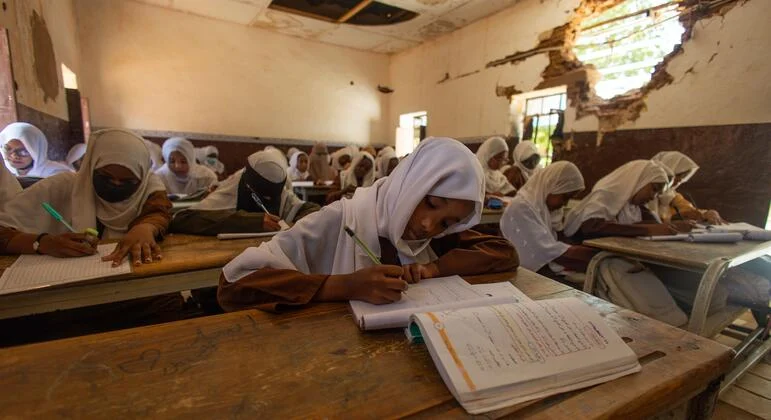
As global geopolitical and environmental pressures intensify, the United Nations has issued urgent alerts regarding three distinct but equally devastating crises. From the escalating threat of mass atrocities in Sudan and the rising death toll in Ukraine to the launch of a pioneering climate displacement initiative in Southern Africa, the international community faces a critical juncture in humanitarian response and conflict resolution.
1. Sudan: A Nation at the Precipice of Humanitarian Collapse
The humanitarian landscape in Sudan has deteriorated significantly, with the United Nations warning of an impending catastrophe in the North Kordofan capital, El Obeid.
Main Facts and Current Situation
UN Spokesperson Stéphane Dujarric reported on Wednesday that a massive buildup of Rapid Support Forces (RSF) militia and allied troops has surrounded El Obeid. The city is currently enduring "siege-like conditions," with civilians trapped and deprived of essential services. Recent drone strikes have targeted critical infrastructure, including schools, fuel stations, and a facility housing internally displaced persons (IDPs).
The situation in El Obeid echoes the harrowing events in El Fasher, Western Darfur, earlier this year. A new report from Amnesty International corroborates reports of grave rights violations, suggesting a systematic pattern of violence that threatens to engulf the region.
Chronology of the Conflict
- 2023: Full-scale civil war erupts between the Sudanese Armed Forces (SAF) and the Rapid Support Forces (RSF), shattering a fragile political transition.
- Early 2024: The conflict intensifies in Western Darfur, with the RSF accused of ethnic cleansing and summary executions in El Fasher.
- June 18, 2026: UN High Commissioner for Human Rights Volker Türk warns that an offensive on El Obeid is imminent, highlighting high risks of arbitrary detention and violence.
- June 2026 (Present): The siege tightens; UN member states (Germany, Ireland, the Netherlands, Norway, and the UK) petition for an urgent Human Rights Council (HRC) debate.
The Public Health Crisis
Beyond the immediate threat of kinetic warfare, the conflict has paralyzed the Sudanese health system. Dr. Shible Sahbani, WHO Representative in Sudan, noted that 40 percent of health facilities are entirely non-functional, while the remaining 60 percent operate at partial capacity.
This collapse has exacerbated a concurrent public health emergency:
- Cholera: 1,102 cases and 120 deaths reported since the most recent outbreak began.
- Malaria and Dengue: Rapidly spreading due to stagnant water and the lack of sanitation infrastructure.
- Response: The UN has mobilized to provide cholera kits for 3,000 patients and launched a preventive vaccination campaign targeting 200,000 people.
Official Responses and Implications
In response to the mounting crisis, the UN Human Rights Council will hold an urgent debate on July 3 to formalize an international response. The implications are profound: if the siege of El Obeid results in the predicted atrocities, the international community will be forced to confront the failure of current diplomatic efforts to halt the violence that has already displaced 14 million people and pushed millions to the brink of famine.
2. Climate Resilience: A New Paradigm in Southern Africa
While conflict ravages Sudan, another form of crisis—climate-driven displacement—is being addressed through a proactive regional partnership between the European Union (EU) and the International Organization for Migration (IOM).
Addressing the Root Causes
Sub-Saharan Africa has become a frontline in the climate emergency, with the region experiencing a record-breaking frequency of cyclones, floods, and droughts. In 2025 alone, climate-related disasters triggered 2.9 million internal displacements.
The newly launched Regional Responses to Climate Displacement in Sub-Saharan Africa (RE2CLID) Programme represents a strategic shift from reactive disaster relief to proactive displacement prevention.
Programmatic Objectives
- Forecasting and Data: Enhancing the ability of national governments to anticipate displacement trends through improved meteorological and sociological data integration.
- Institutional Integration: Embedding displacement risk management into national climate adaptation strategies and disaster risk reduction (DRR) policies.
- Localized Engagement: Partnering with traditional leaders, district councils, and civil society to ensure that disaster response is locally driven and culturally sensitive.
Implications for Regional Stability
The program, which held its official launch in Malawi on June 15, seeks to bridge the gap between scientific climate forecasting and grassroots policy. Patricia Wiskes, Malawi’s Minister of Natural Resources, emphasized that the program is not merely about aid; it is about building national "capacity to prevent, prepare for, and respond" to the inevitability of a changing climate. By formalizing these partnerships, the IOM hopes to reduce the chaotic, unplanned migration patterns that often lead to further instability in Southern African nations.
3. Ukraine: The Persistent Cost of Hostilities
The war in Ukraine continues to exact a heavy toll on the civilian population, with recent escalations resulting in a surge of casualties and the systematic destruction of critical civilian infrastructure.
Supporting Data on Civilian Impact
According to the UN Office for the Coordination of Humanitarian Affairs (OCHA), the window between June 26 and the morning of July 1 saw:
- Deaths: Over 40 civilians killed.
- Injuries: More than 460 civilians wounded.
- Regional Concentration: The Dnipro, Zaporizhzhia, and Kharkiv regions remain the epicenter of the most intense strikes.
Chronology of Recent Escalations
- June 26: Sustained strikes begin across frontline regions.
- July 1 (Morning): A drone strike on a public bus in Kherson leaves two dead and eight injured, underscoring the extreme danger of civilian transit.
- July 2–3: Continued attacks on fuel stations in the Sumy region create a domino effect, limiting the ability of emergency services to operate and hindering humanitarian aid delivery.
Implications for Humanitarian Operations
The destruction of energy infrastructure is perhaps the most critical development. The Ukrainian Minister of Energy confirmed that parts of six frontline regions are currently without electricity. This blackout not only endangers the elderly and the vulnerable during extreme weather but also disrupts the cold chain for medical supplies and the communication networks necessary for aid coordination.
Humanitarian organizations, supported by the UN, have pivoted their focus toward emergency shelter, psychological trauma counseling, and the distribution of life-sustaining supplies like water and snacks. However, as the intensity of the strikes increases, aid workers are warning that the "humanitarian emergency" is evolving into a long-term crisis of sustainability, where basic infrastructure may take years to rebuild even if a ceasefire were achieved today.
Conclusion: A Global Call to Action
The events of this week highlight a sobering reality: the global community is being tested on multiple fronts. In Sudan, the failure to stop a potential atrocity would represent a significant blow to international human rights mechanisms. In Southern Africa, the success of the RE2CLID programme could provide a blueprint for how nations manage the climate-driven migration of the future. Meanwhile, in Ukraine, the persistent, daily loss of civilian life remains an unresolved tragedy that continues to destabilize European security.
Whether through urgent UN debates, regional development partnerships, or on-the-ground humanitarian aid, the international response in the coming weeks will be decisive. The scale of these crises—ranging from 14 million displaced in Sudan to millions at risk of climate displacement—demands a level of sustained political will that is currently struggling to keep pace with the speed of events.
 Lina Hope
 Asro
Asro
 Layla Zulfa
