

Main Facts
The cultural landscape of the San Francisco Bay Area and the classical music world at large was forever altered earlier this year with the passing of Michael Tilson Thomas—affectionately and universally known simply as "MTT"—at the age of 81. A towering figure as a Grammy-winning conductor, composer, pianist, educator, and visionary, Tilson Thomas left an indelible mark during his celebrated 25-year tenure as music director of the San Francisco Symphony.
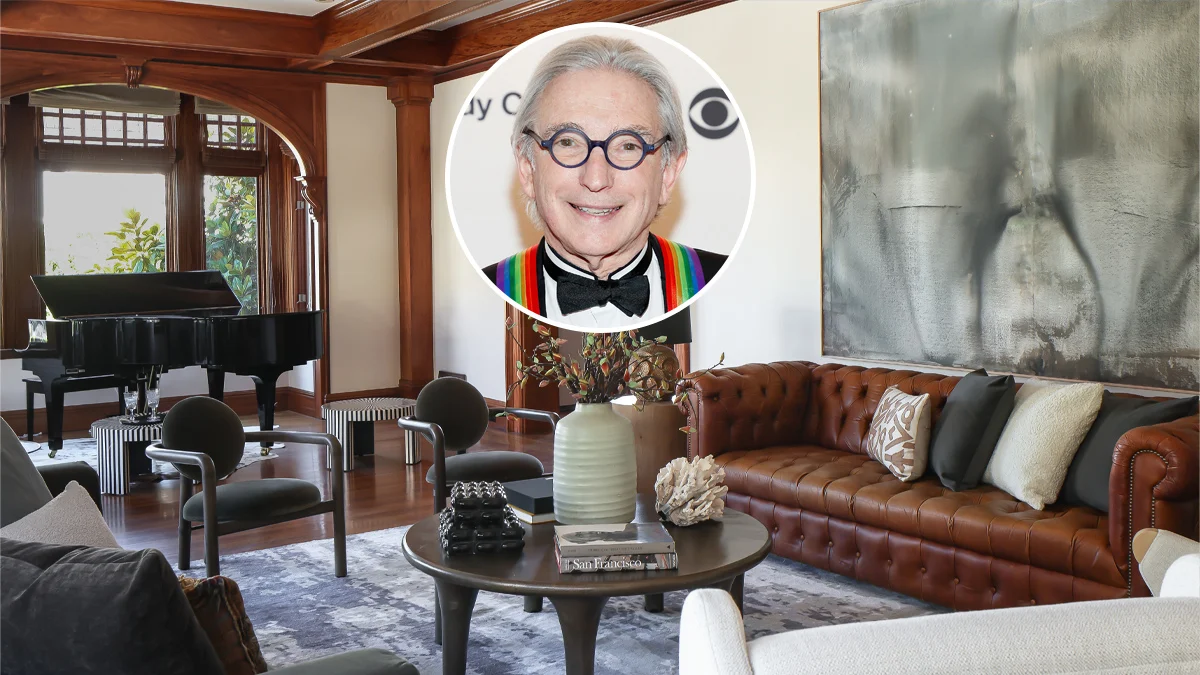
Months after his passing, and following the death of his husband and longtime manager, Joshua Robison, just two months prior, the couple’s historic Pacific Heights residence has officially been listed for sale. Priced at $9.85 million, the 7,000-square-foot Tudor Revival home at 2670 Pierce Street is being handled by Helena Zaludova of Compass.
Acquired by Tilson Thomas and Robison in 1994 for $1.4 million, the half-timbered architectural gem served as their creative and personal headquarters for 32 years. More than just a luxury estate, the residence played host to luminaries of both the classical music world and broader artistic spheres—ranging from legendary vocalist Linda Ronstadt to architectural titan Frank Gehry. Today, the property stands as a physical monument to a life dedicated to artistic excellence, boundary-pushing collaboration, and a profound, all-encompassing love for music.

Chronology: A Life in Sound and Space
1906: The Genesis of 2670 Pierce Street
Long before it became a haven for modern classical royalty, the property was brought to life in 1906. Built by prominent building contractor Jeremiah Deneen to serve as his own personal residence, the structure was crafted during a pivotal era in San Francisco’s architectural history, right on the heels of the devastating 1906 earthquake and fire. Deneen imbued the home with classic Tudor Revival characteristics, utilizing half-timbered accents, sturdy framing, and expansive spatial layouts designed to weather the decades with grace and sophistication.
1994: A New Era Begins
Eighty-eight years after its construction, the Pierce Street property entered its most culturally significant chapter. Michael Tilson Thomas, then cementing his status as the newly appointed music director of the San Francisco Symphony, purchased the home alongside Joshua Robison for $1.4 million. The couple recognized the estate’s potential not merely as a domestic retreat, but as a dynamic salon capable of nurturing creative output, housing expansive personal collections of scores and artifacts, and offering a private sanctuary away from the demanding global stages MTT commanded. Over the ensuing decades, they meticulously updated and maintained the residence, blending its early-20th-century historical integrity with modern amenities tailored to a life immersed in the arts.
2019: The Ultimate Cross-Genre Triumph
While Tilson Thomas spent decades burnishing the San Francisco Symphony’s reputation as a global powerhouse through rigorous interpretations of core classical standards and daring American repertoires, his cultural footprint extended far beyond the traditional concert hall. This was underscored globally in late 2019.

Upon MTT’s induction into the 42nd annual Kennedy Center Honors class, Metallica drummer Lars Ulrich made a surprise appearance to pay tribute to the maestro. Ulrich’s presence startled casual observers—Why is a heavy metal icon honoring a classical maestro?—but the answer was rooted in a historic collaboration just three months prior. On a massive circular stage at San Francisco’s Chase Center arena, the symphony joined forces with Metallica for their landmark S&M2 concert, seating classical virtuosos and heavy metal icons side-by-side.
In his poignant tribute, Ulrich praised Thomas not just as an esteemed conductor, but as a scholar "with a deeply profound understanding of music—all music—from medieval to hard rock, from Mosolov to, well, Metallica." That specific reference to Soviet modernist composer Alexander Mosolov celebrated a historic moment during the S&M2 run when Metallica joined the orchestra to perform Mosolov’s 1926 futurist industrial piece, "The Iron Foundry"—marking the band’s first-ever cover of a purely classical work.
2024: Passing of an Era
The cultural community suffered an immense double loss in early 2024. Joshua Robison passed away in February, followed closely by the death of Michael Tilson Thomas in April at age 81. The Leonard Bernstein protégé left behind a legacy that included pioneering an in-house record label for the San Francisco Symphony, redefining audience outreach, and mentoring generations of young musicians. Following their passings, the estate executors prepared the property for the market, ensuring that a significant portion of proceeds would directly support the charitable organizations and artistic institutions that meant the most to the couple throughout their lives.

Supporting Data: Architectural and Spatial Breakdown
Spanning approximately 7,000 square feet across four distinct levels, 2670 Pierce Street offers a masterclass in urban residential design, maximizing its Pacific Heights footprint to provide privacy, luxury, and sweeping views.
- Total Area & Layout: ~7,000 square feet, offering up to 7 potential bedrooms, 5 full bathrooms, and 2 powder rooms distributed thoughtfully across four stories.
- First Level (Entry & Ground Floor): Features a formal entry foyer anchored by a graceful curving staircase. The lower level also incorporates a private guest suite, a secondary study, a dedicated laundry area, and a separate ground-level garage equipped with a private fitness space and temperature-controlled wine storage.
- Second Level (The Main Entertaining Hub): Designed explicitly for hosting San Francisco’s cultural elite, this floor features a sprawling, fireside living room and a stately, wood-paneled dining room positioned beneath an intricate coffered ceiling. The adjacent kitchen has been fully modernized, featuring a central prep island and a bright, bay-windowed breakfast nook that looks out directly onto the lush private garden below.
- Third Level (Family Quarters): Houses four well-appointed bedrooms. This includes two bedrooms connected by a shared Jack-and-Jill bathroom, a flexible room currently utilized as a comfortable sitting area, and a serene, Japanese-inspired primary bedroom suite that opens directly onto a private outdoor patio.
- Top Level (Penthouses & Creative Spaces): The uppermost floor serves as a versatile creative zone. It holds an additional bedroom and bathroom, a primary study outfitted with custom built-in bookshelves, a media room complete with its own fireplace, and a sun-drenched, skylit family room offering panoramic, elevated views stretching out over the San Francisco Bay.
Official Responses and Testimonials
The transition of the property from a private sanctuary to the open market has prompted deep reflection from those closest to the estate, the marketing team, and cultural commentators.
An anonymous estate trustee shared profound insights into the lingering aura of the home in an official press statement:

"When I first saw the home, I could feel the beauty and love that had lived here. The two Yamaha pianos, Michael’s composing keyboard, and the extraordinary personal collection of musical scores and artifacts made his creative life feel so present. Even now, with their personal belongings and furnishings removed, the house still speaks that same language of sophistication and warmth."
Listing agent Helena Zaludova of Compass emphasized the rare pedigree of the offering. While high-end Pacific Heights real estate frequently trades on square footage and pristine views, properties anchored by such deep, authentic cultural lineage are vanishingly rare. The home does not merely market a physical address; it offers the next custodian a chance to inhabit a space where world-changing compositions were conceived, refined, and celebrated.
Implications: The Preservation of Cultural Heritage in Real Estate
The listing of 2670 Pierce Street arrives at a critical juncture for San Francisco’s real estate and cultural identity. As the city continues to navigate economic shifts and urban evolution, the loss of figures like Michael Tilson Thomas marks the closing of a golden chapter in its artistic history.

For real estate investors and cultural preservationists alike, homes of this caliber represent a delicate intersection. They are high-value luxury assets in one of the country’s most exclusive neighborhoods (Pacific Heights), yet they also function as localized museums of modern history. The $9.85 million price tag reflects prime San Francisco real estate metrics, but the true value of the home lies in its intangible resonance—the echoes of orchestral scores, the late-night artistic debates among visiting icons, and the quiet domestic harmony shared by two men who fundamentally shaped global music appreciation.
Furthermore, the allocation of a significant portion of the estate’s proceeds toward philanthropic and musical organizations ensures that Tilson Thomas and Robison’s impact will outlive the bricks and mortar of Pierce Street. Whether the future buyer is a tech titan, a patron of the arts, or a rising creative force, they will step into a legacy of elegance, intellectual curiosity, and sonic audacity. As the keys to 2670 Pierce Street change hands, the home remains a testament to the enduring truth articulated by Lars Ulrich and lived out daily by MTT: that great music—and great living—knows no boundaries.
 Evan Lee Salim
 Asep Darmawan
 Laily UPN
