

LONDON — Over the past two years, fractional jet provider Flexjet has established a relentless pace of expansion. Fuelled by a record $800 million investment from LVMH’s L Catterton, the company has forged high-profile cultural alliances across luxury sectors. These include a nautical-inspired aircraft interior design collaboration with iconic Italian boatbuilder Riva and a multiyear partnership as the official private aviation partner of Formula 1.
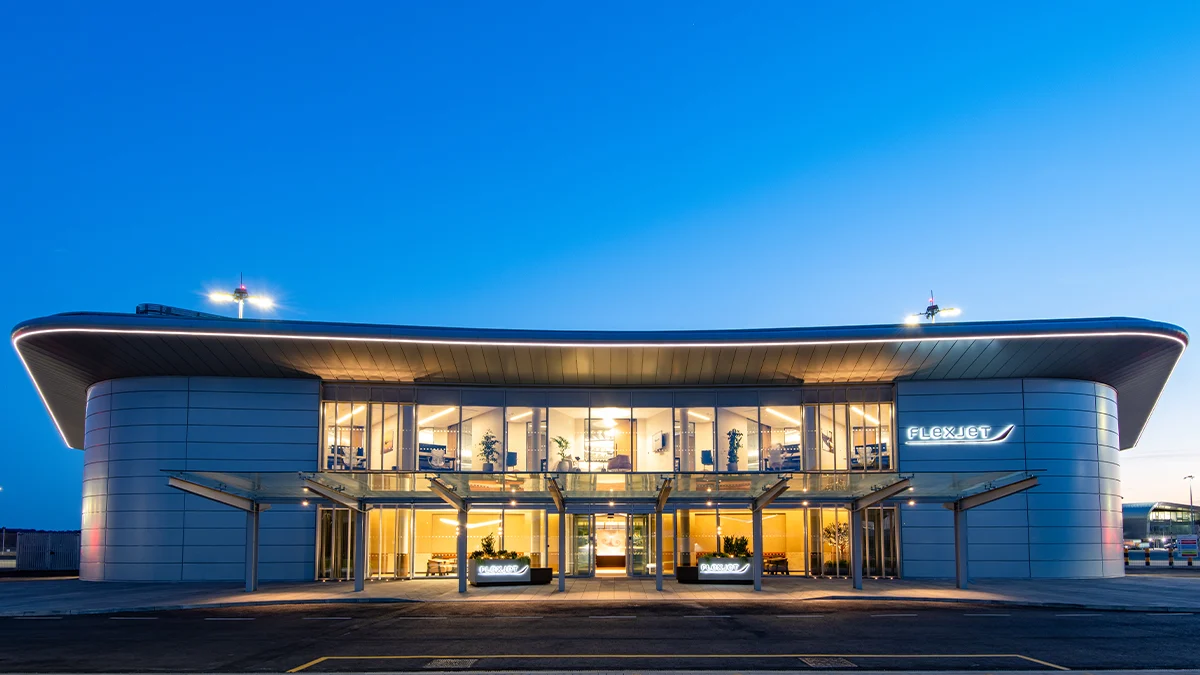
Yet, for all its high-speed branding on the global stage, Flexjet’s most tangible monument to luxury has just opened its doors. The company has officially unveiled a brand-new private terminal at Farnborough Airport, just outside London. Marking Flexjet’s inaugural private fixed-base operator (FBO) space in Europe, the 22,600-square-foot, $34 million facility represents a strategic masterclass in marrying hyper-personalized hospitality with operational aviation infrastructure.
Main Facts: The Farnborough Flagship
The Farnborough facility is designed to act as a seamless European gateway for travelers utilizing Flexjet’s fleet of roughly 350 private jets and helicopters. Operating independently from the airport’s main terminal, the nearly 22,600-square-foot structure functions as a hybrid of high-end hospitality, a functional workspace, and a brand showroom.

Designed by Carber Hain Art + Design, the interior rejects the sterile, corporate aesthetic traditionally associated with private aviation terminals. Instead, it features warm, hexagonal wood flooring contrasted by vibrant pops of rusty orange and deep navy blue. At the heart of the terminal sits a swanky, airfield-facing bar pouring rare wines from Cheval Blanc alongside bespoke specialty cocktails.
Beyond the lounge areas, the facility houses private meeting spaces, a tactical control center, the European operational headquarters for Flexjet, and an expanded training hub for the company’s Red Label Academy crew members. The crown jewel of the interior, however, is a full-scale physical model of a Gulfstream G700 cabin layout. Finished in moody blues and neutral tones, the mock-up allows prospective and current clients to step inside and experience the spatial configuration of the ultra-long-range jet before ever stepping foot on a tarmac.
Chronology of Expansion: From Teterboro to London
Flexjet’s trajectory toward European terminal dominance has been methodical and deliberate. The company’s rise in infrastructure began with domestic FBO rollouts in key U.S. markets, including Dallas and White Plains, New York. These domestic lounges established a blueprint for vertical integration—controlling the passenger experience from the moment a traveler steps out of a car to the second they board the aircraft.

The timeline leading up to the Farnborough launch highlights a broader corporate strategy of scaling through high-end partnerships and fleet acquisition:
- The Investment Surge: Securing the $800 million capital injection from L Catterton provided the financial runway necessary to accelerate international real estate acquisitions and fleet expansion.
- Design Collaborations: Partnerships with Riva translated maritime luxury into aviation interiors, setting a precedent that private jet cabins should reflect the artisanal detail of superyachts.
- Fleet Evolution: Flexjet became the world’s largest operator of Gulfstream aircraft, integrating ultra-long-range assets like the Gulfstream G700 into its fractional model.
- The Farnborough Unveiling: Culminating years of planning, the UK terminal opened as the first of an anticipated 12 to 15 branded FBOs worldwide, securing London as the anchor of Flexjet’s international network.
Supporting Data and Fleet Mechanics: A Transatlantic Journey
To truly understand the operational philosophy behind Flexjet’s new European hub, one must experience the ecosystem in motion. A journey from Manhattan to Farnborough via Flexjet’s multi-modal transit network demonstrates the meticulous coordination required to eliminate travel friction.
The transit begins at the West Side Heliport in New York, where passengers board a Sikorsky S-76 helicopter. A mere 15-minute flight deposits travelers directly onto the tarmac at Teterboro Airport—the busiest private aviation terminal in the United States. From there, passengers transition to an $85 million Gulfstream G700, an ultra-long-range jet added to the Flexjet fleet.

The Gulfstream G700 Experience
- Cabin Altitude: Engineered to maintain a cabin pressure altitude equivalent to just 2,840 feet (compared to roughly 6,000 feet on commercial wide-bodies), drastically mitigating the physical impacts of jet lag.
- Acoustics: The cabin sound suppression is so profound that the sensation of flight is reduced to a quiet, steady hum.
- Capacity and Layout: Designed for up to 15 passengers, the jet features white leather seating, patterned carpeting, a fully enclosed forward and aft lavatory setup, and a dedicated bed in the rear.
- In-Flight Hospitality: Service is elevated beyond standard catering. Dedicated flight attendants prepare gourmet meals—ranging from made-to-order eggs Benedict to formal afternoon tea—complemented by destination-themed mocktails, such as Earl Grey-infused concoctions.
Official Responses: The Philosophy of Detail
Flexjet leadership attributes the company’s staggering 80% to 90% customer retention rate to an uncompromising obsession with visual and experiential detail. Unlike many corporate executives who leave interior design strictly to third-party contractors, Flexjet Chairman Kenn Ricci and CEO Michael Silvestro are personally involved in selecting woods, trims, color palettes, and fabrics.
"Perception is reality," Kenn Ricci told Robb Report during an early preview of the Farnborough terminal. "There’s no better way for our clients to understand how Flexjet is different from our competitors because the planes are different, the uniforms are different, how you’re greeted is different. All of that, and even [the new terminal], nobody does this."
This localized customization will define future international properties. According to CEO Michael Silvestro, the company will deliberately avoid a cookie-cutter corporate template for its upcoming global terminals.

"It needs to be Flexjet, but Flexjet in London, in Scottsdale, and one designer wouldn’t be able to capture that sensibility," Silvestro noted.
Ricci recounted the strict adherence to aviation realities during conversations with luxury conglomerate LVMH. When brainstorming bespoke touches, Ricci had to gently remind his fashion-industry partners of regulatory boundaries: "I had to convince them we can’t put chandeliers in an aircraft."
However, the partnership bore fruit in other ultra-exclusive ways. When designing a custom line of Louis Vuitton luggage exclusively gifted to new Flexjet owners—featuring hanging and soft-sided bags tailored for frequent fliers—Flexjet initially suggested shipping the items to clients. Louis Vuitton promptly rejected the idea, asserting that mail delivery failed to honor the maison’s standards. Instead, new clients are now invited for private, after-hours appointments in closed Louis Vuitton boutiques to select their travel pieces in person.

Industry Implications: The Shift Toward "Younger, Farther, Bigger"
The opening of the Farnborough terminal arrives at a pivotal inflection point for the private aviation sector. According to Flexjet executives, the industry is currently defined by a distinct demographic and operational trend: clients are getting younger, flying longer distances, and demanding larger aircraft.
By anchoring its European operations at Farnborough with a $34 million flagship, Flexjet is positioning itself to capture the upper echelon of international wealth moving through Europe’s financial capitals. The company plans to scale its branded FBO network to roughly 12 or 15 locations worldwide, with six additional sites currently under development or active consideration.
As the lines between high fashion, bespoke design, and aviation infrastructure continue to blur, Flexjet’s fanatical attention to detail is setting a new benchmark. By turning transit hubs into extensions of the luxury lifestyle itself, the company is proving that in the rarefied air of private aviation, the journey begins long before takeoff.
 Evan Lee Salim
 Laily UPN
