

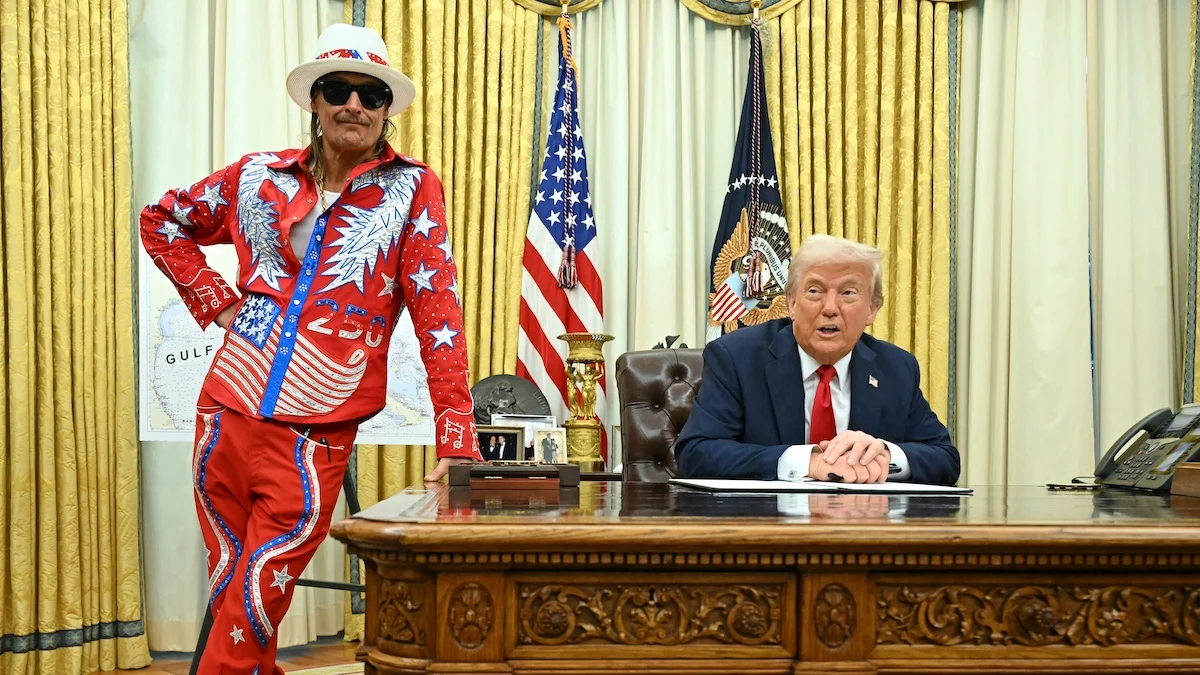
In the landscape of American political polarization, few alliances have proven as enduring or as eccentric as that between multi-platinum recording artist Kid Rock and Donald Trump. A staunch, long-term supporter of the MAGA movement, the Detroit-born rocker has solidified his position not just as a musical provocateur, but as a genuine insider within the Trump orbit. However, in a recent, candid interview with Sky News Australia, Kid Rock offered a characterization of that relationship that has left both supporters and detractors reeling, labeling his proximity to the presidency as a "front-row seat to the greatest shit show on Earth."
The Genesis of the "Late-Night Drinking Trick"
The comments, made during a wide-ranging conversation with host Paul Murray, provided a rare, behind-the-scenes glimpse into the informal communication channels between the entertainer and the former President. When prompted by Murray about the surreal nature of being friends with a man holding the most powerful office in the world, Kid Rock—born Robert James Ritchie—offered a response that was quintessentially "American Bad Ass."
"Fucking awesome," he stated with a laugh, before pulling back the curtain on his nocturnal habits. Ritchie described his interactions with Trump as a product of their shared sleep cycles. "It’s one of my late-night drinking tricks," he admitted. "I know when to get him. And he’s so gracious. He always picks up. Or he’ll call and check in, just to shoot the shit most of the time."
Ritchie was quick to clarify that these calls are not policy-driven sessions involving geopolitical strategy or national security briefings. "He’s not calling me to ask, ‘Hey, what should we do in Iran, Bob?’ I don’t get those calls," he noted. Instead, the dialogue is firmly rooted in the camaraderie of two men who share a similar nocturnal disposition. "It’s 11:00, 12:00 on a Friday or Saturday. I know he’s up. He sleeps like me—he sleeps like five hours. And I’ll be like, ‘Hey, let’s call the President and bullshit.’ And he’ll be like, ‘Hey, Bob, what’s up?’"
Chronology of an Unlikely Political Alliance
To understand the weight of these recent comments, one must look back at the trajectory of the pair’s relationship, which began in earnest during the 2016 campaign. Kid Rock’s endorsement was not a hesitant, calculated political maneuver; it was a loud, visible, and aggressive embrace of the Trump platform.
- 2016-2017: Kid Rock emerged as one of the most prominent cultural figures to back Trump, frequently wearing MAGA hats on stage and selling pro-Trump merchandise.
- 2017: In a high-profile visit to the White House, Kid Rock joined Sarah Palin and Ted Nugent for an Oval Office meeting, signaling his transition from musician to political surrogate.
- 2019-2020: The relationship deepened, with the musician becoming a regular fixture at Mar-a-Lago. Trump, for his part, often spoke of the rocker with genuine warmth, frequently referencing their golf outings and private conversations.
- 2024-Present: Despite the shifting political landscape and the various legal challenges facing the former President, Ritchie has remained steadfast. His recent interview serves as an update on the current state of their rapport, demonstrating that even as the "show" becomes more intense, his access remains constant.
The Paradox of the "Shit Show" Comment
The phrase "greatest shit show on Earth" is inherently polysemous. When uttered by a critic, it is a condemnation of chaos, incompetence, and disorder. When uttered by Kid Rock, however, the phrasing takes on a more complex, almost admiring tone.
The comment suggests an appreciation for the spectacle. For a performer like Kid Rock, who has built a career on disruption and challenging the status quo, the Trump presidency represents the ultimate performance art. Yet, the remark created a moment of cognitive dissonance for many observers. It sounded, for a fleeting second, like a critique that one might expect from a far-left artist like Tom Morello—a jab at the erratic nature of the Trump administration.
However, the ambiguity was short-lived. Ritchie immediately pivoted to a spirited defense of the former President, framing the "show" not as a failure, but as a necessary disruption of the status quo that has plagued American politics for decades.
Supporting Data: Why the Loyalty Persists
Ritchie’s defense of Trump rests on a few core pillars that define his political worldview: the rejection of "career politician" tropes, the celebration of capitalist success, and the belief in a singular "America First" mission.
In the interview, Ritchie expressed frustration with the criticism leveled against Trump’s business dealings. "It kills me, the people that don’t see that," he said, referencing the common critique that Trump utilized his presidency to benefit his business interests. "They want this level of bullshit we’ve had for—since I’ve been alive, with these politicians, presidents. They’re like, ‘Well, he’s making so much money while he’s president.’ Like, no shit, ’cause he’s a businessman. He’s smart. He did that before he was president."
This sentiment aligns with a significant portion of the American electorate that views traditional political experience as a liability rather than an asset. By framing Trump as a "businessman" first and a politician second, Ritchie justifies the unconventional nature of the presidency, positioning it as a necessary evolution of executive leadership.
Official Responses and Public Reception
The reaction to the interview has been predictably divided along partisan lines. Supporters of the MAGA movement have largely viewed the comments as a refreshing, if blunt, endorsement of Trump’s authenticity. In an era of highly curated political messaging, Ritchie’s "shoot the shit" approach is perceived as a form of transparency.
Conversely, political pundits have seized upon the "shit show" remark to illustrate the perceived chaos of the Trump years. Critics argue that even his most loyal surrogates are inadvertently acknowledging the instability of the administration. The interview has become a Rorschach test for viewers: those who see the Trump era as a period of transformative change interpret the rocker’s words as an honest appraisal of a rough-and-tumble political revolution, while those who view it as a crisis of governance see it as a validation of their worst fears.
Implications for the Cultural Divide
The implications of this interview extend beyond a single headline. It highlights the widening chasm between different segments of American culture. The fact that an A-list musician is essentially acting as a late-night confidant to a head of state underscores how much the barriers between entertainment and governance have dissolved.
This "front-row seat" metaphor also speaks to the way modern political discourse is consumed. It is viewed as entertainment, a spectacle that people tune into—or, in Ritchie’s case, tune into directly—to witness the latest drama. The implications for the future of political engagement are significant. As the lines between celebrity culture and political power continue to blur, the expectations for how a leader should communicate and how they should be supported are being rewritten in real-time.
As Kid Rock continues his "Rock the Country" tour and remains a fixture in the conservative cultural sphere, his relationship with Donald Trump serves as a barometer for a specific, vocal segment of the American population. Whether the "shit show" is viewed as a tragedy or a triumph remains the central question of the era—a question that, for now, the rocker and the President seem happy to discuss over the phone, late on a Friday night.
 Pevita Pearce
 Asro
Asro
 Lina Irawan
