

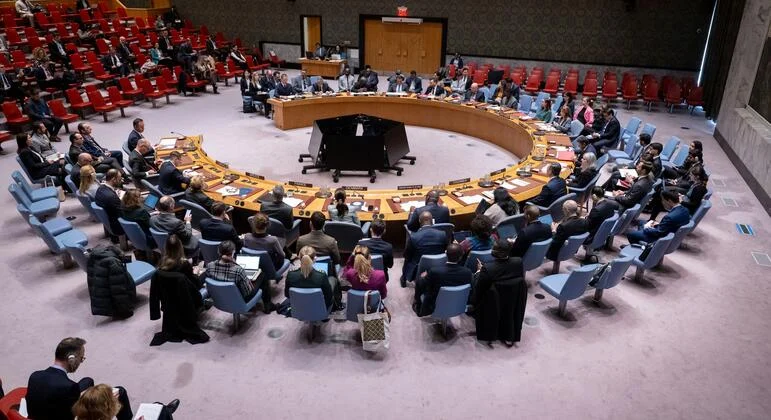
UNITED NATIONS, NEW YORK — The United Nations Security Council met today in its 10167th session to conduct a high-level review of the multifaceted security and humanitarian landscape across Central Africa. With the region grappling with a confluence of political instability, climate-induced displacement, and the lingering threat of armed insurgent groups, the session focused heavily on the mandate of the United Nations Regional Office for Central Africa (UNOCA) and the enduring, albeit diminished, threat posed by the Lord’s Resistance Army (LRA).
The Main Facts: A Region at a Crossroads
The Security Council’s deliberations come at a critical juncture for the Central African sub-region. Ambassadors were presented with a comprehensive report outlining the operational challenges faced by UN missions and regional security architectures. The primary focus of the meeting was the implementation of the UN’s integrated strategy for the region, which emphasizes the "Triple Nexus"—the intersection of humanitarian aid, development, and peacebuilding.
The LRA, once a dominant force of terror across northern Uganda, South Sudan, the Central African Republic (CAR), and the Democratic Republic of the Congo (DRC), remains a central point of concern. While the group’s leadership has been fractured and its operational capabilities significantly degraded by regional military efforts and international sanctions, the UN continues to classify it as a significant security risk. According to the latest UN estimates, the LRA is responsible for over 100,000 deaths and the displacement of millions since its inception.
Ambassadors discussed the necessity of maintaining pressure on the remnants of the LRA while simultaneously addressing the power vacuums that allowed such groups to flourish in the first place.
Chronology: The Evolution of a Long-Running Threat
To understand the gravity of today’s Security Council session, one must look at the historical trajectory of the LRA and the international community’s evolving response:
- 1987–1990s: The LRA emerges in northern Uganda, led by Joseph Kony, utilizing a mix of religious mysticism and brutal guerrilla tactics. The group begins the systematic abduction of children to serve as soldiers and sex slaves.
- 2005: The International Criminal Court (ICC) issues its first arrest warrants for Kony and top LRA commanders, marking the beginning of international legal pursuit.
- 2008–2012: The LRA expands its reach across borders, terrorizing remote villages in South Sudan, the DRC, and the CAR, complicating regional security efforts and thwarting humanitarian access.
- 2011: The United Nations Regional Office for Central Africa (UNOCA) is established to assist countries in the region in addressing cross-border threats and promoting political stability.
- 2017: Following sustained pressure from the African Union Regional Task Force (AU-RTF) and the withdrawal of US military advisors, the LRA’s formal structure fractures. Many mid-level commanders surrender, but Kony remains at large.
- 2026 (Present): The Security Council reviews the state of Central Africa, shifting the focus from large-scale military confrontation to civilian protection, disarmament, demobilization, and the integration of former combatants into society.
Supporting Data: The Humanitarian Toll
The statistics provided to the Security Council reflect a region under immense strain. The humanitarian consequences of the conflict are not limited to the LRA but are exacerbated by broader regional instability.
- Civilian Casualties: The 100,000-death estimate serves as a sobering baseline, yet the "hidden" toll—deaths from preventable diseases, malnutrition, and the collapse of local infrastructure due to insecurity—is believed to be significantly higher.
- Displacement Crisis: The region currently hosts millions of internally displaced persons (IDPs) and refugees. The movement of people across porous borders has stretched the capacity of host communities, which are often already suffering from food insecurity.
- Economic Impact: The persistent insecurity in the Great Lakes region and Central Africa has stifled foreign investment and hindered the development of critical infrastructure, trapping millions in a cycle of subsistence poverty.
- The "Protection Gap": UNOCA’s report highlights that despite improvements in intelligence sharing, the ability of state actors to provide consistent, reliable protection to remote, vulnerable communities remains a primary weakness.
Official Responses and Strategic Shifts
During the session, the representative from UNOCA briefed the Council on the current strategy for the region. The emphasis has shifted from purely military responses to a focus on “soft security.”
"The military degradation of the LRA is a success, but it is incomplete," stated the UNOCA representative. "True stability in Central Africa cannot be achieved through the barrel of a gun alone. It requires the restoration of state authority, the provision of basic services, and a commitment to cross-border cooperation that transcends national interests."
Key points of the official UN strategy include:
- Strengthening Cross-Border Cooperation: Creating seamless communication channels between security forces in the DRC, CAR, and South Sudan to prevent insurgent groups from exploiting national borders.
- Community-Based Reintegration: Implementing programs that focus on the psychosocial rehabilitation of former LRA abductees, particularly those who were forced to commit atrocities as children.
- Humanitarian Access: Addressing the bureaucratic and physical hurdles that prevent aid agencies from reaching the "forgotten" populations in the hinterlands of the CAR and the DRC.
Several member states emphasized the need for sustained funding. The representative of the African Union echoed these sentiments, urging the international community not to "suffer from conflict fatigue."
Implications: A Future for Central Africa?
The Security Council’s meeting today signals a shift in the international paradigm regarding Central African security. The focus is no longer just on the "capture or kill" of high-profile warlords, but on the long-term stabilization of the governance architecture.
The Security Vacuum
One of the most concerning implications discussed was the emergence of new, decentralized armed groups filling the void left by the LRA. Many of these groups are motivated less by the ideology of the LRA and more by the illicit exploitation of natural resources—gold, timber, and diamonds. The Security Council was warned that if the state does not step in to provide security and legal economic opportunities, the cycle of violence will simply mutate into new, equally lethal forms.
Climate and Conflict
The discussion also touched upon the nexus between climate change and security. In parts of Central Africa, prolonged droughts and floods have led to increased competition for arable land and water. The Council acknowledged that climate resilience must be integrated into any long-term peacebuilding strategy, as environmental stress often serves as a primary recruitment tool for extremist groups.
The Responsibility of the International Community
As the 10167th session concluded, the consensus among the permanent and elected members was clear: the international community cannot afford to look away. While the LRA may no longer dominate global headlines as it did a decade ago, the instability it helped cultivate remains a cancer on the region.
The Security Council is expected to issue a formal resolution in the coming weeks that mandates a more robust UNOCA oversight role, specifically regarding the monitoring of illegal resource flows and the facilitation of regional peace summits.
Conclusion
The situation in Central Africa remains one of the UN’s most complex challenges. Today’s session served as a reminder that peace is not merely the absence of war, but the presence of the conditions necessary for human development. As the UN looks toward the future, the lessons learned from the decades-long battle against the LRA will be vital in crafting a more resilient, integrated approach to peace—one that recognizes the agency of local communities and the necessity of regional solidarity.
The path ahead is fraught with difficulty, but as noted by the UN Secretariat, the cost of inaction remains far higher than the cost of sustained engagement. The world’s eyes remain on the Security Council, waiting to see if these words translate into the tangible change so desperately needed by the people of Central Africa.
For more information on this developing situation, citizens and journalists are encouraged to subscribe to the daily UN News updates or download the official UN News app for real-time alerts on regional developments.
 Lina Hope
 Asro
Asro
 Layla Zulfa
