

By Lakshmi Rivera Amin
Published in the Pocket Review
Main Facts: A Transhistorical Dialogue of Visceral Realities
To step into a contemporary New York City gallery housing the paired works of Chaïm Soutine and Ilana Savdie is to enter a space where historical trauma and modern somatic overload bleed into one another. The exhibition proposes an audacious visual and psychological dialogue: the Jewish-Belarusian master of early 20th-century expressionism is placed in direct conversation with the Colombian-American contemporary painter.
While Soutine wrestled with the physical and existential turmoil of a Europe torn apart by two World Wars, Savdie deconstructs the cacophony, sensory bombardment, and ecological anxieties of the 21st century. The resulting exhibition acts as a dark, luminous mirror. It guides viewers through the hidden, often terrifying chambers of their own minds and bodies.
The core of the exhibition rests on a striking artistic dichotomy. If Soutine hung up carcasses to dry—rendering flesh as a vibrating, bleeding landscape of raw pigment—Savdie dissects them with a contemporary, almost surgical precision. Soutine’s rebellious, frenetic hand charges his historical canvases with static shocks that still jolt the modern nervous system. Meanwhile, Savdie melts the dizzying noise of contemporary life into oozing, polymorphic creatures of our own making. Together, their works provoke a jarring dual sensation of alienation and eerie recognition: an acknowledgment that the internal architecture of human suffering, vulnerability, and resilience has fundamentally remained unchanged across the decades.
Chronology: From the Trenches of Paris to the Contemporary Studio
To understand the weight of the current exhibition, one must trace the historical and creative arcs that bridge these two distinct eras of upheaval.
- 1893: Chaïm Soutine is born in Smilovichi, Minsk Governorate, within the Russian Empire (now Belarus), into a deeply impoverished orthodox Jewish family. His early life is marked by anti-Semitic violence and profound destitution, laying the psychological groundwork for his tormented relationship with the physical world.
- 1913: Soutine moves to Paris, settling into the vibrant, destitute artist community of La Ruche in Montparnasse. Here, he absorbs the avant-garde shockwaves of Cubism and Fauvism, yet maintains a singular, violent urgency derived from Old Masters like Rembrandt and El Greco.
- 1914–1918: World War I ravages Europe. While Soutine is not conscripted due to poor health, the surrounding societal collapse and scarcity deeply inform his dark, expressionistic palette, characterized by bruised blues, clotting crimsons, and sickly yellows.
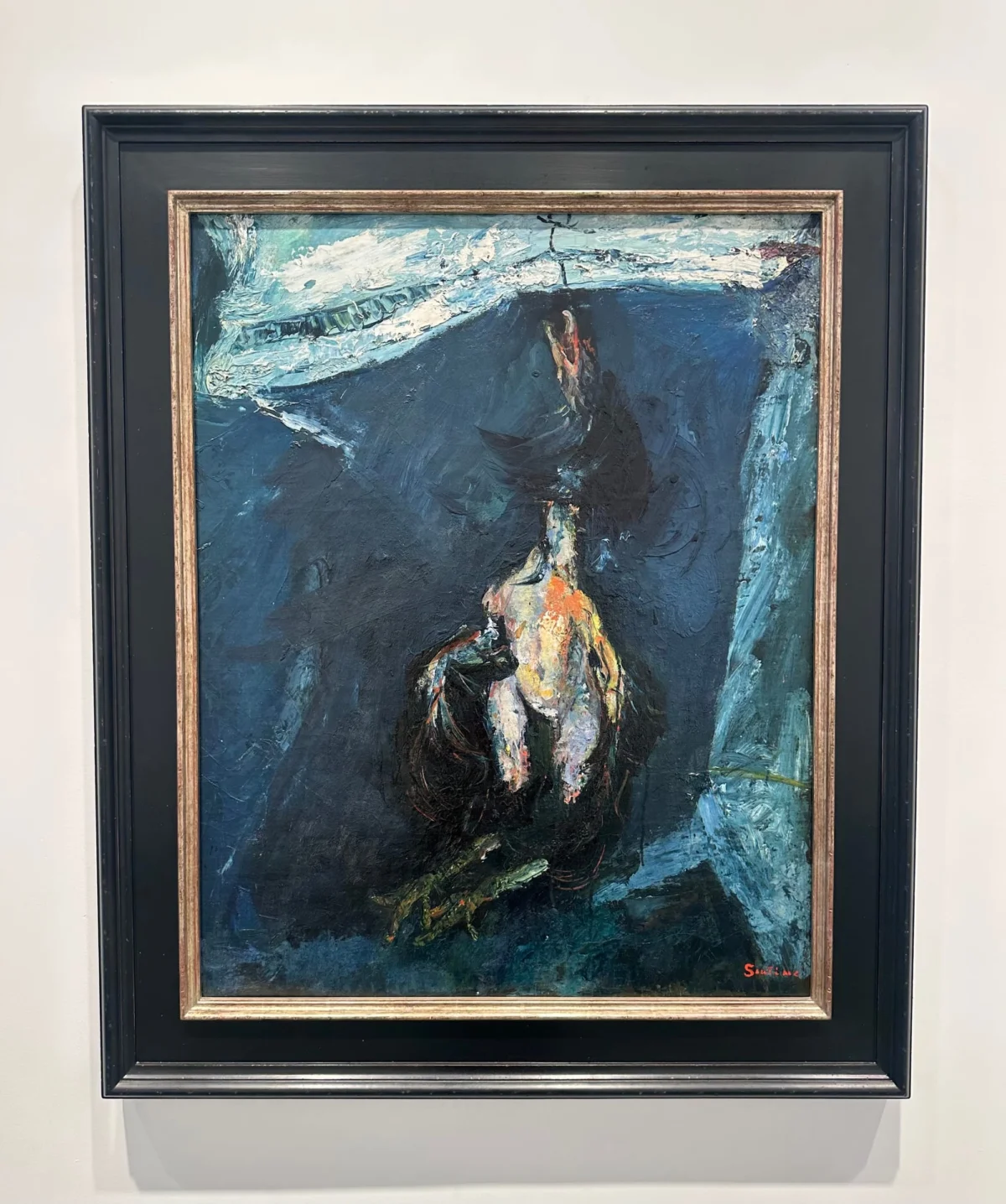
- c. 1925: Soutine paints Hanging Turkey, transforming a mundane market subject into a monument of agony. Channeling his reverence for El Greco, the plucked fowl takes on the horrific dignity of a decapitated angel.
- 1940–1943: With the Nazi occupation of France, Soutine—a Jewish artist—is forced into hiding, constantly moving through the French countryside to evade arrest. The psychological terror of this era exacerbates his failing health, culminating in his death in Paris in 1943 following emergency surgery for a bleeding ulcer.
- Decades Later (The Contemporary Era): Ilana Savdie emerges as a vital voice in contemporary painting. Based between New York and various international projects, Savdie develops a signature vocabulary that fuses oil, acrylic, and beeswax on canvas stretched over panel. Her works interrogate bodily autonomy, identity, and the grotesque mutations of contemporary visual culture.
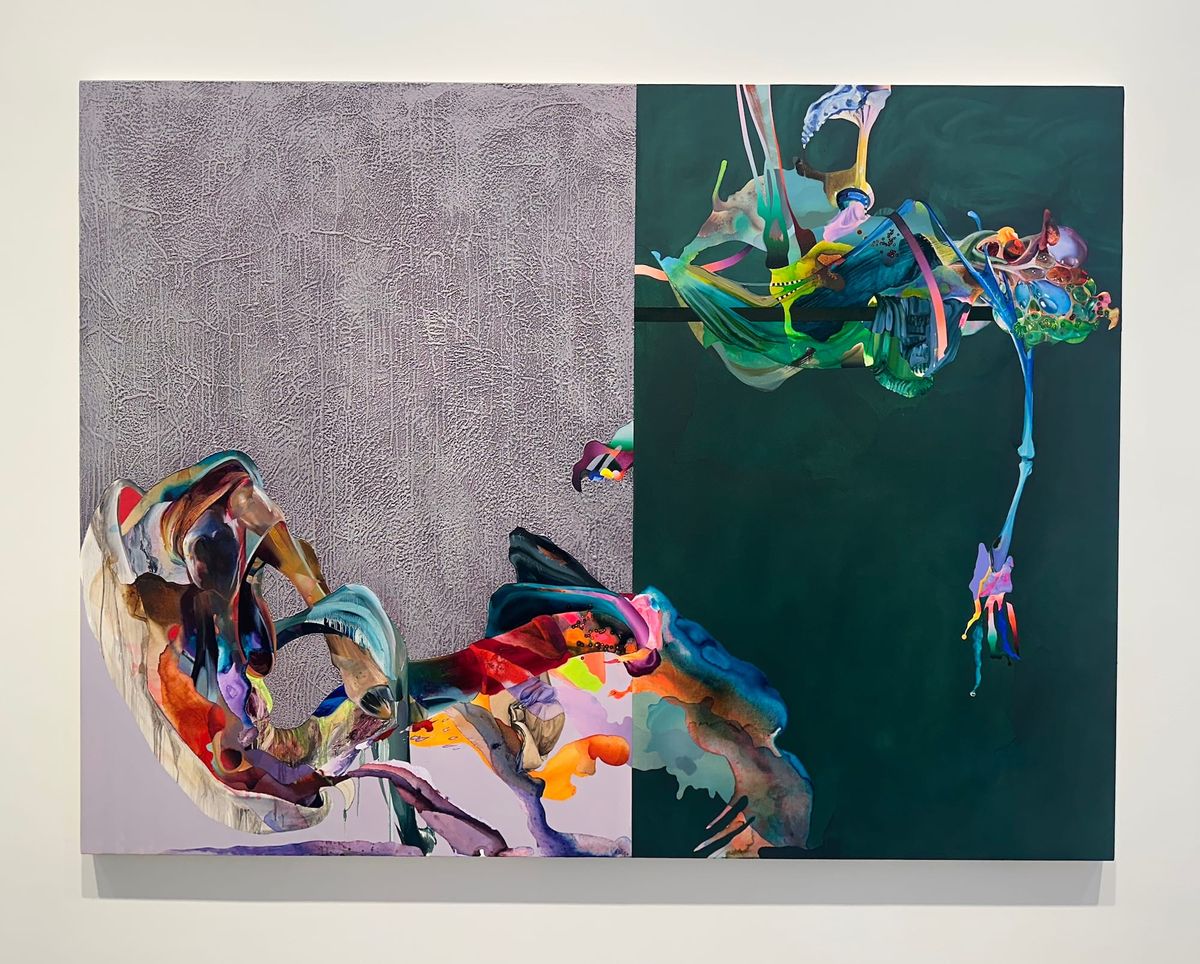
- 2026: The current exhibition opens in New York City, officially bridging a century of artistic output. By pairing Savdie’s Galactophore (2026) with Soutine’s Hanging Turkey (c. 1925), curators and critics alike are forced to reckon with how both artists shed the skin of polite society to expose the pulsing machinery underneath.
Supporting Data: Materiality, Technique, and the Anatomy of Paint
The visual power of the Soutine-Savdie pairing relies heavily on the physical manipulation of materials. Neither artist treats paint as a flat, passive medium; instead, they both deploy paint as a proxy for flesh.
Chaïm Soutine: The Impasto of Torment
- Medium Choice: Thick, heavy oil on canvas. Soutine was known to apply paint with ferocious speed, often reworking the surface until the canvas could barely support the weight of the pigment.
- Color Palette: Dominated by visceral reds, deep ochres, bruised purples, and chalky whites. In Hanging Turkey, the palette mimics the stages of decay and slaughter, rendering the bird not as a culinary object, but as a sentient body undergoing metaphysical strain.
- Historical Influence: Soutine spent countless hours studying masterworks at the Louvre, particularly favoring the dramatic elongation and emotional intensity of El Greco and the dark domesticity of Rembrandt’s Slaughtered Ox (1655).
Ilana Savdie: The Alchemy of Wax and Plasticity
- Medium Choice: A complex hybrid of oil, acrylic, and beeswax stretched across canvas on panel. The inclusion of beeswax allows Savdie to build topographical, skin-like layers that can be carved, scraped, and melted.
- Scale and Composition: Works like Galactophore (2026) utilize biomorphic forms that evoke secretory glands, nervous systems, and hyper-modern prosthetics. The surfaces ripple with glossy bulges and matte fissures, mirroring the digital and physical overload of the 21st century.
- Tactile Engagement: Where Soutine attacked the canvas to rescue an inner truth from chaos, Savdie constructs intricate, layered chimeras that question how bodies are commodified, monitored, and altered in contemporary spaces.
Official Responses and Curatorial Perspectives
The pairing has drawn significant attention from contemporary art critics, historians, and curators who see the exhibition as a timely intervention in how we view historical art through a modern lens.
Art historians note that while Soutine was long categorized as a solitary, tragic genius—often mythologized for his eccentricities and poverty—placing him alongside a contemporary practitioner like Savdie rescues him from historical pigeonholing.
"Soutine’s work has always possessed a dangerous, prophetic energy," notes one curatorial statement accompanying the exhibition. "By introducing Ilana Savdie’s biometric and visceral landscapes into the dialogue, we realize that Soutine wasn’t just reacting to the ghosts of World War I; he was diagnosing a permanent condition of human vulnerability that our current digital and ecological age has only amplified."
Critics have likewise praised Savdie’s ability to hold her own against an icon of expressionism. Rather than being overshadowed by Soutine’s historical weight, Savdie’s Galactophore acts as a modern anchor. It demonstrates that the grotesque and the sublime remain powerful tools for exploring bodily autonomy. As viewers navigate the gallery space, the dialogue between Soutine’s plucked fowl and Savdie’s slick, oozing abstractions prompts a collective reckoning with the anxieties of our shared socio-political climates.

Implications: What This Pairing Tells Us About the Future of Painting
The juxtaposition of Ilana Savdie and Chaïm Soutine extends far beyond a clever curatorial pairing; it points to fundamental shifts in how contemporary art engages with history, trauma, and the human form.
1. The Persistence of Somatic Painting
In an art world increasingly dominated by digital media, algorithmic curation, and frictionless slickness, both Soutine and Savdie champion the slow, messy, and intensely physical labor of painting. Their works insist that certain psychological and physical truths cannot be neatly digitized; they must be dragged through the mud, rendered in impasto, and sculpted in wax. The exhibition serves as a fierce defense of painting as an anatomical act—a way of opening up the canvas to see what is beating underneath.
2. Bridging Historical Traumas
By drawing a direct line from the shadow of the World Wars to the compounding crises of the 2020s (pandemics, ecological collapse, political polarization), the exhibition argues that anxiety has its own transhistorical lineage. Soutine’s tortured carcasses and Savdie’s mutated chimeras remind us that humanity has continually sought refuge in the grotesque when the rational world fails us.
3. Redefining the "Body" in Art
Ultimately, the exhibition challenges viewers to rethink their relationship with their own physical vessels. In an era where human bodies are increasingly monitored, optimized, and commodified, both artists strip away the superficial layers of civilization. They invite us to confront our inner anatomy—not as a clinical diagram from a medical textbook, but as a chaotic, bleeding, and ultimately magnificent landscape of survival.
 Evan Lee Salim
 Iffa Jayyana
 Nila Kartika Wati
