

Main Facts
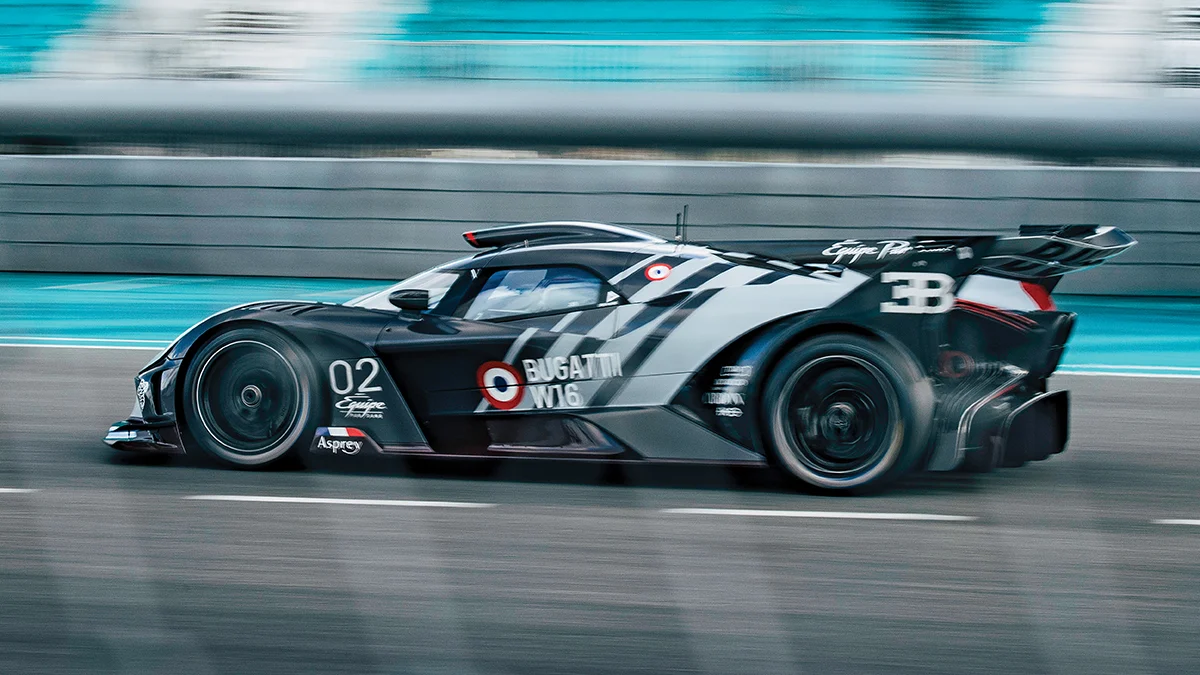
Standing on the sun-baked tarmac of the Miami International Autodrome—the high-speed playground typically reserved for the elite machinery of Formula 1—the sheer visual gravity of the Bugatti Bolide is enough to arrest the pulse.
Priced at an astronomical $4.8 million, the Bolide is the most extreme, uncompromising vehicle ever forged by the historic French marque. Its name translates fittingly from French to "fireball" or "meteor," a moniker that hints at both its celestial performance capabilities and its fiery temperament. Powered by Bugatti’s legendary 8.0-liter quad-turbocharged W16 engine, this track-only hypercar churns out an earth-shattering 1,578 horsepower and 1,180 ft-lbs of torque on standard pump gas. Should an owner feed it race fuel, those figures scale to a staggering 1,826 horsepower and 1,475 ft-lbs of torque.
Exclusivity is woven into every strand of its carbon-fiber monocoque chassis. Bugatti has limited the Bolide’s global production run to a mere 40 units, all of which have already been spoken for and delivered to an ultra-select fraternity of collectors and driving enthusiasts. Capable of generating over 6,000 pounds of downforce—double the aerodynamic grip of an F1 racer at top speed—the Bolide occupies a vanishingly small, hyper-exclusive intersection of aerospace engineering and automotive art.
Chronology of the Experience
The journey toward taming the Bolide at the Miami International Autodrome did not begin behind the wheel, but rather in the sobering quiet of a paddock briefing room.
The Briefing and the Storm
As the assembled owners and media personnel prepared for the track session, Bugatti’s head driving instructor offered a stark, paradoxical mantra: “It’s just a car.” He repeated the phrase several times to counter the palpable intimidation in the room, only to add with a knowing smirk, “Actually, it’s a gun. But it’s just a car.”

Moments later, reality arrived in carbon fiber. Seeing a single Bolide in the wild is an exceedingly rare privilege; witnessing a pack of these meteoric machines idling in the pit lane induced instant goosebumps. Contorting my tall frame into the passenger seat, I buckled up beside Le Mans winner and Bugatti chief test-driver Andy Wallace.
Just as Wallace prepared to introduce the track, South Florida’s temperamental weather intervened. The sky abruptly darkened, unleashing sheets of torrential rain upon the circuit. Wallace calmly assured me that the Bolide handles wonderfully in the wet. It was an easy statement to make from the driver’s side of a multi-million-dollar hypercar.
The Lap with Andy Wallace
Once the tropical squall passed and the racing line dried, Wallace wasted no time. Within seconds of leaving the pit lane, he matted the accelerator.
“Get on the brakes early and much harder than you think,” Wallace yelled over the screaming quad-turbo engine as we rocketed past 200 mph on the circuit’s straightaway.
To demonstrate, he stomped on the brake pedal with brutal authority, driving my body violently into the six-point safety harness and showcasing the terrifying, instantaneous deceleration of the car’s aerospace-grade brakes.

Taking the Driver’s Seat
When my turn finally arrived to strap into the left-hand drive position, initial anxieties melted away, replaced by mechanical intimacy. From the driver’s seat, the first surprise was the unexpected breadth of forward visibility through the expansive windshield. My gaze quickly shifted to the minimalist, X-shaped steering wheel—a deliberate nod to the Bolide’s distinctive rear lighting and aerodynamic spoiler motif.
Burying my right foot into the floorboard required a deliberate suspension of disbelief. Under full acceleration, the visual field distorted; the red-and-white track curbing blurred into a solid band of pink as tunnel vision set in. Yet, despite the apocalyptic power surging through the rear wheels, the chassis felt entirely docile. The electronic stability control worked in seamless harmony with the massive aero package, keeping the car glued to the asphalt without fighting the driver’s inputs.
By turn six, all pre-drive apprehension had evaporated. The car simply did what it was asked to do, reaffirming the instructor’s opening refrain: It’s just a car.
Supporting Data and Engineering Specifications
The Bugatti Bolide is not merely a styling exercise; it is an engineering masterclass designed to push the boundaries of physics on a closed circuit.
- Engine: 8.0-liter quad-turbocharged W16
- Standard Output: 1,578 hp and 1,180 ft-lbs of torque
- Race Fuel Output: 1,826 hp and 1,475 ft-lbs of torque
- Acceleration: 0 to 62 mph (100 km/h) in a blistering 2.2 seconds
- Top Speed: Electronically limited to 236 mph (though theoretical simulations suggest a much higher ceiling)
- Braking Force: Up to −2.5 G, enabled by a bespoke Brembo carbon-carbon braking system developed over two years—utilizing technology adapted from the Concorde supersonic jet and Formula 1.
- Downforce: Generates in excess of 6,000 pounds of downforce at top track speeds, doubling the aerodynamic load of a modern Formula 1 car.
- Production Volume: Strictly limited to 40 worldwide units, priced at $4.8 million each.
Official Responses and Perspectives
Bugatti’s engineering and driving teams have been vocal about the unique philosophy underpinning the Bolide. Unlike previous Bugatti models—such as the Chiron or Veyron, which were engineered to conquer absolute top-speed records on long straightaways—the Bolide was conceived specifically for technical circuit performance.

Bugatti chief test-driver and Le Mans champion Andy Wallace emphasized the car’s uncanny accessibility despite its monumental output. “People see nearly 1,600 horsepower and a carbon monocoque and expect an unruly beast that wants to bite your head off,” Wallace notes. “In reality, the engineering allows the driver to exploit the limits of the car with supreme confidence. The downforce and the braking systems do the heavy lifting, transforming what could be an intimidating monster into a precise, responsive instrument.”
Bugatti’s driving instructors maintain that the psychological barrier of piloting a $4.8 million vehicle is the hardest hurdle for owners to clear. Once drivers realize that the vehicle’s electronic safety nets and aerodynamic grip far outstrip human reflexes, the intimidation gives way to pure driving euphoria.
Implications for the Hypercar Market
The arrival and delivery of all 40 Bolide units marks a watershed moment in the echelon of ultra-luxury, track-only automobiles. For years, manufacturers like Aston Martin (with the Valkyrie AMR Pro) and Ferrari (with their XX programs) have vied for supremacy in the private track-day arena. Bugatti’s entry into this space with the Bolide effectively redefines the upper limits of what is mechanically possible for a private owner to pilot.
The End of an Era for the W16
Furthermore, the Bolide represents a monumental chapter in automotive history: the twilight of Bugatti’s legendary W16 engine. As emissions regulations tighten and the automotive landscape pivots irrevocably toward hybridisation and electrification, the quad-turbo W16 is riding off into the sunset. The Bolide serves as its most violent, uncompromising, and glorious swansong.
The Psychology of Ownership
For the 40 owners who have taken delivery of their Bolides, these machines represent more than mere financial investments or garage queens. They are tools meant to be unleashed on elite circuits around the globe—from the Miami International Autodrome to Spa-Francorchamps and the Nürburgring.

As the automotive world looks toward an electrified future, the Bolide stands as a monolithic monument to internal combustion. It proves that even at the bleeding edge of speed—where physics, financial exclusivity, and raw terror intersect—a car can still inspire absolute confidence. After all, as the instructors in Miami love to remind nervous drivers stepping into a $4.8 million fireball: It’s just a car.
 Evan Lee Salim
 Asep Darmawan
 Laily UPN
