

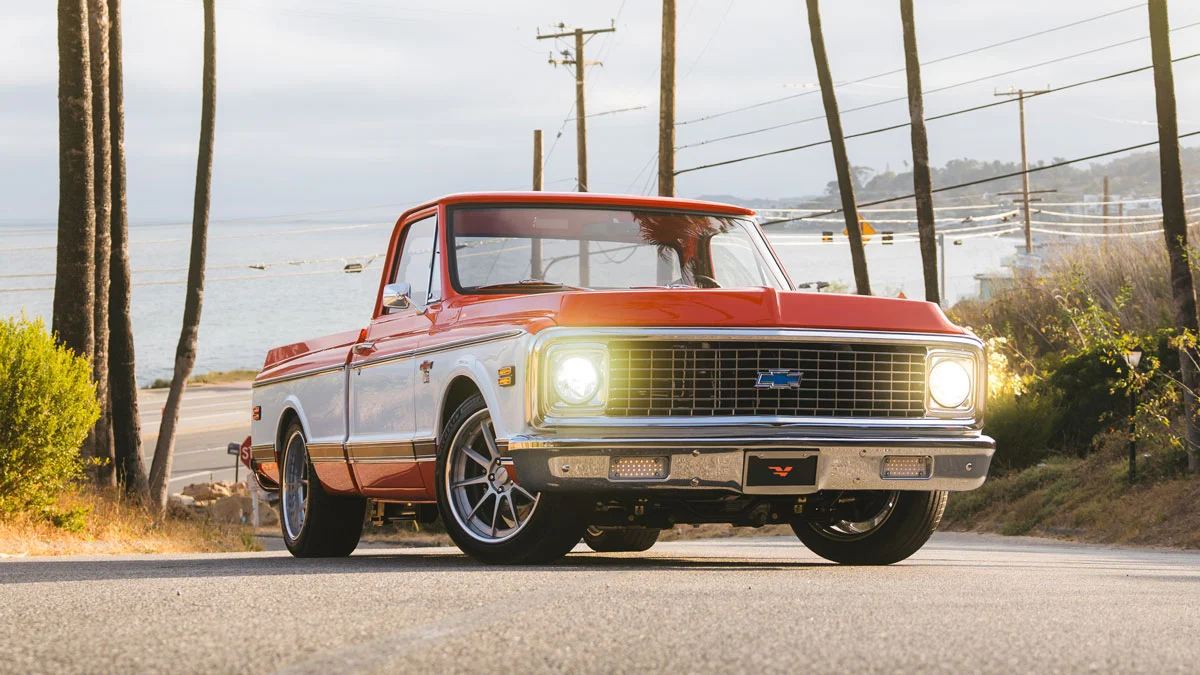
For the generation that came of age in the 1970s, the Chevrolet C10 was the quintessential American workhorse. It was as common as the suburban driveway itself—a purely utilitarian instrument designed for hauling lumber, towing trailers, and enduring the daily grind of blue-collar labor. It lacked the aggressive styling, digital nannies, and luxury pretensions of today’s modern S.U.V.s; it was simply a tool, reliable and rugged.
Yet, five decades later, that same platform has been elevated to the status of high art. In a world where vintage trucks are increasingly being treated as collector’s items rather than tools, Velocity Restorations has unveiled a 1971 Chevy C10 restomod that commands a price tag nearing $350,000. It is a staggering figure for a vehicle that once served as the backbone of the American fleet, but it reflects a broader, rapidly expanding cottage industry dedicated to preserving and perfecting the automotive icons of the late 20th century.
Main Facts: The Evolution of an Icon
The 1971 Chevrolet C10 was, by any historical metric, a massive success for General Motors. Records indicate that more than 260,000 examples were produced in that year alone, cementing its place in the cultural zeitgeist. It was the truck your neighbor drove, the truck the local contractor relied on, and the truck that defined the American road.

Velocity Restorations, a leader in the high-end restomod space, has taken this humble icon and subjected it to a total mechanical and aesthetic overhaul. The result is a vehicle that maintains the spirit of the original while performing at a level that would have been unimaginable to the engineers at Chevrolet in 1971. The build does not merely "restore" the truck; it re-engineers it for the demands of the modern driver, blending the visceral, analog soul of the ’70s with the precision of contemporary performance hardware.
A Chronology of Rebirth
The process of transforming a rusted, well-worn C10 into a six-figure showpiece is an arduous, multi-stage journey.
Phase I: Sourcing and Structural Integrity
Unlike some "restomod" operations that discard the original vehicle in favor of fiberglass replicas or kit-car bodies, Velocity begins with an authentic donor C10 body. Once a suitable candidate is sourced, the original frame—often fatigued by decades of service—is cast aside. In its place, Velocity installs a bespoke, modern chassis developed in partnership with the Roadster Shop. This provides the foundation for all subsequent performance upgrades.

Phase II: Mechanical Integration
With the chassis secured, the powertrain is swapped for a modern GM 6.2-liter LT1 V-8, a powerhouse capable of producing 460 hp. This engine is mated to a 10-speed automatic transmission, a choice that prioritizes long-term reliability and modern drivability over the maintenance-heavy nature of vintage gearboxes.
Phase III: Aesthetic Refinement
The final stage is the "restoration" of the cabin and exterior. Velocity works to ensure the vehicle retains its period-correct appearance—colors like Hugger Orange and Frost White are used to evoke the original era—while integrating subtle, modern necessities like billet door handles, LED headlights, and backup cameras. The interior is completely fabricated from scratch, incorporating custom bench seats, machined door panels, and high-fidelity infotainment systems.
Supporting Data: The Specs of Modernity
The technical specifications of the Velocity C10 reveal a vehicle that is built to be driven, not just admired behind velvet ropes.

- Engine: GM 6.2-liter LT1 V-8
- Output: 460 Horsepower
- Transmission: 10-Speed Automatic
- Suspension: Fox Coil-over system with front sway bar
- Wheels: 18-inch Forgeline CV3C
- Tires: Michelin Pilot Sport
- Braking: Baer Disc Brakes
These components transform the handling characteristics of the truck. While the original C10 was known for its lumbering, truck-like road manners, the Velocity version is capable of cornering with a degree of precision that rivals contemporary performance sedans. The use of Michelin Pilot Sport tires and Baer brakes ensures that the 460-horsepower output is not just accessible, but manageable in traffic, on mountain roads, or on the freeway.
Official Responses: The Philosophy of "Subdued Excellence"
Stuart Wilson, the founder and C.E.O. of Velocity Restorations, views these builds as a delicate balance between nostalgia and necessity.
"I’ve tried to stay true to the heritage and the craftsmanship of the original vehicle," Wilson says. "We always modernize everything with drivability, engineering, things along those lines—it’s all upgraded. But as far as the aesthetics of the vehicle, the exterior appearance, we really tried to stick almost with period-correct colors and finishes. When you look at our truck, it looks like it could have rolled off the assembly line back in the ’70s, but you know something’s a little different about it—that was intentional."

Wilson’s mission statement is clear: he wants to build a vehicle that is "usable every day." By resisting the urge to "overengineer" the truck, he maintains the raw, authentic feel that enthusiasts crave. "When you get in it, it still is very similar to an original interior, it’s just ultra-refined," he notes. The interior, while featuring Apple CarPlay and custom digital-analog gauges, does not feel like a spaceship; it feels like a high-end, bespoke version of the truck you remember from your childhood.
Implications: The Market for Nostalgia
The price tag of $350,000 raises a fundamental question: who is this for, and what are they buying?
In the current market, the "restomod" movement is essentially a search for a lost feeling. For many, the modern automotive experience has become overly sanitized, laden with intrusive safety systems and plastic-heavy interiors. The C10, by contrast, represents a time when vehicles were tactile, mechanical, and distinct.

However, a raw 1971 C10 is a difficult machine to live with in the 21st century. It is loud, slow, prone to mechanical failure, and lacks the safety features required for modern highway speeds. Velocity is effectively selling the idea of 1971, stripped of all the inconveniences that would normally accompany a vehicle of that age.
This is the "nostalgia-induced catharsis" that justifies the investment. For the buyer, the return on investment is not measured in financial appreciation alone, but in the ability to experience a beloved era without the frustration of constant repair. Whether the owner grew up with these trucks or simply appreciates the aesthetic of the era, the Velocity C10 offers a bridge between the past and the present.
As the industry continues to grow—with similar houses now restoring Ford Broncos, Chevy Blazers, and International Scouts—the C10 stands out as a triumph of restraint. It is a testament to the fact that you do not need to radically alter the appearance of an icon to make it a modern masterpiece. Sometimes, you just need to give it the heart, the bones, and the refinement it always deserved.

In the end, the value proposition is, as Wilson suggests, entirely subjective. It is a purchase made not by the head, but by the heart. And for those who yearn for a time when trucks were simple and the road felt wide open, the price of a dream is exactly what they are willing to pay.
 Laily UPN
 Raul Delapena Setiawan
