

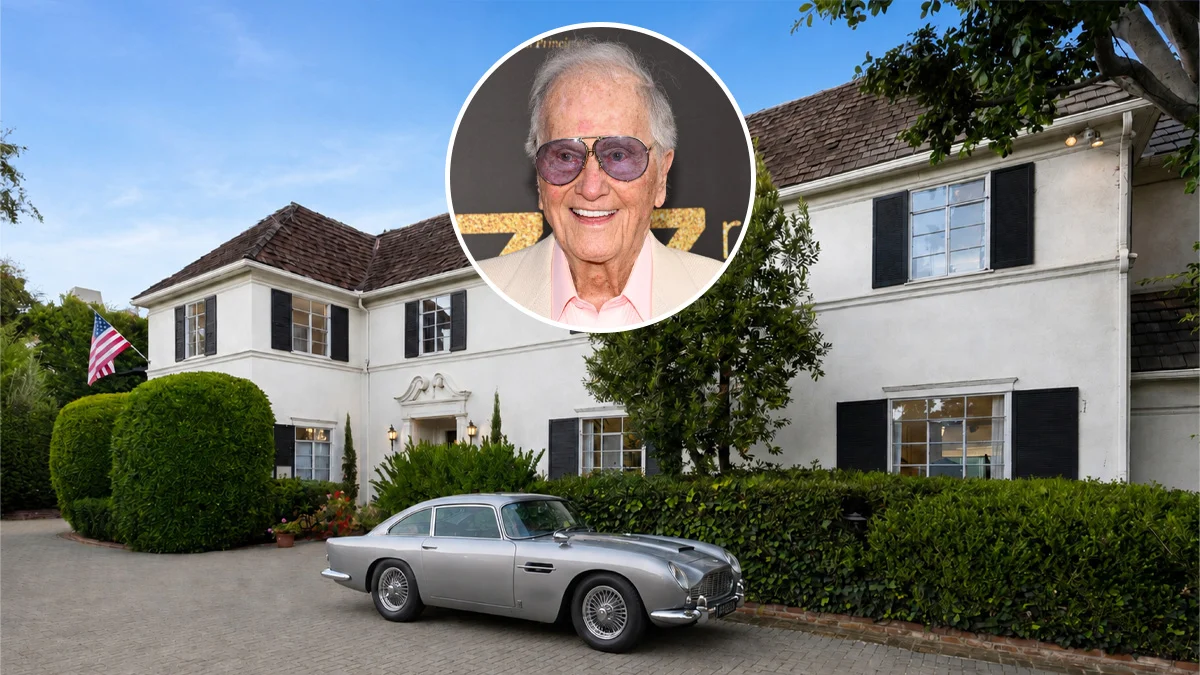
In the pantheon of mid-century American pop culture, few narratives are as distinct as the parallel ascents of Elvis Presley and Pat Boone. While Presley’s raw, rebellious magnetism—defined by greased hair, leather jackets, and a kinetic, hip-swiveling stage presence—shook the foundations of the 1950s, Boone provided the antithesis. With his squeaky-clean aesthetic, signature white buck shoes, and unassuming cardigans, Boone became the poster child for the "All-American" ideal. Yet, behind these divergent public personas lay a surprising, decades-long friendship, one that frequently found its home within the walls of a sprawling, gate-guarded Colonial Revival estate in Beverly Hills.
Now, that very estate—a property that served as the backdrop for the private life of one of America’s most enduring entertainers—has hit the market. After 66 years of continuous family ownership, Pat Boone has officially listed his legendary Beverly Hills residence for nearly $23 million, marking the conclusion of a chapter in Hollywood history that stretches back to the dawn of the rock-and-roll era.
The Main Facts: A Legacy on the Market
The property, located at the prestigious intersection of North Beverly Drive and Sunset Boulevard, is more than just a home; it is a monument to a bygone era of Tinseltown. Purchased by Boone in 1960 for $159,000, the estate has served as the primary residence for the singer, his late wife, Shirley, and their four daughters.
Spanning over an acre of prime Beverly Hills real estate, the property features a two-story white stucco structure encompassing approximately 7,000 square feet. It currently holds six bedrooms and eight bathrooms. While the home retains much of its original 1930s architectural charm, it is being marketed as a prime development or renovation opportunity. The estate is currently listed with Lea Porter of The Beverly Hills Estates.

A Chronology of Stardom and Shelter
To understand the significance of the property, one must look at the trajectories of its inhabitants. In the late 1950s, Presley and Boone were the titans of the industry. Their paths to success were wildly different, yet they intersected frequently. Presley dominated the cultural zeitgeist, eventually moving into the legendary Las Vegas residency era, while Boone successfully pivoted into a multifaceted career that included major studio feature films—such as the sci-fi adventure Journey to the Center of the Earth—and later, a transition into the worlds of Christian gospel music and conservative media.
The history of the home itself is a timeline of the Boone family’s growth. Acquired during the height of Pat’s fame, the house became a sanctuary where the "All-American" crooner could retreat from the spotlight. Throughout the 1960s, 70s, and beyond, the home played host to the elite of the entertainment world. It was a place where Elvis Presley, despite his vastly different public image, felt comfortable visiting his friend, bridging the gap between the rock-and-roll rebel and the wholesome pop icon.
The property’s journey on the real estate market has been equally storied. Boone first attempted to part with the estate in 2014, testing the waters with a quiet, private pocket listing. When that failed to produce a sale, he pivoted to a public offering of $18.5 million. Ultimately, that effort was withdrawn, as the family wasn’t quite ready to sever ties with the residence. Now, after more than a decade of contemplation, the house is back on the market with a significantly higher price tag, reflecting the explosive growth of the Beverly Hills luxury market over the last 66 years.
Supporting Data: Architectural Nuances and Amenities
The residence is a masterclass in classic, understated elegance, characterized by its traditional 1930s architecture. A carved stone portico greets visitors, leading into a grand central hallway defined by a sweeping timber staircase. The floor plan is structured around formal living and dining rooms, which retain a sense of the grandeur typical of the era.

Beyond the formal spaces, the home reveals its character through more intimate, lived-in areas. The kitchen, which retains a retro aesthetic, features a breakfast banquette that flows seamlessly into a large recreation room. This space, a clear favorite for family gatherings, is equipped with a wet bar, a dedicated dining area, and a pool table—the latter of which is included in the sale.
The house also reflects the work-from-home culture that preceded the modern era. It features a wood-paneled music room lined with floor-to-ceiling bookshelves and a private home office complete with its own fireplace. The upstairs primary suite serves as the crown jewel of the interior, offering a massive, mirrored dressing area and dual bathrooms that speak to the luxury standards of the 1960s.
The exterior grounds are equally impressive. The sprawling backyard is anchored by a large, rectangular swimming pool bordered by traditional red brick and a flagstone terrace. The property is lush with mature trees and vast, flat lawns, a rarity in the densely packed hills. A separate guesthouse provides additional utility, while a basketball court sits adjacent to a three-car garage, rounding out a estate that offers total privacy behind its iconic gates and manicured hedges.
Official Responses: The Philosophy of Downsizing
At 92 years old, Pat Boone’s decision to sell is rooted in a desire for simplicity rather than financial necessity. In a recent interview with Mansion Global, the singer spoke candidly about the emotional weight of leaving a home that has held his family for over six decades.

"I would probably do better in a smaller place here," Boone noted. "I don’t need a place this big, but I love it, and I still walk around and enjoy it all." His words highlight a common struggle for long-term homeowners: the balance between the love of a space that holds a lifetime of memories and the pragmatic reality of managing a massive, historic estate in one’s later years. For Boone, the home is not just a collection of rooms; it is a living document of his career and family life.
Implications: The Evolution of Beverly Hills Real Estate
The listing of the Boone estate carries significant implications for the current real estate climate in Beverly Hills. Positioned mere steps from the legendary Beverly Hills Hotel, the property is in one of the most desirable neighborhoods on the planet.
However, the fact that it is being marketed as a "renovation or development project" is a telling sign of the times. In the world of high-end real estate, there is a constant tension between preserving historic structures and maximizing the utility of the underlying land. While the home possesses an undeniable pedigree, the $23 million asking price reflects the value of the land itself—over an acre at a prime intersection.
This listing follows a trend of "legacy properties" hitting the market, where homes held by the same owners for half a century are being turned over to a new generation of buyers. Whether the new owner chooses to meticulously restore the existing 1930s structure to its former glory or opts to replace it with a modern, ultra-luxury mega-mansion remains to be seen.

For fans of mid-century pop culture, the sale represents the final closing of the door on a specific type of Hollywood lifestyle. It is the end of an era where stars lived in homes that felt personal and grounded, rather than just assets in an investment portfolio. As the curtains close on the Boone family’s time at 904 North Beverly Drive, the property stands as a reminder of a time when the biggest stars in the world found their happiness not in the glare of the flashbulbs, but in the quiet, tree-lined streets of a neighborhood they called home.
Whether it becomes a museum-grade restoration or a site for a new architectural vision, the home will forever be known as the place where the "All-American" singer lived his most authentic life, marking a final, historic chapter in his 66-year residence.
 Ali Ikhwan
 Laily UPN
 Raul Delapena Setiawan
