

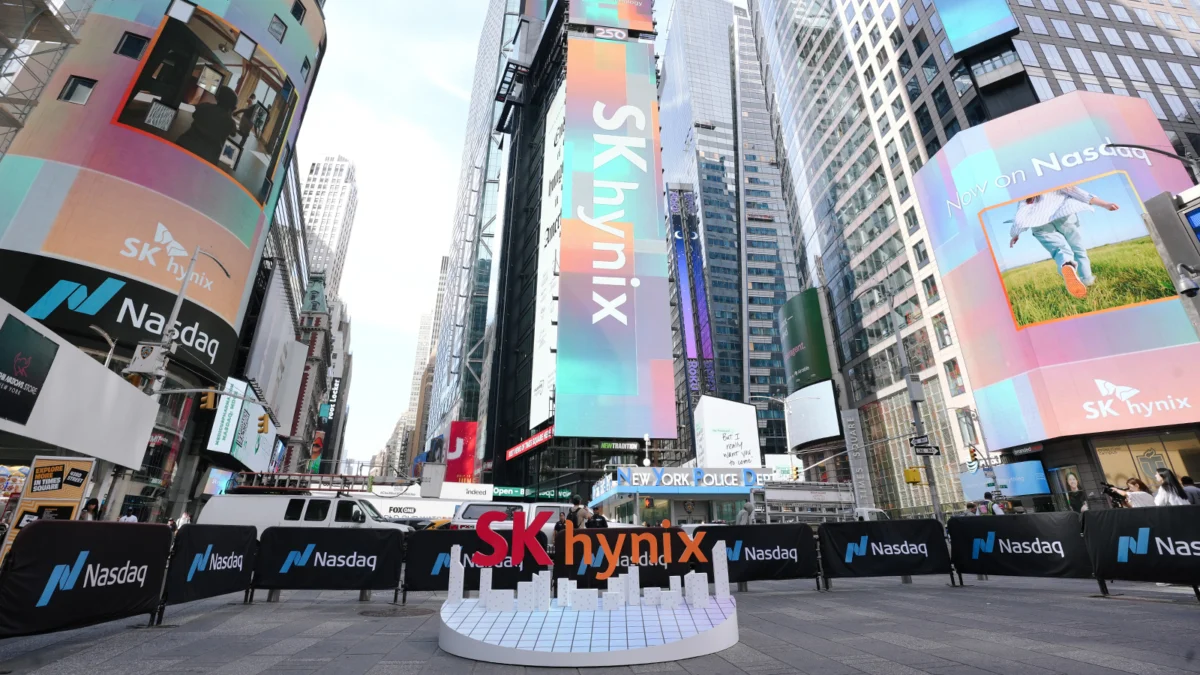
The global artificial intelligence revolution has reached a fever pitch, and its latest manifestation is not a chatbot or a generative model, but a massive capital infusion into the bedrock of the AI infrastructure: memory chips. On Friday, July 10, 2026, South Korean semiconductor giant SK Hynix cemented its position at the center of the AI ecosystem by successfully executing the largest-ever U.S. market debut by a non-American company, raising an unprecedented $26.5 billion.
This landmark listing on the Nasdaq not only signals the insatiable investor appetite for AI-enabling hardware but also serves as a potent rebuttal to the long-standing "Korea Discount"—a phenomenon where South Korean firms have historically traded at lower valuations due to governance and geopolitical concerns.
A Historic Milestone: Breaking the Alibaba Record
The numbers surrounding SK Hynix’s debut are staggering. By selling 177.9 million American depositary shares (ADRs) at $149 per share, the company has eclipsed the $25 billion IPO set by Alibaba in 2014. The offering was meticulously structured to grant U.S. investors accessible entry points, pricing the ADRs at approximately one-tenth the cost of a full share on the Korea Stock Exchange.
Market response was instantaneous and aggressive. Despite the shares being priced at a 2.7% premium relative to their three-day average in Seoul, the offering was reportedly oversubscribed by a factor of seven. When trading commenced under the temporary ticker "SKHYV," the stock surged 14% above its IPO price within minutes, maintaining a strong upward trajectory throughout early trading. The ticker is set to transition to the permanent "SKHY" on Monday, July 13.
Chronology: The Path to a $26.5 Billion Listing
The journey to this historic Friday began months ago as SK Hynix looked to capitalize on its pivotal role as a primary supplier for Nvidia’s AI GPUs.
- Pre-Launch Phase: Recognizing the global supply crunch for High Bandwidth Memory (HBM), SK Hynix initiated the regulatory and financial groundwork to tap into U.S. capital markets, aiming to fund massive capacity expansion.
- The Oversubscription Surge: As word of the offering spread through institutional circles, demand far outpaced supply. The 7x oversubscription rate underscored a shift in investor sentiment, moving away from purely software-focused AI plays toward the tangible infrastructure required to run large language models.
- Friday, July 10 (The Debut): The stock hit the Nasdaq boards. The 14% opening pop served as a bellwether for the semiconductor sector, validating the firm’s strategic pivot toward high-end memory.
- Monday, July 13 (Full Integration): The transition to the "SKHY" ticker marks the final stage of the company’s integration into the U.S. equity landscape, signaling to global markets that SK Hynix is now a centerpiece of the American investment portfolio.
Overcoming the "Korea Discount"
For years, analysts have struggled to explain why high-performing Korean tech titans consistently traded at a discount compared to their Western or even Japanese counterparts. The "Korea Discount" is typically attributed to a cocktail of concerns: complex cross-shareholding structures, historically low shareholder returns, unpredictable regulatory shifts, and the looming, constant geopolitical shadow of North Korea.
SK Hynix’s successful U.S. debut suggests that the AI narrative has effectively overridden these systemic concerns. By positioning itself as an indispensable link in the AI hardware supply chain, the company has demonstrated that when a firm is critical enough to the future of global computing, traditional valuation headwinds fade. Investors are no longer looking at SK Hynix through the lens of a regional manufacturer; they are viewing it as a global necessity.
Strategic Capital Allocation: Where the Money Goes
The $26.5 billion raised is not intended to sit in a corporate treasury. According to the company’s filings, the capital is earmarked for three mission-critical objectives:
- Next-Generation Fabs: Construction of a new fabrication plant in South Korea designed specifically to alleviate the global shortage of high-end memory chips.
- Advanced Packaging Facilities: Investment in cutting-edge packaging technologies, which are increasingly vital for integrating HBM with powerful AI processors.
- EUV Scanner Acquisition: The procurement of Extreme Ultraviolet (EUV) lithography machines. These ultra-expensive, highly complex scanners are the "holy grail" of semiconductor manufacturing, enabling the production of the next generation of nodes that power AI-specific workloads.
The Geopolitical Chessboard: Commerce Secretary’s Call to Action
The significance of this IPO extends beyond the balance sheet and into the realm of national security and industrial policy. On the day before the listing, U.S. Commerce Secretary Howard Lutnick made a pointed appearance at a Micron event, emphasizing a clear directive: the United States must secure its own supply chain.
Lutnick confirmed that he is in active, high-level discussions with both Samsung and SK Hynix, urging them to shift more of their manufacturing footprint to the United States. The Biden administration’s goal is clear: prevent South Korea from maintaining a monopoly on the production of the world’s most advanced memory chips.
"We cannot allow our technological future to be entirely dependent on overseas facilities," a sentiment echoed by the administration’s aggressive push for domestic semiconductor sovereignty.
In response, Micron has doubled down on its own commitment, announcing a $250 billion investment plan for new U.S. manufacturing. Micron estimates this initiative will create over 90,000 jobs, aiming to solidify the U.S. as a global hub for both chip design and mass-market production.
Implications for the Global Tech Landscape
The tension between the massive influx of capital into the Korean chip sector and the U.S. government’s push for "onshoring" creates a complex dynamic for the next decade.
While both Korean giants—SK Hynix and Samsung—have recently pledged over $550 billion to bolster their domestic manufacturing capabilities in South Korea, they are simultaneously being courted by Washington to build in the U.S. This "dual-track" strategy reflects the reality of the semiconductor industry: it is too capital-intensive to ignore either the established, highly efficient manufacturing ecosystem in Korea or the strategic imperative of having production located closer to the primary consumers in the U.S.
For investors, the takeaway is stark. We are witnessing the birth of an "AI Supercycle." The infrastructure required to sustain the current pace of innovation is so vast that it is requiring the largest capital raises in corporate history.
As SK Hynix begins its life as a U.S.-listed entity, it serves as the ultimate barometer for the AI industry. If the demand for HBM remains as resilient as the demand for the stock itself, the company’s move into the U.S. market may be remembered not just as a record-breaking financial event, but as the moment the world fully committed to the physical foundations of the AI era.
The market has spoken: in the race to build the future of intelligence, memory is the most valuable commodity of all.
 Asep Darmawan
 Siti Muinah
 Ali Ikhwan
