

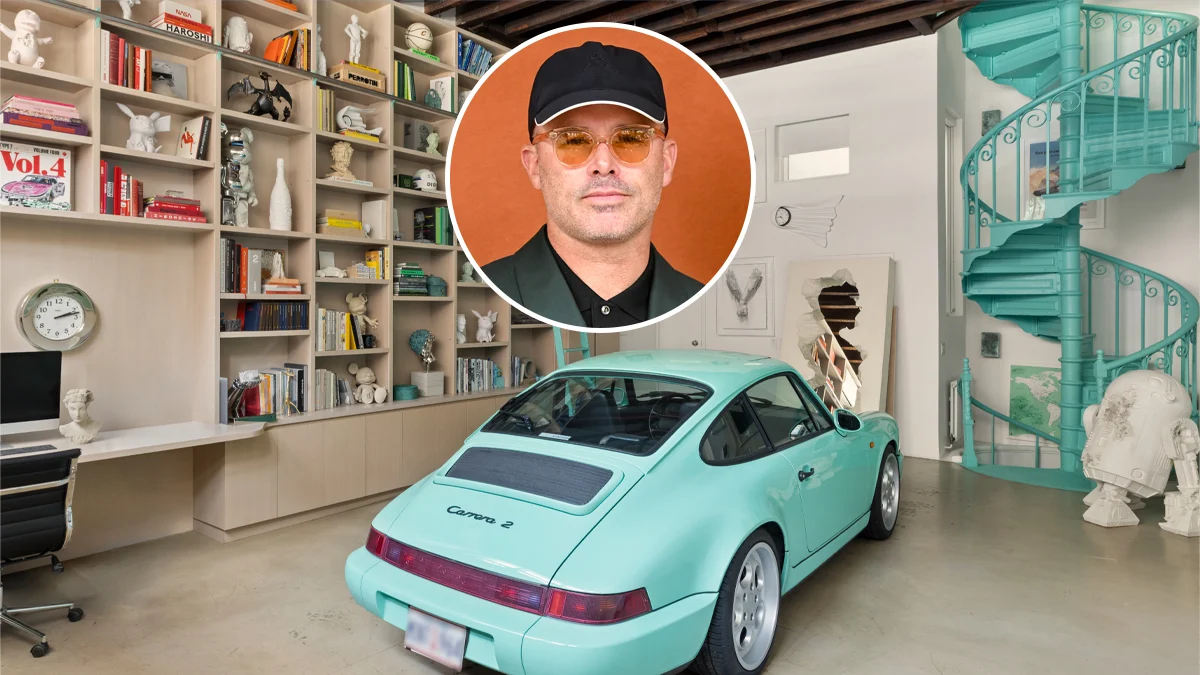
In the rarefied world of high-end Manhattan real estate, few properties possess the architectural pedigree and creative soul of 185 Lafayette Street. Once a functional bastion of the New York City Fire Department, the 1887-built engine house for Engine Company No. 55 has served as the creative laboratory for one of contemporary art’s most recognizable figures: Daniel Arsham. Having purchased the landmarked structure for nearly $6 million in the summer of 2022, the artist has placed the property back on the market with a price tag just under $9 million.
Represented by Nick Gavin of Compass, the listing offers a rare opportunity to own a slice of New York history reimagined through the lens of a visionary. While the property has been meticulously curated to serve as both a residence and a high-concept studio, it stands as a testament to the intersection of industrial heritage and modern, avant-garde design.

The Evolution of a Landmark: From Engine Company to Art Atelier
The structure, designed by the legendary FDNY architect Napoleon LeBrun, represents a golden era of municipal architecture. LeBrun, whose legacy is etched into the very masonry of New York City, designed this firehouse with the stoic, functional elegance that defined the late 19th century. Spanning nearly 21 feet in width and providing approximately 2,100 square feet of interior space across four stories, the building retains its original charm: patterned brickwork, imposing cast-iron pillars, and distinctive flame-motif capitals that pay homage to its original purpose.
When Arsham acquired the property in 2022, his objective was not merely to renovate, but to transform. Known globally for his "fictional archaeology"—a practice that renders contemporary pop-culture icons, technology, and automobiles as if they were calcified, eroded relics of a distant future—Arsham applied his signature aesthetic sensibilities to the firehouse.

The ground floor, formerly the domain of fire engines, was converted into a soaring, versatile studio and gallery space. Here, the artist introduced poured concrete floors that ground the room in industrial minimalism, complemented by bespoke custom bookshelves and an iron spiral staircase finished in his unmistakable "Arsham mint" green. The original double-bay doors, paired with a rare, pre-existing curb cut, allow the space to function as an indoor garage—an essential feature for an artist who famously incorporates high-end automotive design into his own creative output, often housing his matching Porsche 964 Carrera 2 within the building’s walls.
Chronology of a Masterpiece
- 1887: Napoleon LeBrun completes the construction of the firehouse for Engine Company No. 55.
- Late 19th/Early 20th Century: The building serves as a vital component of Manhattan’s fire safety infrastructure, witnessing the industrial growth of the SoHo neighborhood.
- Summer 2022: Contemporary artist Daniel Arsham acquires the property for approximately $6 million, viewing it as a blank canvas for his creative practice.
- 2022–2024: Arsham undertakes a comprehensive, sensitive renovation, upgrading mechanicals while preserving the historical integrity of the building’s facade and structural bones.
- July 2026: After successfully integrating his studio and residence within the four-story structure, Arsham lists the property for just under $9 million.
Inside the Design: Where Minimalism Meets Heritage
The residence is a masterclass in the balance between raw industrial history and curated luxury. Ascending from the ground-floor studio, the upper levels open into light-filled, airy living spaces. The interior palette is defined by wide-plank oak flooring and 13-foot ceilings that capture the dramatic scale of the 19th-century architecture.

The living room serves as the heart of the home, featuring tall, four-pane sash windows that frame the bustling streetscape of Lafayette Street below. Above, exposed wood-beam ceilings offer a tactile, organic contrast to the sleek, modern kitchen, which is outfitted with high-end white oak cabinetry, an expansive eat-in island, and a suite of professional-grade Miele and Sub-Zero appliances.
Perhaps the most personal touch is found in the full-floor primary suite. The bedroom is draped in custom wallpaper inspired by a bespoke installation Arsham created for an exhibition in Paris, creating a cocoon-like environment. The suite includes a meticulously crafted walk-in closet and an en-suite bathroom that serves as a sanctuary. Here, Vola fixtures, a sculpted sink, and a windowed steam shower reflect the artist’s obsession with form and function.

Infrastructure and Technological Integration
While the aesthetics are the primary draw, the building is fortified with the technical infrastructure required for the modern collector. The basement, often an overlooked utility space, has been optimized for storage, laundry, and flexible recreation, ensuring that the footprint of the home is maximized.
Crucially, the building is equipped with state-of-the-art climate control systems, specifically calibrated for the preservation of fine art. Integrated smart-home technology manages everything from security to lighting, allowing the resident to monitor the environment from anywhere in the world—an essential feature for an artist whose work requires precise temperature and humidity stability.

The crowning jewel of the property is the landscaped rooftop. Far from the noise of the SoHo streets, this private oasis features a built-in outdoor kitchen and a private cabana. It offers panoramic views of the downtown Manhattan skyline, serving as an ideal setting for both private reflection and high-profile entertaining.
Implications for the SoHo Real Estate Market
The listing of 185 Lafayette Street comes at a time when the market for "trophy" artist-owned properties in Manhattan is particularly buoyant. As the neighborhood continues to evolve, the demand for unique, historical structures that offer both residential and professional utility has skyrocketed.

The sale of the firehouse signals a broader trend: the "creative’s estate." Buyers in this tier are increasingly looking for properties that offer more than just a place to sleep; they are looking for identity. By purchasing a building that has been touched by a prominent artist, the future owner is effectively buying into a specific cultural narrative.
Furthermore, the listing highlights the scarcity of private, drive-in garage access in Manhattan. The inclusion of an existing curb cut in a landmarked firehouse is a feature that cannot be replicated, making the property a rare commodity that transcends standard residential valuation. While the art currently decorating the space—pieces by KAWS, Josh Sperling, and Arsham himself—is not included in the transaction, the "bones" of the home provide a permanent installation of style that will likely attract collectors and design aficionados alike.

Conclusion
Daniel Arsham’s tenure at 185 Lafayette Street has been defined by his ability to bridge the gap between the past and the future. By preserving the work of Napoleon LeBrun while infusing it with his own distinct "eroded" aesthetic, Arsham has turned a piece of municipal history into a contemporary icon. As the property enters the market at nearly $9 million, it remains a monument to the power of design to reshape our perception of space and time. Whether as an art studio, a gallery, or a singular family residence, the firehouse stands ready for its next chapter, waiting for a new steward to continue its transformation in the heart of SoHo.
 Evan Lee Salim
 Asep Darmawan
 Laily UPN
