

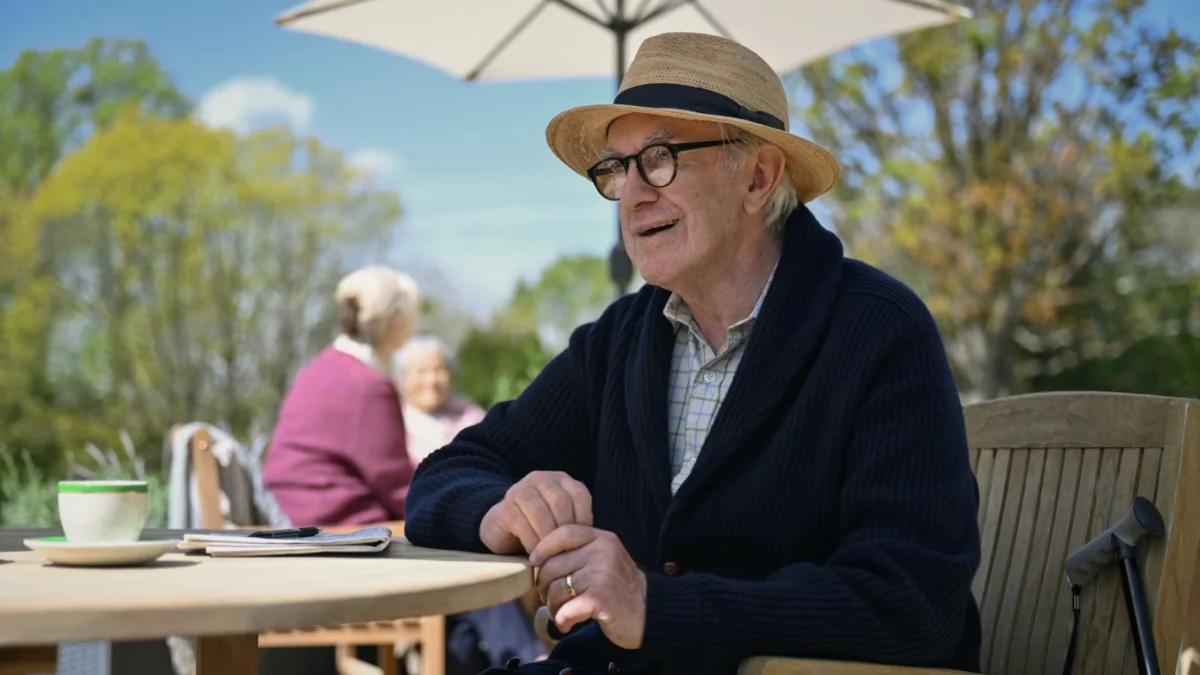
Jonathan Pryce is an actor who has spent five decades inhabiting the skin of history’s most formidable figures. He has worn the papal vestments of a Pope, the regal tailoring of Prince Philip, and the cold, calculated armor of high-stakes political operators. Yet, in the murky, cynical corridors of Apple TV+’s hit espionage thriller Slow Horses, Pryce has found perhaps his most hauntingly resonant role yet: David Cartwright.
As the elder statesman of the MI5 "rejects" club—Slough House—Pryce’s character is a relic of a bygone era of intelligence, a man who once held the keys to the kingdom’s deepest secrets, now adrift in the quiet, terrifying fog of dementia. Five seasons into the series, which is based on the celebrated novels by Mick Herron and steered by showrunner Will Smith, Pryce’s performance has become a masterclass in subtlety. It is a portrayal defined not by grand monologues, but by the smallest of gestures—the flicker of confusion in a glance, the sudden, brittle vulnerability of a man who has forgotten how to be strong.
The Chronology of a Character: Playing in Real Time
For an actor accustomed to the rigid constraints of period dramas or the mapped-out arcs of high-fantasy epics, the experience of Slow Horses has been uniquely organic. In many long-running series, actors are given a roadmap of their character’s trajectory. With Slow Horses, Pryce chose a different path: he opted to live the character in real time, mirroring the audience’s own discovery of David Cartwright’s decline.
"You’re playing it in real time," Pryce explains, reflecting on his five-season journey. "It’s a bit like life. You don’t know what’s around the corner, and I think that’s vital for this performance. The character grows at the same time as the audience’s recognition of him."
This approach stands in stark contrast to his work on projects like The Crown. "With Prince Philip, I knew exactly what was going to happen; the history was written in textbooks," he notes. Even his tenure on Game of Thrones as the High Sparrow offered a deceptive narrative arc—a character he initially believed was a beacon of moral clarity, only to realize, upon receiving the Season 6 scripts, that he was playing a zealot of a different color. In Slow Horses, the ambiguity is the point. By avoiding the temptation to "map out" David’s eventual decline, Pryce keeps the character’s struggle raw, immediate, and painfully human.
Supporting Data: The Craft of Cognitive Decline
Portraying the onset of dementia is a daunting task for any performer, fraught with the risk of falling into melodrama or caricature. Pryce, however, approaches the subject with a clinical, almost tender precision. His preparation was not rooted in research manuals or long production meetings, but in his own life experience and a profound respect for the gravity of the condition.
"There were no gags about it," Pryce asserts, highlighting the show’s refusal to use the character’s illness as a cheap narrative device. "It was always dealt with seriousness."

Pryce’s performance is deeply informed by his stage work, specifically in the production The Height of the Storm. That experience provided him with a profound realization: the audience’s reaction is as much a part of the performance as the acting itself. "People would wait at the stage door to tell me it was a great comfort to them," he recalls. "One man told me it was the first time in a year he’d been able to cry since his father died from Alzheimer’s. I knew then the value of portraying David Cartwright with this level of honesty."
By working closely with writer Will Smith, Pryce ensured that the character’s internal struggle was externalized through the reactions of those around him. When River Cartwright (played by Jack Lowden) observes his grandfather’s fading lucidity, the audience sees the tragedy not through David’s eyes, but through the heartbreak of his grandson.
Official Responses and Creative Synergy
The collaboration between Pryce and Will Smith is a testament to the power of creative trust. In a television landscape often dominated by heavy-handed exposition, the team behind Slow Horses opts for an economy of language that allows the actors to fill the silence.
"Will had great confidence in me, so we didn’t really need to talk a lot about it," says Pryce. "The writing is so economic, which is brilliant, because it allows the audience to do a lot of the work. You’re not over-explaining."
This, he argues, is what makes the scenes between David and his grandson, River, so magnetic. The chemistry between Pryce and Jack Lowden is palpable, anchored by a mutual respect that transcends the script. "This could possibly cost me an acting award," Pryce jokes, "because in the scenes with Jack, there’s no acting required! It’s a young man and an old man. It’s a young man who respects the old man, and the old man becoming very attached to his grandson."
The dynamic is further complicated by the inclusion of Jackson Lamb, the irascible MI5 boss played by Gary Oldman. Lamb serves as a narrative foil, a man who knows the "sinister" side of David’s past—the man who was capable of cold-blooded pragmatism—and uses that history to mock the vulnerability of the man he has become.
The Physicality of Power and Vulnerability
As the series moves toward its climax, the physical transformation of David Cartwright becomes impossible to ignore. Pryce credits a brief, personal medical scare for the inspiration behind this shift. "I had a brief experience in a hospital in the last few years where I felt completely vulnerable," he shares. "It was frightening, that awareness that you’re in someone else’s hands. Someone who has been totally in control of his life and of many other people has lost that control."

This "loss of control" is the central theme of Pryce’s performance. Whether he is playing a king or a spy, he is fascinated by how power—or the lack thereof—is defined by the reactions of others. "One day you can be in control, the next day you’re not," he reflects. "Every character has their own sense of self-importance. It’s other people’s reactions that make him seem vulnerable."
Implications: A Legacy of Nuance
What does the enduring appeal of David Cartwright say about the current state of television? It suggests that audiences are increasingly hungry for characters who are allowed to be flawed, fading, and fundamentally broken, rather than heroes who always have the answers.
Jonathan Pryce’s performance in Slow Horses serves as a poignant reminder that the most compelling dramas are not those that shout, but those that whisper. By resisting the urge to play the "dementia" and instead playing the "man," Pryce has elevated David Cartwright from a supporting character into one of the most memorable portraits of aging in modern fiction.
As the series continues to explore the shadows of the intelligence world, the question of whether David will reveal the secrets he has kept buried for decades remains a potent subtext. But for Pryce, the mission is simpler: to surprise himself, to surprise the audience, and to find the humanity in the silence.
"I like to surprise myself," he concludes. In Slow Horses, he has certainly done that—and in doing so, he has reminded us all that even the most formidable figures among us are, in the end, only human.
 Ammar Sabilarrohman
 Siti Muinah
 Iffa Jayyana
