

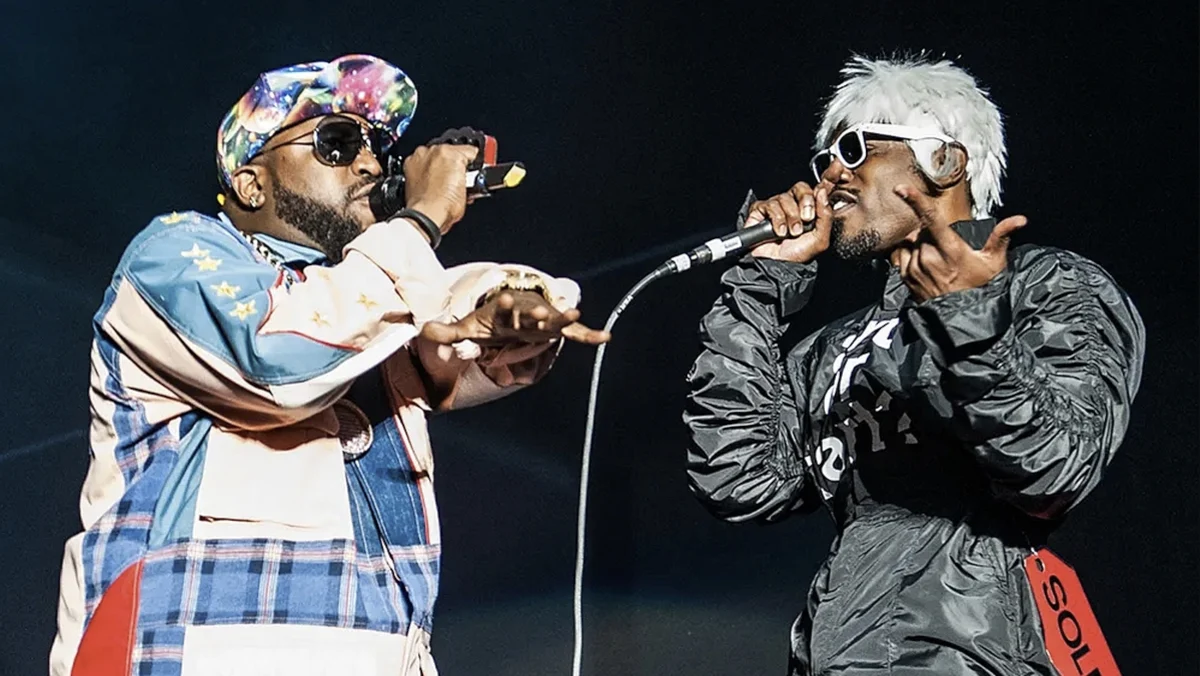
ATLANTA — In the upper echelons of hip-hop history, few brands are as meticulously guarded, culturally revered, or commercially valuable as OutKast. Comprising the legendary pairing of André 3000 (André Benjamin) and Big Boi (Antwan Patton), the Atlanta-born duo transformed southern rap into a global phenomenon, crafting a multi-platinum catalog that defined a generation. Now, decades after dominating the charts with genre-bending anthems like "Hey Ya!", "Ms. Jackson," and "Rosa Parks," the group’s corporate entity is taking legal action to protect the integrity and exclusivity of the name that built an empire.
High Schoolers LLC, the intellectual property holding company representing André 3000 and Big Boi, has officially filed a federal lawsuit against Oakland-based rapper and producer Silas Wilson, who performs under the stage name Ovrkast. Filed on September 16 in a Georgia federal court, the legal action alleges trademark infringement, unfair competition, and breach of contract. At the heart of the dispute is a fundamental accusation: that Wilson’s moniker is an intentional, phonetically deceptive knockoff designed to exploit consumer confusion and ride the coattails of OutKast’s hard-earned legacy.
The unfolding legal battle bridges distinct eras of hip-hop—pitting a foundational pillar of 1990s and 2000s commercial dominance against a modern underground producer who carved out a niche in the indie and alternative rap scenes of the 2020s. As the case proceeds through the federal court system, it raises critical questions about branding, phonetic similarity, and the lengths to which legacy acts will go to police their intellectual property in the streaming era.
Main Facts: The Core Allegations Against Silas Wilson
According to the extensive, 31-page complaint lodged in the U.S. District Court, High Schoolers LLC contends that Silas Wilson’s choice of the stage name "Ovrkast" is not an innocent coincidence, but rather a calculated strategy to deceive consumers. The lawsuit argues that the visual and phonetic similarities between "OutKast" and "Ovrkast" are so pronounced that they inevitably lead the public to draw a false association between the independent producer and the legendary Grammy-winning duo.
The legal document pulls no punches, asserting that Wilson’s utilization of the moniker is "knowing, deliberate, willful, and in bad faith." High Schoolers LLC maintains that the defendant’s primary objective is to wrongfully trade upon the immense goodwill, cultural capital, and commercial reputation that OutKast has cultivated over more than three decades in the music industry.
The plaintiffs are seeking sweeping legal remedies from the court. In addition to demanding a permanent injunction that would legally bar Wilson from ever performing, releasing music, or conducting business under the name Ovrkast, the lawsuit requests that the court compel the artist to recall and destroy all physical and digital merchandise, promotional materials, and recordings bearing the disputed name. Furthermore, OutKast’s legal representation is pursuing financial damages, seeking to strip Wilson of any profits generated under the alias and demanding statutory penalties for trademark violations, unfair business practices, and an alleged breach of a signed contract.
Chronology of a Dispute: From Private Negotiations to Federal Court
While the lawsuit was officially filed in mid-September, the friction between OutKast’s legal team and Silas Wilson is far from sudden. It represents the culmination of months—if not years—of tension, private communications, and broken promises regarding brand dilution and market confusion.
The Rise of Ovrkast (2020)
Silas Wilson began generating significant industry buzz around 2020, emerging as a promising voice in underground hip-hop. Operating primarily as a producer and lyricist, Ovrkast gained critical acclaim and a dedicated online following after crafting beats for high-profile artists, including underground heavyweight Earl Sweatshirt and pop-rap titan Drake. As his profile grew within internet-native hip-hop circles, the phonetic overlap between his stage name and the legendary Atlanta duo began to draw passive notice from industry observers and fans alike.
The Rolling Stone Admission (2025)
The turning point for OutKast’s legal radar came in 2025, when Wilson addressed his moniker directly in a profile with Rolling Stone. In the interview, the Oakland artist openly acknowledged the linguistic ambiguity of his stage name, explicitly noting that people frequently "read Ovrkast [as] Outkast." For High Schoolers LLC, this public admission served as a smoking gun—direct evidence that the defendant was not only acutely aware of the confusion his name generated, but was potentially leaning into it for visibility.
The Broken Agreement (2025–2026)
Realizing the potential for brand dilution, representatives for OutKast initiated direct communications with Wilson throughout 2025 and 2026 to resolve the naming conflict outside of a courtroom. According to the federal complaint, these negotiations initially bore fruit. Both parties allegedly reached a formal, binding agreement: Wilson would voluntarily and systematically phase out the use of the name "Ovrkast" by mid-July of 2026. As a compromise, the producer agreed to transition his professional identity to a visually distinct alternative spelling: Ovrkxst.
However, when the agreed-upon July deadline arrived and passed, Wilson allegedly failed to honor the terms of the settlement. Instead of completing the transition to "Ovrkxst," the artist continued to release music, promote shows, and conduct business under the original, disputed moniker. It was this alleged breach of contract, coupled with continued consumer confusion, that forced High Schoolers LLC to abandon negotiations and escalate the matter to the federal court system.
Supporting Data: Building the Case for Confusion
To convince a federal judge that trademark infringement has occurred, a plaintiff must demonstrate that the defendant’s use of a similar mark is likely to cause consumer confusion regarding the source, sponsorship, or approval of goods and services. In their 31-page complaint, OutKast’s legal team meticulously constructed a narrative outlining the decades-long investment required to cement their cultural footprint, juxtaposing it against the tangible evidence of market crossover.
Safeguarding a Legacy
The complaint details the exhaustive measures OutKast has taken since their 1994 debut album, Southernplayalisticadillacmuzik, to protect their intellectual property. Through trademark registrations, global touring, critical accolades (including becoming the first hip-hop group to win the Grammy Award for Album of the Year with 2003’s Speakerboxxx/The Love Below), and high-profile cultural touchstones, the name "OutKast" has achieved iconic status. The plaintiffs argue that this immense brand equity makes them uniquely vulnerable to dilution by acts utilizing confusingly similar names.
Evidence of Market Overlap
In legal filings, proving consumer confusion often relies on anecdotal and media-driven proof. By citing Wilson’s own 2025 Rolling Stone interview, OutKast’s legal team highlighted an explicit acknowledgement of the exact harm trademark laws are designed to prevent: the misattribution of an artist’s identity. The complaint suggests that casual music consumers, algorithmic recommendation engines, and festival bookers could easily conflate the two names, leading to diverted streams, misplaced press coverage, and unearned market exposure for the junior act at the expense of the senior brand.
Official Responses and Legal Landscape
As of publication, Silas Wilson and his designated legal representation have not yet formally responded to the allegations laid out in the federal complaint. Under federal civil procedure guidelines, Wilson’s defense team generally has a standard window of 30 days from the date of formal service to file a response, motion to dismiss, or answer with the Georgia district court, acknowledging receipt of the lawsuit and outlining their initial legal defenses.
Legal analysts specializing in intellectual property note that cases involving stage names often hinge on a delicate balance between a creator’s freedom of expression and an established brand’s trademark rights. Phonetic similarity—how a name sounds when spoken aloud—plays a major role in audio-centric industries like the music business, where radio announcers, streaming algorithms, and word-of-mouth recommendations are vital for discovery.
If Wilson’s defense team chooses to fight the lawsuit, they may argue that "Ovrkast" is a distinct, self-contained word (a stylized variation of "overcast") rooted in weather terminology, and that the spelling differences and distinct sub-genres of their respective music catalogs (Southern alternative funk-rap versus contemporary underground West Coast hip-hop) are sufficient to prevent any reasonable consumer from confusing a 1990s multi-platinum institution with a 2020s indie producer. Conversely, the existence of the previously negotiated agreement to switch to "Ovrkxst" could prove to be a formidable hurdle for Wilson’s defense, as it suggests the artist previously recognized the legitimacy of OutKast’s trademark concerns.
Broader Implications for Hip-Hop and Intellectual Property
The clash between OutKast and Ovrkast is more than a localized legal dispute; it serves as a fascinating case study in how modern hip-hop navigates branding, nomenclature, and the long shadow cast by foundational legends.
In an era where the barrier to entry for releasing music has collapsed due to digital distribution platforms like Spotify, Apple Music, and SoundCloud, the global marketplace is increasingly saturated. Thousands of new tracks are uploaded daily, leading to crowded naming conventions where emerging artists often adopt monikers that echo, riff upon, or pay homage to the icons who preceded them.
For legacy acts, policing these variations has become an increasingly necessary, if litigious, aspect of brand management. Trademarks do not merely protect commercial goods like t-shirts and vinyl records; they safeguard the distinct identity of cultural institutions that represent millions of dollars in licensing, catalog value, and historical legacy.
Whether Silas Wilson chooses to litigate, settle, or quietly adopt the previously discussed "Ovrkxst" moniker, the lawsuit serves as a stark reminder to the next generation of independent artists. In the modern music industry, a clever name inspired by a childhood hero can quickly transform from an underground homage into a high-stakes legal liability when the architects of the culture decide to draw a hard line in the sand.
As the legal clock ticks down toward Wilson’s formal response deadline, the hip-hop community watches closely, recognizing that the outcome of this Georgia federal court case could establish a significant precedent for how phonetic similarity and trademark rights are enforced within the ever-expanding universe of recorded music.
 Asro
Asro
 Lina Irawan
 rifanmuazin
