

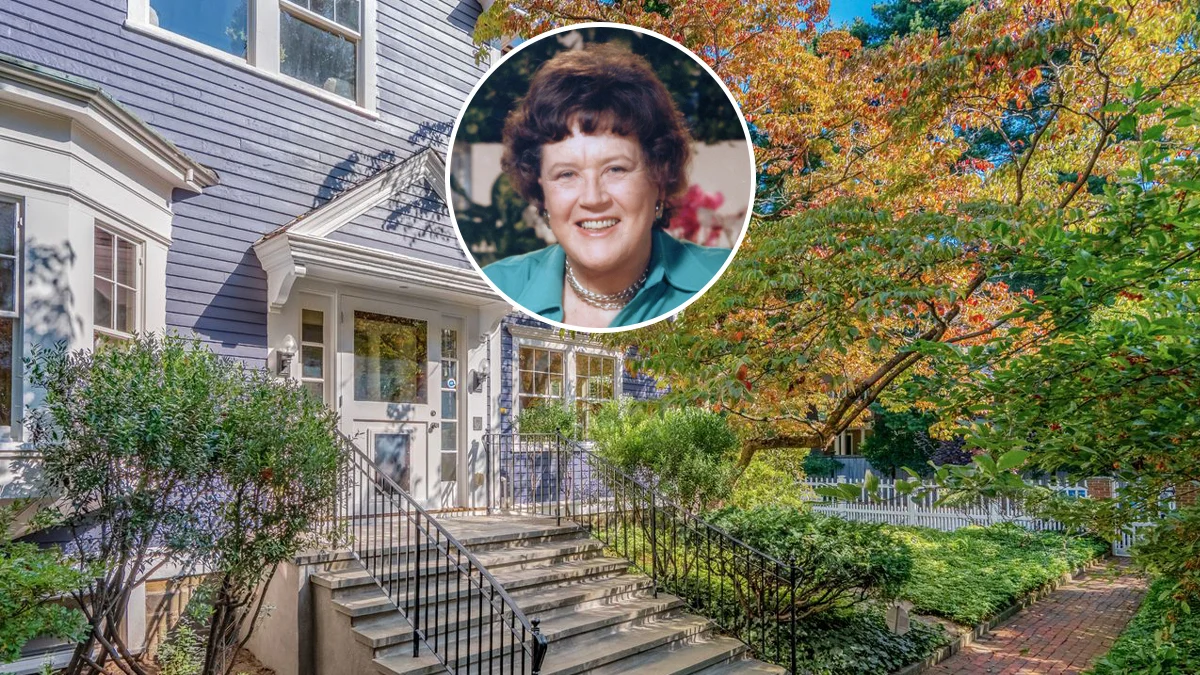
In the pantheon of American cultural icons, few domestic spaces have achieved the near-mythic status of the kitchen at 103 Irving Street in Cambridge, Massachusetts. For decades, this room served as the laboratory, stage, and sanctuary for Julia Child, the woman who demystified French cooking and brought the joy of the culinary arts into millions of American living rooms. Today, as the historic residence hits the market for $6.475 million, it stands as a testament to both the enduring legacy of a legend and the inevitable evolution of a home once defined by the scent of butter, garlic, and simmering stock.
A Legacy Relocated: The Smithsonian’s Grand Acquisition
The story of the kitchen’s departure from Cambridge is one of the most remarkable chapters in museum history. In 2001, as a 89-year-old Julia Child prepared to relocate to her home state of California, a delegation from the Smithsonian’s National Museum of American History traveled to Irving Street. Their initial ambition was measured: they hoped to secure a handful of artifacts—perhaps a few copper pots or a single knife—to represent Child’s contributions to American life in their permanent exhibition.
However, upon crossing the threshold into the 14-by-20-foot space, the curatorial team experienced a profound realization. The kitchen was not merely a collection of tools; it was an artifact in its own right, a living extension of Child’s personality and pedagogical mission.
"The kitchen revealed so much about Julia and her message," Paula Johnson, a curator specializing in the intersection of food and culture, remarked in a 2015 interview with Yankee Magazine. The team broached the idea of a total relocation with Child. She, ever the pragmatist and public servant, considered the millions who had tuned in to her programs. Her response was immediate and characteristic: she said yes to the American people.

Months later, the museum orchestrated a Herculean task: the extraction and transport of the entire kitchen. Over 1,200 objects—ranging from her heavy-duty Garland range and iconic pegboard wall to marrow scoops and a whimsical painting of cats and asparagus—were packed into 55 crates. Today, that reassembled space remains one of the most visited exhibits at the Smithsonian, a physical manifestation of a culinary revolution.
A Chronology of a Home: From Irving Street to History
The history of 103 Irving Street is deeply intertwined with the trajectory of the Childs’ lives. The couple acquired the lilac-hued, 1889 residence in 1956, during a period of transition. It wasn’t until 1961, following Paul Child’s retirement from the U.S. Foreign Service, that the couple moved into the house full-time.
For nearly four decades, the roughly 6,300-square-foot property served as their anchor. It was here that Julia honed the recipes for Mastering the Art of French Cooking, hosted countless dinner parties, and filmed segments that would redefine the medium of television cooking. The house was not just a home; it was a cultural hub where the intellectual energy of Harvard-era Cambridge met the refined, worldly sensibilities of the Childs.
Following Paul’s passing in 1994, Julia remained in the home for several years. Ever the philanthropist, she eventually gifted the property to her alma mater, Smith College, which subsequently sold the house to provide funding for a new campus center. A major renovation project in 2009 modernized the interior, and now, represented by Gail Roberts and Ed Feijo at Coldwell Banker Realty, the house enters a new chapter of ownership.

The Modern Residence: Preserving the Soul of the Estate
While the famous kitchen has been replaced by a sleek, contemporary culinary space, the home retains the architectural integrity and historical charm that defined the Childs’ tenure. The current iteration of the property is a sophisticated blend of 19th-century bones and 21st-century luxury.
Architectural Highlights
- The Culinary Evolution: The modern kitchen now features top-tier Poggenpohl cabinetry, polished marble countertops, and dual dishwashers. While the pegboard walls are gone, the space is designed for high-performance cooking, a subtle nod to its predecessor.
- The Butler’s Pantry: Perhaps the most evocative space in the home is the butler’s pantry. This area, where Paul Child once famously mixed evening martinis for friends and colleagues, has been transformed into a fully equipped caterer’s kitchen, retaining its functional importance while evolving its purpose.
- Living and Dining: The formal living and dining rooms maintain a sense of grandeur, flowing seamlessly through French doors into an intimate sitting room. The presence of a gas fireplace and custom built-in bookshelves creates an environment that feels both expansive and cozy.
Private Quarters and Amenities
The second floor hosts four bedrooms, including a sprawling primary suite. This retreat features a fireplace, a private balcony overlooking the grounds, and a walk-in closet with bespoke cabinetry. The uppermost level offers two additional bedrooms, including one with its own fireplace, and a dedicated workstation. The lower level has been finished into a walk-out basement that includes a state-of-the-art exercise room, a temperature-controlled wine cellar, and ample storage.
Official Recognition and Historical Context
The city of Cambridge recently acknowledged the home’s significance by installing an official historical plaque on the grounds. This serves as a permanent marker for fans of the culinary icon, ensuring that despite the interior renovations, the site’s historical weight is never forgotten.
The sale of 103 Irving Street coincides with a broader market interest in properties tied to Child. Just this past August, "Four Oaks," the Montecito, California estate where Child filmed her PBS series Dinner at Julia’s, was listed for just under $22 million. These listings highlight the ongoing fascination with the domestic lives of cultural figures; buyers are not just purchasing real estate, but a piece of the American narrative.

Implications for the Future of Celebrity Real Estate
The listing of the Julia Child house presents a fascinating case study in the preservation of "living history." When a home is stripped of its most famous artifacts—as was the case with the kitchen—how does it retain its value?
Real estate experts suggest that the "celebrity provenance" acts as a floor for the property’s value, but the long-term desirability is driven by the home’s ability to adapt. By modernizing the residence, the current owners have ensured that the house is a viable, high-end family home rather than a static museum piece. The preservation of the garden—designed by Paul and Julia—and the porte-cochère, where Julia famously unloaded her groceries, provides a tangible link to the past that transcends the interior design choices.
The challenge for the next owner of 103 Irving Street will be balancing the stewardship of a piece of American culinary history with the requirements of modern living. Given the high interest in the property, it is clear that the "Julia Child effect"—the aura of warmth, hospitality, and intellect—remains a powerful selling point.
Conclusion
As the sun sets on the current listing period, the house at 103 Irving Street remains a quiet, elegant witness to a life well-lived. While the copper pots and the familiar kitchen layout have moved on to the Smithsonian, the spirit of the home endures. Whether it is in the lush, mature gardens or the quiet corner of the butler’s pantry, the presence of the woman who taught America to eat well is palpable.

The home is more than a structure of wood and stone; it is a monument to a legacy that prioritized curiosity, community, and the sheer joy of a well-prepared meal. As it transitions to its next stewards, it carries the history of an era that changed the American palate forever, proving that some homes, much like the best recipes, only improve with time.
 Lina Hope
 Jia Lissa
 Ali Ikhwan
