

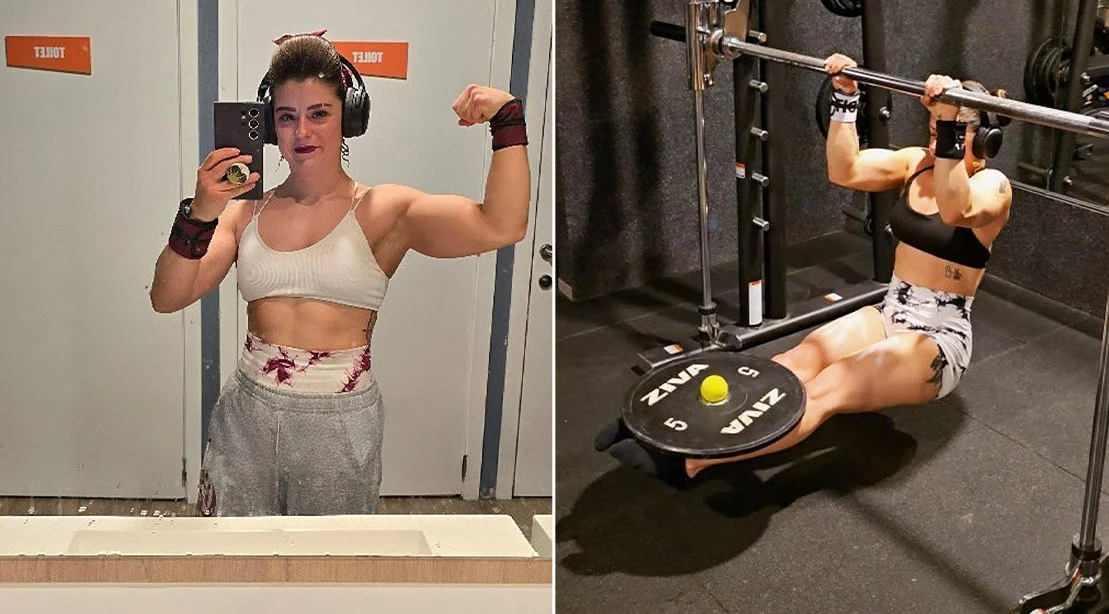
In the ever-evolving landscape of fitness trends, few movements manage to bridge the gap between circus-level acrobatics and functional strength training quite like the latest sensation sweeping the Instagram fitness community. Professional pole dancer and calisthenics athlete Laura Verberne, known to her 100,000+ followers as @x.hellnokitty.x, has officially set a new, daunting bar for core conditioning. Her latest video, featuring a hybrid movement she aptly dubs the “Diabolical Hanging Leg Raise Challenge,” has captivated onlookers, leaving even the most seasoned gym-goers questioning their own abdominal strength.
By fusing the classic hanging leg raise with the precision-based mechanics of a “ball-in-a-maze” puzzle, Verberne has created an exercise that demands more than just raw power; it requires neuro-muscular control, extreme stability, and the patience of a saint.
The Anatomy of the Challenge: A Breakdown of the Mechanics
To understand why this movement has been labeled “diabolical,” one must look at the physics involved. The exercise is a masterclass in controlled instability.
Step-by-Step Execution
The setup is deceptive in its simplicity:
- The Foundation: The athlete begins by positioning themselves underneath a standard pull-up bar.
- The Loading: A weighted plate is placed horizontally across the shins. This serves as the “maze” floor.
- The Variable: A single tennis ball is placed in the center hole of the weight plate.
- The Suspension: The athlete grips the bar and initiates a hanging leg raise, maintaining a straight-leg position throughout the movement.
- The Objective: While suspended, the athlete must manipulate the angle of their legs—and by extension, the weight plate—to keep the tennis ball from rolling off the edge. This requires subtle, constant micro-adjustments in hip, oblique, and core engagement.
As Verberne noted in her viral post, the movement is “unnecessarily difficult.” Even for an athlete of her caliber, the learning curve is steep. Her social media post, which included a collection of “bloopers,” served as a humble reminder that high-level fitness is rarely perfected on the first attempt.
Chronology of a Viral Fitness Trend
The rise of the “Diabolical” challenge is a testament to the speed at which specialized fitness content can permeate global training culture.
- Inception: The concept originated from fitness influencer and coach Emanuela, whose own training philosophy often leans into unconventional, movement-based challenges.
- The Adoption: Verberne, constantly seeking to push the boundaries of her pole-dancing and calisthenics regimen, identified the challenge as an opportunity to test her core stabilization.
- The Viral Surge: Upon posting the demonstration to her Instagram, the video saw an immediate spike in engagement. Within days, it moved from niche fitness circles into the mainstream, with users sharing the video as a benchmark for “next-level” abdominal training.
- The Community Reaction: The digital discourse shifted quickly from awe to competitive interest. Followers began tagging their gym partners, debating the physics of the movement, and questioning the feasibility of using heavier plates to increase the difficulty.
The Physiological Implications: Why Your Abs Are Screaming
While the visual spectacle of the tennis ball is what catches the eye, the physiological benefits of the exercise are profound. This is not merely a party trick; it is a high-tension stabilization drill.
Core Engagement and Beyond
The primary muscles recruited during this exercise include the rectus abdominis, which is forced to work isometrically to maintain the straight-leg hold, and the obliques, which act as the steering mechanism. Because the ball requires constant, minute adjustments, the core is never allowed to settle into a static hold.
Furthermore, the secondary muscle recruitment is substantial:
- Hip Flexors: Essential for maintaining the leg angle under load.
- Forearms and Grip: The duration of the sets required to complete the “maze” significantly taxes grip strength.
- Lats and Shoulders: These provide the rigid support structure for the entire kinetic chain.
- Quadriceps: Acting as the steering column, the quads must remain tight and controlled to prevent the plate from tilting uncontrollably.
Supporting Data: Stability Training in Modern Athletics
Sports scientists have long argued that core training should move beyond simple crunches and sit-ups. Research from organizations like the National Academy of Sports Medicine (NASM) suggests that "unstable surface training" can significantly improve neuromuscular efficiency.
When an athlete introduces an unstable element—like a tennis ball on a plate—the body is forced to recruit more motor units to stabilize the spine. This "reactive core training" is vital for athletes who require high levels of balance, such as gymnasts, pole dancers, and martial artists. Verberne’s challenge represents the extreme end of this spectrum, where the external load (the plate) and the high-precision requirement (the ball) converge to create a hyper-demanding environment for the central nervous system.
Official Responses and Public Sentiment
The response to the video has been a mixture of admiration and playful intimidation. For many, the challenge serves as a reality check regarding the state of their own conditioning.
“The lightest plate I own is 10 pounds. Oh no,” one follower lamented, highlighting the barrier to entry for the challenge. Another user remarked, “My core is trained just looking at it,” echoing a sentiment shared by thousands who viewed the content.
The professional fitness community has largely received the trend as a positive development in movement culture. By encouraging followers to step outside the traditional “3 sets of 15” mentality, influencers like Verberne are pushing the fitness industry toward more creative, functional, and engaging forms of movement.
The Broader Implications for Fitness Culture
The “Diabolical” challenge is symptomatic of a larger shift in the digital fitness space. As audiences become fatigued by repetitive, standard workout routines, there is a growing appetite for "skill-based" fitness. This trend emphasizes:
- Precision over Volume: It is no longer just about how many reps you can do, but how much control you can exert over your body.
- Gamification of Training: Incorporating elements of play—like the tennis ball maze—makes grueling physical tasks more mentally stimulating.
- Cross-Disciplinary Integration: The blending of pole dance, calisthenics, and traditional weightlifting demonstrates that the best results come from borrowing techniques across different athletic disciplines.
A Word of Caution: Should You Try It?
While the challenge is inspiring, experts warn that it is not for beginners. The strain placed on the lower back when holding a weighted leg raise is significant. Without a foundation of baseline core strength and proper form, attempting this movement could lead to lumbar strain.
Those looking to emulate Verberne are advised to:
- Master the basic hanging leg raise first, ensuring no swinging or momentum is used.
- Start without the plate and ball to practice the core-tightening technique.
- Use a lightweight plate to begin, focusing on the stability of the movement rather than the weight itself.
Conclusion: The Future of Functional Fitness
Laura Verberne’s “Diabolical” challenge is more than just a viral moment; it is a reminder that the human body is capable of extraordinary feats of coordination and strength when pushed to its limits. Whether or not you decide to balance a tennis ball on a weight plate at your next gym session, the challenge serves as an invitation to think differently about how we train.
As we move toward a future where fitness is increasingly defined by movement quality and neuro-muscular control, one thing is clear: the bar has been set. The only question remains—who will be the first to complete a full circuit of the maze? For now, we watch, we learn, and perhaps, we try it—carefully.
For those interested in following the latest in calisthenics and fitness trends, Laura Verberne continues to document her journey on Instagram at @x.hellnokitty.x.
 Lina Hope
 rifanmuazin
 Laily UPN
