

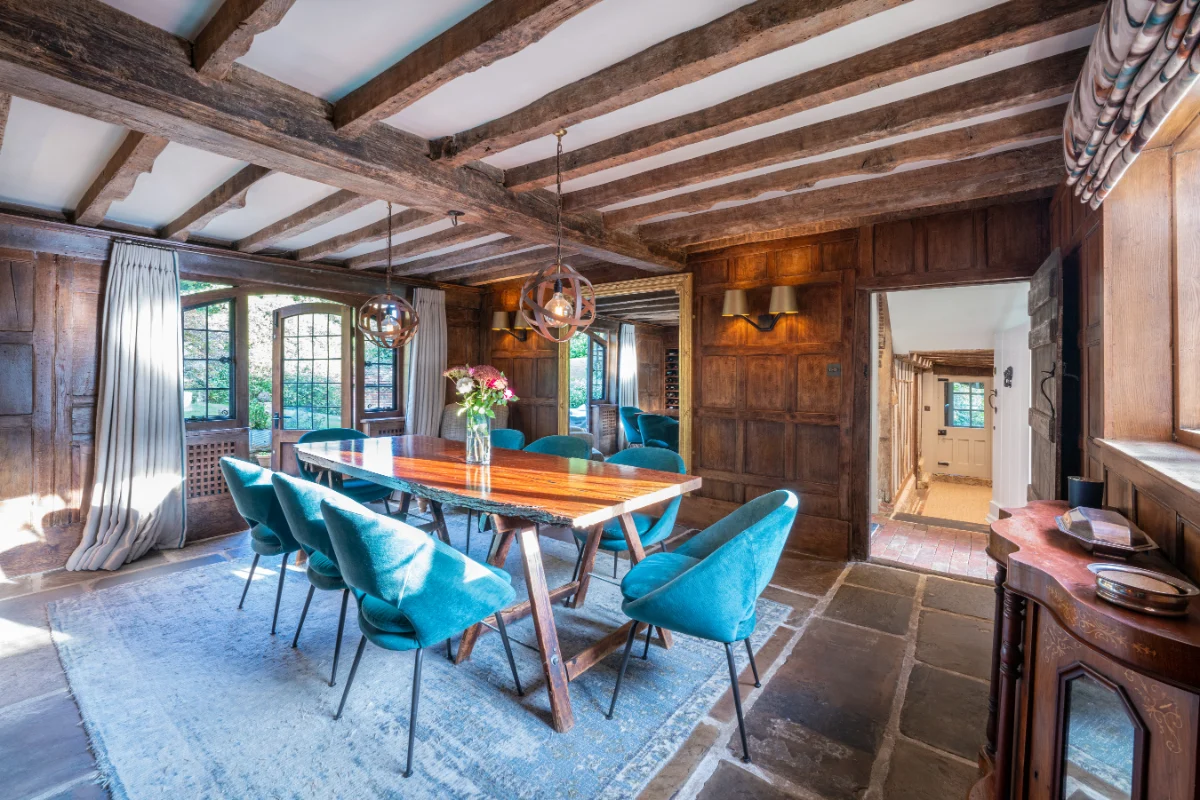
Deep within the verdant, mist-covered landscape of East Sussex, nestled on the northern edge of the historic Ashdown Forest, lies a property that serves as a bridge between two of the most iconic cultural legacies of the 20th century. Cotchford Farm, a Grade II-listed farmhouse dating back to the 16th century, is far more than a mere residence; it is a storied sanctuary where the gentle philosophy of Winnie-the-Pooh was birthed and where a troubled rock-and-roll icon sought a final, fleeting refuge from the global spotlight.
Today, this storied estate is available for lease, offering a rare opportunity to inhabit a space that once echoed with the rhythmic tapping of A.A. Milne’s typewriter and, decades later, the frantic energy of the Swinging Sixties.

Main Facts: A Time Capsule in East Sussex
Cotchford Farm is a masterclass in historical preservation. Spanning over 3,400 square feet across three floors, the residence maintains its architectural integrity through centuries of change. The six-bedroom home features an array of period-accurate details, including exposed timber beams that frame the ceilings, wide oak floorboards that bear the patina of centuries, and leaded-light windows that look out over the sprawling gardens.
The interior layout is expansive yet intimate. It boasts three dedicated reception rooms, a formal oak-paneled dining room, a private library for quiet contemplation, and a spacious, modernized kitchen that seamlessly integrates with the home’s traditional aesthetic. Every room tells a story, whether through the warmth of the original brick fireplaces or the panoramic views of the surrounding woodland, which remains largely unchanged since the 1920s.

A Chronological Journey: From Milne to the Stones
The Pooh Era (1924–1956)
The history of Cotchford Farm as a cultural touchstone began in 1924, when author A.A. Milne purchased the estate. Seeking a peaceful retreat from the burgeoning notoriety of his literary success, Milne turned the sitting room of the farmhouse into his creative sanctum.
It was here, amidst the quietude of the Sussex countryside, that Milne drew inspiration from the natural world surrounding his home. Accompanied by his son, Christopher Robin, and his son’s stuffed animal collection, Milne crafted the whimsical tales of the Hundred Acre Wood. The nearby woods, streams, and bridges—many of which remain identifiable today—became the blueprint for the landscapes explored by Pooh, Piglet, and Eeyore. For decades, the house was synonymous with the innocence of childhood literature, serving as the physical grounding for a world that has since captivated generations.

The Rock ’n’ Roll Transition (1968–1969)
In a stark tonal shift, the farmhouse transitioned from a site of literary tranquility to a den of rock-and-roll history in 1968. Brian Jones, the enigmatic founder and multi-instrumentalist of The Rolling Stones, purchased the property as he struggled to navigate the pressures of fame and the shifting dynamics of his legendary band.
Jones’s tenure at the farm was brief but remains a subject of intense historical fascination. It was within these walls that Jones reportedly received the news of his dismissal from the Rolling Stones, an event that marked the beginning of his final chapter. The estate was his retreat, a place where he could escape the chaos of London and the scrutiny of the press. Despite the tragedy that followed his residence, the physical space—particularly the swimming pool and the expansive gardens—retains the aesthetic imprint of the era, reflecting the complex duality of a man who lived a life of intense light and shadow.

Supporting Data: Architectural and Environmental Specifications
The property’s allure is not solely dependent on its famous inhabitants; it stands on its own as a significant architectural asset.
- Property Type: Grade II-listed, 16th-century farmhouse.
- Living Space: Approximately 3,400 square feet.
- Accommodations: Six bedrooms, three reception rooms, library, oak-paneled dining room, and kitchen.
- Historical Features: Original brick fireplaces, exposed timber beams, leaded windows, and antique oak flooring.
- Grounds: Set within the protected landscape of Ashdown Forest, the property includes manicured formal gardens, sweeping lawns, vibrant flower borders, and private woodland paths.
- Leisure Facilities: A heated outdoor swimming pool framed by wisteria and a private tennis court surrounded by mature trees.
The grounds themselves function as an extension of the living space. The connection to the landscape is intentional; the home’s orientation ensures that the gardens are visible from almost every room, blurring the lines between the interior and the enchanting, woodland-heavy exterior.

Official Responses and Market Context
The listing of Cotchford Farm via the agency Hamptons has generated significant interest among both literary historians and fans of rock-and-roll lore. The property is currently available for lease at £9,995 (approximately $13,470) per month.
Hamptons, the agency overseeing the lease, has highlighted the rarity of the offering. "To find a property with such a profound connection to two vastly different cultural movements is highly unusual," notes a representative from the agency. "It is not just a rental; it is a chance to live within a piece of history that continues to evolve."

The lease terms, which cater to both six-month and long-term residency, acknowledge the transient nature of modern living while providing a stable, historical anchor for prospective tenants.
Implications: Preserving a Dual Legacy
The ongoing maintenance of Cotchford Farm raises an important question regarding the preservation of "cultural estates." While the property serves as a functioning home, it carries the weight of public expectation. For many, it is a place of pilgrimage. The challenge for any resident of Cotchford is to strike a balance between modern functionality and the stewardship of a site that holds deep personal meaning for millions of people worldwide.

The Literary Impact
The enduring popularity of Winnie-the-Pooh ensures that the farmhouse remains a point of interest for academics and enthusiasts of children’s literature. The preservation of the sitting room—the very place where the stories were penned—is essential. It acts as a physical manuscript, documenting the creative process of an author who transformed simple walks in the woods into a global phenomenon.
The Musical Legacy
Conversely, for the music industry, the estate is a monument to the volatile, creative intensity of the 1960s. The fact that the swimming pool and gardens remain largely as they were during Brian Jones’s stay allows for a tangible connection to a pivotal moment in rock history. It is a reminder of the human cost of stardom and the search for peace in the face of immense public pressure.

A New Chapter
As Cotchford Farm enters its next chapter, the property serves as a living museum of sorts. It does not demand that its occupants be historians or fans; rather, it offers a space of profound character. Whether one is drawn to the soft, honey-dipped nostalgia of Milne’s forest or the rebellious, haunting echoes of the Rolling Stones, the house stands as a testament to the idea that some places are simply built to hold history.
For those looking to secure a lease at this unique address, the experience promises more than just luxury living. It offers the chance to walk the same paths as the inhabitants of the Hundred Acre Wood and the pioneers of British rock. In the quiet corridors of this 16th-century farmhouse, the whispers of the past are not ghosts, but part of the foundation—a legacy that continues to resonate, undisturbed, in the heart of East Sussex.
 Ali Ikhwan
 Laily UPN
 Raul Delapena Setiawan
