

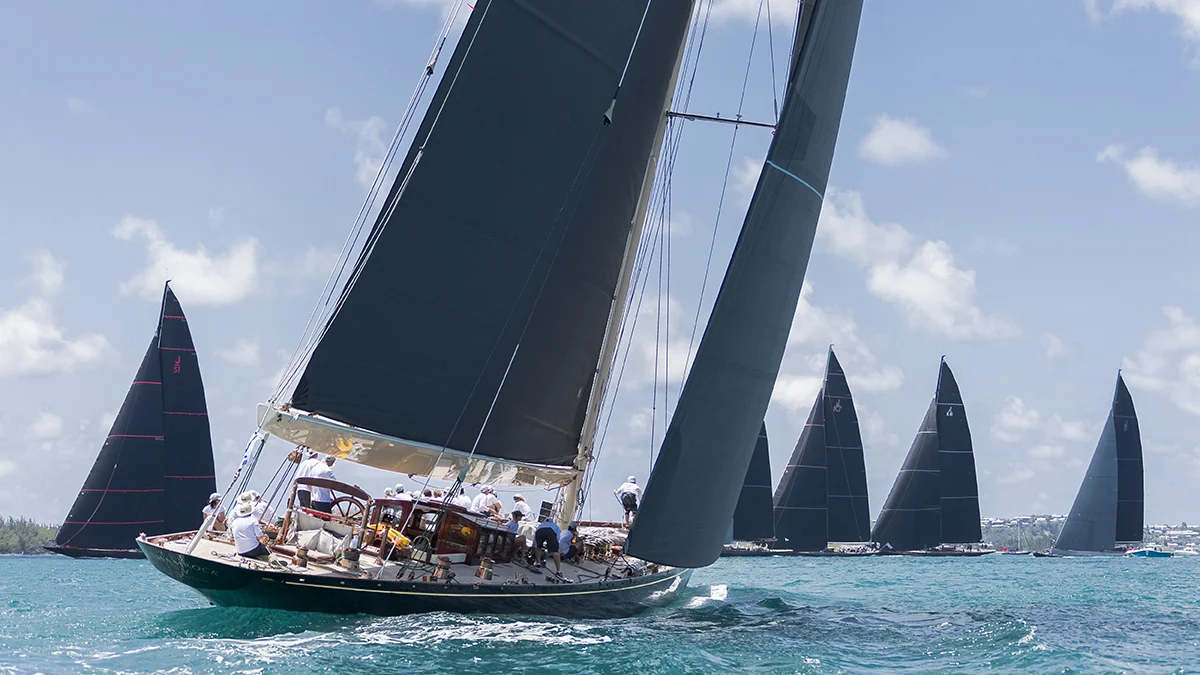
When the J-Class yachts unfurl their sails—deploying up to 7,500 square feet of canvas—the already striking vessels become an impossible sight to ignore. These towering spinnakers, genoas, and mainsails billow above sleek, curved hulls that evoke a bygone era of nautical dominance. Introduced nearly a century ago, the sight of a 120-to-140-foot J-Class yacht remains one of the most evocative spectacles in the maritime world. As a 25-person crew moves in the choreographed precision required to pilot these leviathans, one is transported back to the golden age of the America’s Cup.
Today, the sailing world is witnessing a remarkable resurgence of these vessels. A fleet comprised of both historic survivors and modern, high-tech replicas is currently descending upon the Mediterranean, signaling a new chapter for the class. This navy includes a fresh group of passionate owners, many of whom have traded the comforts of the superyacht lounge for the intensity of the helm, proving that the J-Class remains the ultimate vessel for those who view sailing not just as a pastime, but as a pursuit of perfection.
The Anatomy of a Legend: Main Facts and Technical Prowess
To understand the allure of the J-Class, one must first appreciate the engineering paradox they represent. These yachts are simultaneously delicate in their aesthetic beauty and brutal in their physical demands. Ranging between 119 and 140 feet in length, they possess a slender, graceful profile that cuts through the water with unmatched elegance.
The technical specifications are staggering. These are not modern, lightweight carbon-fiber speedsters; they are massive, heavy-displacement yachts that require a specialized skillset to maneuver. A crew of 25 is standard, working in a symphony of winches, halyards, and sheets to manage a sail plan that can dwarf a residential house in surface area.
"To see four, five, or seven yachts racing is simply so beautiful it takes your breath away," says Louise Morton, class secretary of the J-Class Association. This sentiment is shared by the new generation of stewards, who accept the astronomical costs of support and maintenance—costs that would deter even the most dedicated yachting enthusiasts—as the price of preserving a vital piece of maritime heritage.
A Chronology of Resilience: From the 1930s to the Present
The history of the J-Class is a tale of glory, decline, and miraculous rebirth. In the 1930s, these yachts were the pinnacle of naval architecture, commissioned by the wealthiest titans of industry to compete in the America’s Cup. Ten original yachts were built, but the passage of time and the ravages of war were unkind. By the end of the mid-20th century, six of the American-built boats had been broken up for scrap. Only three British-built hulls survived: Shamrock V, Endeavour, and Velsheda.
The modern renaissance began in the 1980s, when stateside heiress Elizabeth Meyer undertook the monumental task of restoring Shamrock V and Endeavour. Her vision proved that these aging ladies could not only be saved but could compete at a world-class level once again.
This sparked a trend of "archaeological sailing." Today, the fleet has grown through the commissioning of modern replicas based on original blueprints—some of which remained unrealized for nearly eight decades. Svea, for instance, was built in 2017 based on 1937 designs from a Swedish naval architect. At 143 feet, it is the longest J-Class yacht ever constructed, marking the bridge between 1930s engineering and 21st-century performance.
The Modern Fleet: Who is Steering the Giants?
The current revival is driven by a group of owners who are as much historians as they are sportsmen. The armada currently gathering in the Mediterranean represents a fascinating blend of original heritage and modern precision.

- Rainbow: A 2012 replica of the 1934 original commissioned by railway tycoon Harold Vanderbilt. It is now under the stewardship of Peter Harrison, C.E.O. of Richard Mille EMEA.
- Hanuman: A 2009 replica of the 1937 Endeavour II. Originally commissioned by Netscape founder Jim Clark, it is now piloted by Italian sailor Giovanni Lombardi Stronati.
- Svea: The current benchmark for speed and length. Owned by Swedish entrepreneur Niklas Zennström, Svea has enjoyed sustained success since its launch, regularly clashing with the likes of Rainbow and Lionheart on the regatta circuit.
- Shamrock V: Recently restored to its former glory, this legendary vessel completed a four-and-a-half-year, 247,000-man-hour restoration. Its owner, a longtime sailor, describes the experience of helming the boat as "honoring the elements and the core of our sport."
Supporting Data: Engineering the Future of the Past
The secret to the longevity of the J-Class lies in the hybrid approach taken by naval architects, most notably the Dutch firm Dykstra. When rebuilding or commissioning a replica, the goal is not to reinvent the boat, but to optimize its potential.
While the exterior lines remain strictly faithful to the original 1930s plans—maintaining that "styling that always works," according to Dykstra’s Wick Hillege—the guts of the ships have been modernized. Modern J-Class yachts utilize:
- Advanced Aluminum Hulls: Replacing the traditional steel or wood, offering better strength-to-weight ratios.
- Composite Rigging: Allowing for higher tension and more efficient sail shapes.
- Integrated Modern Systems: Sophisticated hydraulics and navigation tech that allow a smaller crew to manage the immense power of the sails.
The result is a vessel that is faster and more reliable than the originals, yet retains the "feel" that made them icons in the first place. The feasibility of these vessels for cruising is also a major point of pride. Velsheda has traversed the Panama Canal, and many others have logged thousands of nautical miles, proving that these are not merely "dock queens" but robust, seaworthy vessels.
Official Responses and Strategic Outlook
The industry’s perspective is clear: the J-Class is not just a class of boat; it is a brand of excellence. "We focus on making sure their maximum performance potential can be achieved," says Hillege. This focus on performance ensures that the racing remains fierce. When these boats meet at events like Les Voiles de Saint-Tropez or the Superyacht Cup Palma, the competition is as intense as it was during the height of the America’s Cup in the 1930s.
The implication of this investment is profound. By continuously pouring resources into the J-Class, these owners are funding the preservation of naval history. There are even plans to expand the fleet further; a replica of the 1930 defender Yankee is currently under construction. If completed, this would bring the active fleet to 10 vessels, matching the historic count of the 1930s circuit.
Implications: A Legacy in Motion
The revival of the J-Class serves as a powerful testament to the intersection of luxury, heritage, and high-performance sport. In an era dominated by rapid technological obsolescence, the J-Class offers something unique: a platform where a person can touch the same deck and hoist the same canvas that sailors did nearly a century ago.
As Shamrock V prepares for a guest appearance at the 38th America’s Cup in Naples, the message to the sailing world is clear: the giants have returned. These vessels are no longer just artifacts of a bygone era, but active, competitive, and breathtaking participants in the modern regatta circuit.
For the owners, the reward is not found in the trophy cabinet alone, but in the visceral experience of the wind hitting the sails. As one owner remarked, there is an "ear-to-ear grin" that comes from sailing in a blow, a feeling that connects the modern tycoon to the industrialist of the 1930s. Whether they are cruising the Mediterranean or locked in a tactical battle off the coast of Saint-Tropez, the J-Class yachts continue to prove that true elegance is timeless, and true power, when properly rigged, never goes out of style.
 Nana Muazin
 Siti Muinah
 Lina Hope
