

In the storied history of Pixar Animation Studios, few franchises have managed to mirror the cultural zeitgeist quite like Toy Story. What began in 1995 as a groundbreaking exploration of childhood imagination has matured alongside its audience. Now, with the highly anticipated Toy Story 5, the series embarks on its most ambitious narrative leap yet: an existential battle between the tactile, enduring magic of classic toys and the all-consuming, data-driven allure of modern technology.
Directed by industry veteran Andrew Stanton—the visionary behind Finding Nemo and WALL-E—the fifth installment shifts the focus from the bedroom walls of Andy’s childhood to the complex, fragmented landscape of a generation raised on tablets and virtual connectivity. As cowgirl Jessie (voiced by Joan Cusack) finds herself at the center of this conflict, the film asks a haunting question: Can imagination survive in a world where play is increasingly digitized?
The Core Conflict: Toys vs. Tech
The primary catalyst for the film’s tension is Lilypad, an energetic, multi-functional tablet voiced by Greta Lee. For 8-year-old Bonnie (Scarlett Spears), Lilypad is more than just a device; it is a gateway to friends, virtual games, and an infinite stream of content. The problem, as the film illustrates, is that devices strip away the necessity of physical, creative engagement. Where Woody and his cohorts relied on a child’s projection of personality and narrative, modern devices provide the stimulation directly, leaving little room for the "old-school" magic of toy-based play.

Stanton, who has served as a story architect for every previous entry, has taken the helm for this sequel with a decidedly philosophical bent. The film explores the life cycle of toys not merely as a narrative device, but as a reflection of how time and technology alter the human experience. The film posits that while one cannot "defeat" technology, the inherent value of a toy lies in its ability to foster a unique, physical bond that a screen can never replicate.
A New Voice at the Helm
Recognizing the need for a fresh perspective, Stanton recruited story artist Kenna Harris—known for her work on Luca, Inside Out 2, and the Luca short "Ciao Alberto"—to serve as co-writer and co-director. This creative pairing was strategic. While Stanton represents the legacy and "Yoda-like" wisdom of Pixar’s foundational era, Harris brings a contemporary lens that understands the nuances of growing up in a world where screens are ubiquitous.
"Andrew says it best all the time: the toys are like little vampires," Harris shared in an exclusive interview with Gold Derby. "He comes from a different era of playtime, and I grew up with a little bit of tech. So, we both knew going into this movie that he’s got a ‘Woody’ vibe and I’ve got that ‘new sheriff in town’ kind of vibe, bringing in new ideas to bridge that gap."

Chronology of an Existential Crisis
The film’s narrative arc is structured around the tension of the toys witnessing their children grow up at an accelerated pace. Harris highlights the beauty of the Toy Story franchise’s ability to handle the passage of time. Unlike most animated films that exist in a vacuum, Toy Story has always been tethered to the reality of its human protagonists.
In this chapter, the stress felt by the toys is palpable. They are not merely competing with other toys; they are competing with a "Swiss army knife" of digital capability. Lilypad represents a threat to their very existence because it offers an instant gratification that toys simply cannot compete with. However, the production team, including producer Lindsey Collins, notes that the film avoids making technology a "villain" in the traditional sense.
"Tech does provide connection, obviously, and that’s what sells it and what everybody buys into," Collins explains. "We show the benefits of tech, but these are either short-lived or very surface. The goal was to highlight that while tech is convenient, it lacks the depth of the physical, imaginative connection that toys provide."

Redefining Playtime: Bonnie’s "Gremlin" Energy
One of the most distinct departures in Toy Story 5 is the shift in how Bonnie’s playtime is visually and narratively represented. Unlike the hyper-real, grand adventures of Andy’s imagination, Bonnie’s playtime is described as tactile, ephemeral, and intentionally "handcrafted."
Harris and her team leaned into the reality of how young children play today. "We wanted to celebrate that Bonnie is a little gremlin and that she’s chaotic," says Harris. "Girls often want to replicate experiences they see in the adult world. They revel in the drama, but they also get weird."
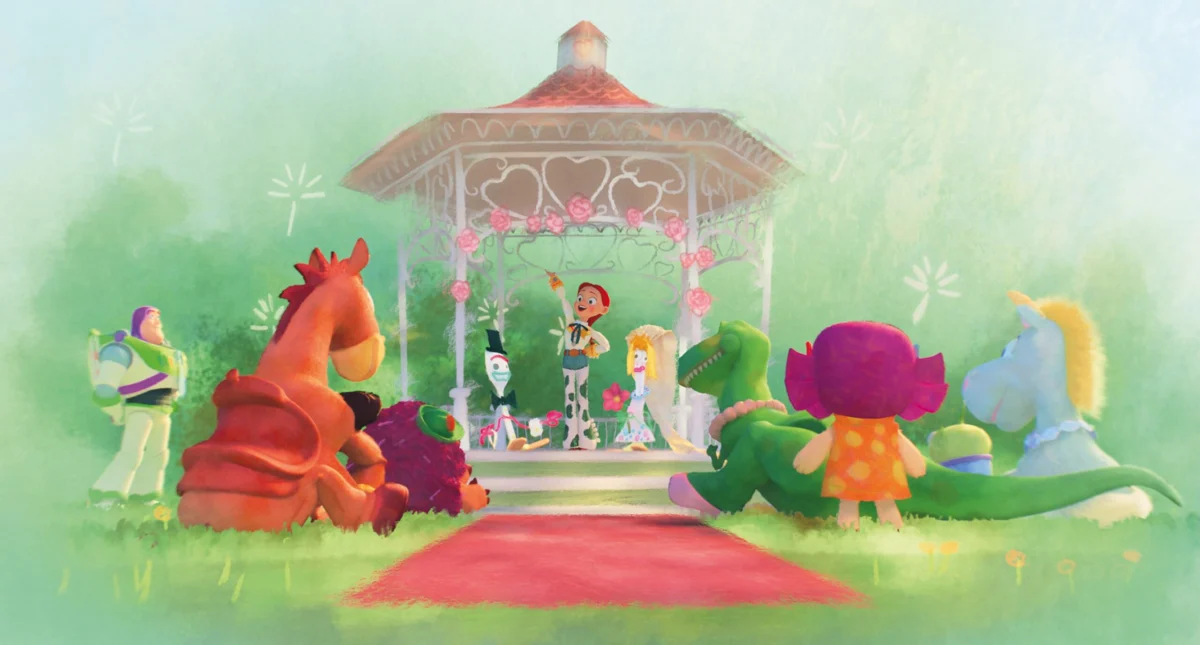
This manifests in scenes like a wedding ceremony featuring Forky (Tony Hale) and Karen Beverly (Melissa Villaseñor). The aesthetic is intentionally raw, resembling chalk drawings or handmade art, which underscores the personal, messy nature of a child’s mind. The scene turns dark and dramatic when Rex (Wallace Shawn) is "poisoned" and Buzz Lightyear (Tim Allen) attempts life-saving CPR. These segments are not just comic relief; they are the heart of the film, showing the specific way a child imbues their toys with life.

The Life Cycle of Toys: Obsolete and Modern
Toy Story 5 broadens its scope by looking at the entire spectrum of the toy life cycle. On one end, there is the "old-timer" contingency, represented by Jessie and a group of "obsolete" devices that live on a ranch—the former home of Jessie’s original owner, Emily.
These characters include:
- Smarty Pants (Conan O’Brien): A rundown, electronic potty-training toy.
- Atlas (Craig Robinson): A cheerful, GPS-equipped hippo.
- Snappy (Shelby Rabara): An excitable, dated toy camera.
These characters contrast sharply with the arrival of 50 high-tech, mass-produced Buzz Lightyears, all voiced by Tim Allen. These Buzzes are "shipwrecked" in the house, searching for a mission they don’t yet understand.

"Blaze (a new character voiced by Mykal-Michelle Harris) is slightly older than Bonnie," Harris notes. "Her playtime has more nuance. She wants high stakes, romance, murder, and a hard twist. That’s what we wanted to capture—the evolution of imagination."
Official Responses and Creative Philosophy
The decision to include so many versions of Buzz Lightyear was, according to the creative team, a quintessential "Stanton" move. While the logistical challenges of writing for 50 versions of the same character were immense, the thematic payoff was clear.
"Andrew would often tell us, ‘I know this is going to work, I just don’t know how yet. So, for now, just trust me,’" Harris recalls. The production team placed their faith in the idea that these characters would serve as a mirror for the audience’s own relationship with technology.

Producer Lindsey Collins adds that the film’s strength lies in its refusal to be binary. "We aren’t saying tech is bad. We are saying that as we move forward, we have to be conscious of what we are losing. The ‘infinite’ qualities of a toy—its ability to be whatever a child needs it to be at any given moment—is something no algorithm can replicate."
Implications for the Future of Pixar
The implications of Toy Story 5 are significant for both the franchise and Pixar as a studio. By tackling the transition from analog to digital, Pixar is addressing the very platform that made them famous. The film acts as a meta-commentary on the medium of animation itself.
As the film moves toward its conclusion, it centers on the idea of "bridging the gap." Lilypad, the digital antagonist, is not an embittered castoff like Lotso or Stinky Pete. She is, as Harris describes, "data-driven" and "well-intentioned." This nuance suggests that the future of play—and perhaps the future of storytelling—is not about choosing between the screen and the physical world, but finding a way to integrate the two without losing the "soul" of the experience.

Toy Story 5 stands as a testament to the fact that while the tools of play may change, the fundamental human need for narrative, empathy, and creative projection remains constant. By pitting the enduring spirit of Jessie against the flickering, rapid-fire nature of Lilypad, Stanton and Harris have created a film that is as much about the survival of the creative spirit as it is about the toys themselves. Whether this serves as the definitive end to the series or a pivot to a new era, Toy Story 5 ensures that the legacy of Pixar’s most iconic franchise remains as relevant as it was in 1995.
 Ammar Sabilarrohman
 Siti Muinah
 Iffa Jayyana
