

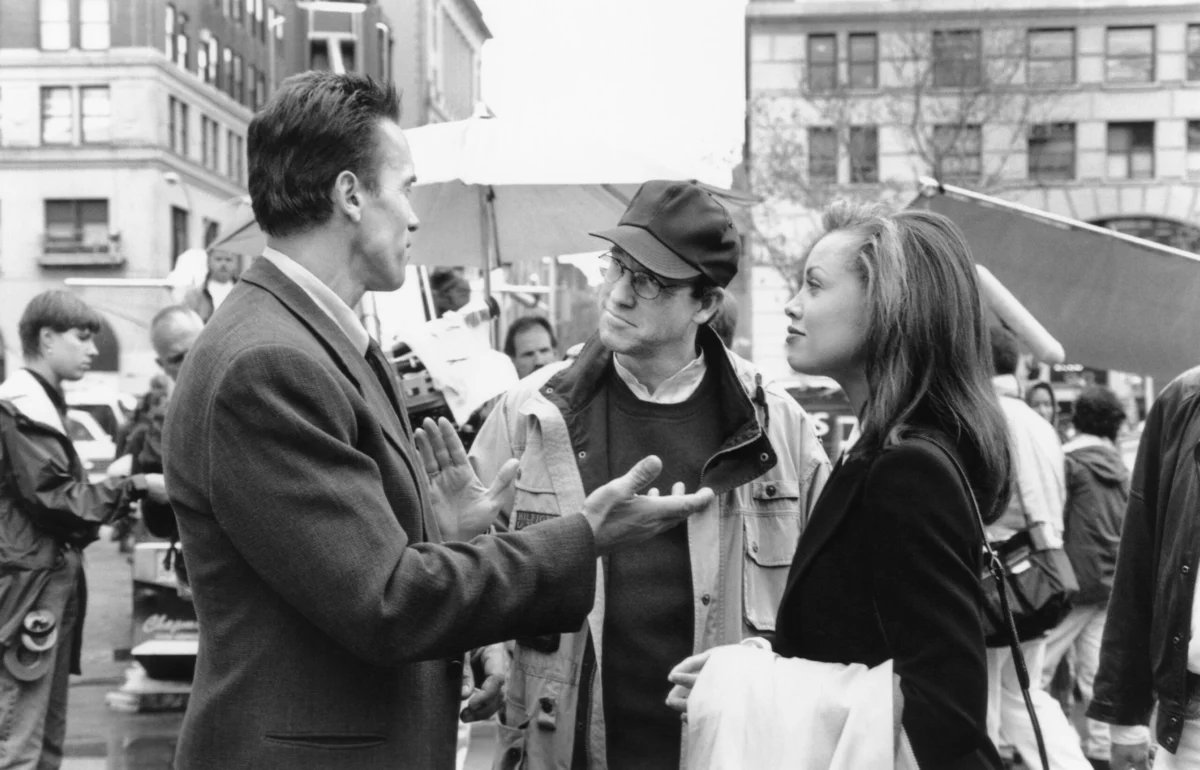
When it comes to the pantheon of action cinema, few stars have curated a vocabulary of violence as iconic as Arnold Schwarzenegger. From the icy, rhythmic delivery of "Hasta la vista, baby" to the savage, pun-laden "Consider that a divorce," the Austrian Oak turned the "parting shot" into an art form. Yet, thirty years after the release of Chuck Russell’s Eraser (1996), one line stands as the pinnacle of his mid-90s bravado. Standing over a defeated, rampaging crocodile in a flooded zoo, Schwarzenegger’s U.S. Marshal John Kruger delivers the definitive final word: "You’re luggage."
As Eraser arrives on 4K UHD from Warner Bros., the film serves as a fascinating time capsule. It was a bridge between the practical-effect heavy era of the late 80s and the CGI-augmented spectacles that would come to define the turn of the millennium. Released on June 21, 1996, Eraser was a muscular, hyper-real vehicle that dared to compete with the industry’s most ambitious blockbusters, including Mission: Impossible, Twister, and Independence Day.
The Genesis of a Hyper-Real Blockbuster
In the summer of 1996, the multiplex was a battleground for the evolution of the blockbuster. Brian DePalma’s Mission: Impossible had redefined the espionage thriller, while Jan de Bont’s Twister pushed the boundaries of natural disaster spectacle. Against this backdrop, Eraser arrived with a singular mission: to provide the ultimate showcase for Schwarzenegger’s indestructible, one-man-army persona.
Director Chuck Russell, whose career spans the cult-horror sensibilities of A Nightmare on Elm Street 3: Dream Warriors to the kinetic energy of The Mask and the sword-and-sandal grit of The Scorpion King, took the helm with a specific vision. He wanted to strip away the "realistic" constraints of the original script and push the film into a realm of heightened, hyper-real action.
"As a director, I’m very hands-on with the script, and there were three things that I specifically needed to say yes to doing Eraser, and Arnold helped me get them," Russell recalls. "The original script was pretty straightforward and tried to be realistic—Arnold only had a handgun and his fists. It was interesting, but he’d done that before. I came up with concepts that would support the tone of the film while pushing the envelope."

Chronology of Destruction: The Zoo and The Sky
To understand the mechanics of Eraser, one must look at its two most ambitious set-pieces: the New York City Zoo sequence and the mid-air plane rescue. Both sequences were designed to handicap the protagonist, forcing the audience to wonder how an unarmed man could possibly survive.
The Reptile House
In the zoo sequence, Kruger is tasked with protecting Vanessa Williams’ character from a legion of mercenaries. Russell’s choice to arm Schwarzenegger with only two bullets—forcing him to improvise with the environment—was a deliberate effort to level the playing field.
"With stars like Arnold and Dwayne Johnson, part of the problem is that you need to level the playing field, or they could just walk through a wall," Russell explains. "So, in the case of the zoo scene, we gave Arnold only two bullets and three bad guys to kill."
The sequence also famously features a water tank blast that bears a striking resemblance to a set-piece in Mission: Impossible. Russell notes the temporal coincidence with a laugh: "Tom Cruise is a friend—I executive produced Collateral—and that movie was shooting at the same time we were. The tones of the two films are very different, so I don’t think they bumped into each other much. Both were good, fun films that pleased the audience."
The Airplane Sequence
The film’s 11-minute aerial centerpiece remains one of the most audacious sequences of the decade. It begins with hand-to-hand combat in a cargo plane and culminates in a gravity-defying skydive. Russell’s goal was to establish a "promise" to the audience: provide an impossible setup and deliver a plausible, albeit hyper-real, escape.

"Arnold specifically says to Jimmy Caan at the top of the scene, ‘Drop the gun or I will kill you.’ He’s just been drugged, he’s unarmed, and he’s got all these goons around him," says Russell. "That gives the audience a moment to think, ‘There’s no way that he’ll get out of this.’ That’s my promise to the audience."
Behind the Scenes: Practicality vs. The Digital Frontier
The production of Eraser was a transitional experience for the crew, particularly regarding the use of animals and visual effects. The crocodile sequence, in particular, presented significant challenges.
"There were real crocodiles on the set on the first day," Russell recounts. "I told them, ‘He’s beautiful, but do not bring him onto my set. I know they’re not trainable animals.’ We ultimately relied on a mixture of mechanical crocs and CGI. The CGI ones are a real riot. I knew they didn’t have to look cartoon-y based on what Steven Spielberg was doing with Jurassic Park, but it was all very last-minute."
Despite the time constraints that forced the use of early-era CGI, the scene retains a certain charm. When asked about the iconic "You’re luggage" line, Russell takes ownership of the quip. "I wrote that punchline. There was no way it was ever going to change because it was one of Arnold’s favorite lines. He would occasionally tease me about it, but we both knew it was good stuff for Arnold. He liked the one-liners a little too much."
The Physicality of the Lead
A defining element of Eraser is the sheer physical commitment of its star. While stunt doubles and visual effects handled the most dangerous aspects of the skydive, Schwarzenegger performed his own close-up work on a state-of-the-art descender rig.

"Arnold didn’t do the skydiving, but he was on a descender rig for the close-ups," Russell explains. "He dropped at least 50 feet on that rig from the highest soundstage ceiling at Warner Bros. That rig was brand new at the time, and you’d get to free-fall speed, but there was a braking system that stopped you without getting you killed. Arnold was athletic enough to do it."
The stunt team, led by Jeff Jones and parachute specialist Guy Manos, were instrumental in ensuring the sequence didn’t just look dangerous—it felt dangerous. Russell recalls a moment where the practical effects nearly went wrong: "I’d scripted it so that Arnold’s character would get tangled up in the parachute silk. Guy [Manos] was diving at such a velocity that the breakaway silk wasn’t breaking away. It looks exaggerated on screen, but Guy was really trying to get out! Fortunately, it only lasted a couple of seconds and everyone was safe."
Implications: A Last Hurrah for the 90s Action Hero
Looking back, Eraser represents a "last hurrah" for a specific iteration of the action star. By the following summer, the genre would undergo a massive shift toward the campy aesthetic of Batman & Robin, a film that famously undermined the gravity of the genre with cringe-inducing puns.
Eraser occupies the sweet spot of the 90s: it was high-budget, star-driven, and possessed enough self-awareness to be fun, yet it remained committed to the "hyper-reality" that defined the era. For Russell, the film’s longevity is a testament to the tools and the talent available at the time.
"I like to compare that scene to the James Bond pictures, which have a lot more money and resources," Russell reflects. "But prior to Eraser, the Bond movies hadn’t really done a scene like that. I was looking for new territory to explore in an action film, and we put a lot of our time and money into that sequence. Those were the tools we had in the 90s, and I was amazed to see how well it worked 30 years later."

As modern audiences revisit Eraser through its crisp, 4K restoration, the film stands as a reminder of a time when the action was practical, the heroes were indestructible, and the luggage was always waiting to be claimed. It is a cinematic relic that, much like its protagonist, refuses to be erased.
 Nana
Nana
 Asro
Asro
 Ammar Sabilarrohman
