

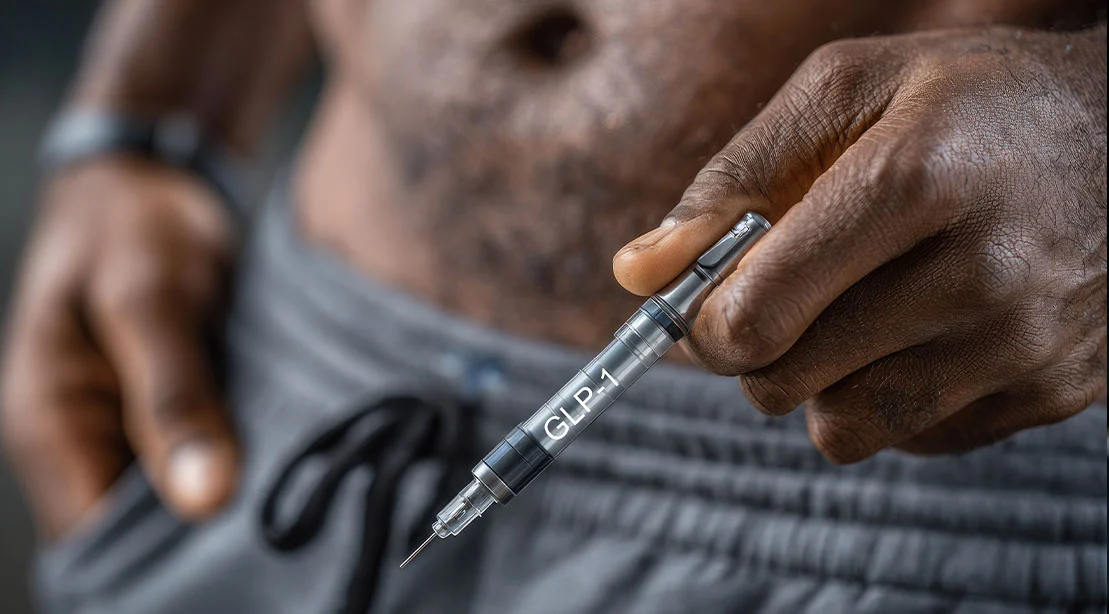
Walking through any major airport terminal today, the evidence of a pharmaceutical revolution is impossible to ignore. Among the bustling crowds, there is a visible subset of travelers who appear to have undergone a rapid physical transformation—people who look as though they left forty pounds of body weight behind in the parking garage. The ubiquity of GLP-1 receptor agonists—Ozempic, Wegovy, Mounjaro, and Zepbound—has transcended the clinical environment to become a defining cultural phenomenon of the 2020s.
However, as these drugs reshape the silhouettes of millions, a fierce debate has emerged within the fitness and bodybuilding communities. The prevailing critique is as blunt as it is persistent: "Yeah, but those drugs eat your muscle." As society grapples with an obesity epidemic, the intersection of pharmacological weight loss and physical performance has become the most contentious topic in health science.
The Science of the Lean-Mass Debate
To understand whether GLP-1 medications are "muscle-wasters," one must first look at the data. A comprehensive 2026 meta-analysis, which examined 20 randomized clinical trials involving 15,782 participants, provides a clarifying perspective on the phenomenon of lean-mass loss during pharmaceutical treatment.
The study compared the loss of lean tissue against the use of semaglutide, tirzepatide, and liraglutide, contrasting these results with traditional lifestyle-based weight loss programs. The findings were stark: lean tissue represented approximately 35% of the total weight lost for those on semaglutide, 25% for those on tirzepatide, and 27% for those on liraglutide.
On the surface, these percentages appear alarming. However, when placed in the context of standard weight-loss interventions, the numbers lose their "horror" factor. In control groups utilizing only diet and exercise, approximately 26% of the weight lost was lean mass. This suggests that the loss of lean tissue is not a unique, malicious side effect of the GLP-1 molecule itself, but rather a biological reality of rapid weight loss through caloric restriction. When the body sheds a significant amount of weight, it rarely does so in a vacuum of pure adipose tissue.
Chronology of the GLP-1 Revolution
The rise of GLP-1 agonists did not happen overnight, but its trajectory has been meteoric.
- Early Development: Originally synthesized for the management of Type 2 diabetes, GLP-1 receptor agonists were designed to stimulate insulin secretion and suppress glucagon release.
- The Clinical Pivot: Researchers soon observed that the secondary effect—profound appetite suppression—could be leveraged for obesity management.
- FDA Approvals: Following successful trials, drugs like Wegovy (semaglutide) and Zepbound (tirzepatide) received FDA approval for chronic weight management, triggering a global shortage and a shift in how medicine approaches metabolic health.
- The 2026 Shift: Current research has moved beyond basic efficacy, focusing now on body composition, physical function, and long-term health outcomes for specific populations, including pediatric patients.
- The Pediatric Frontier: Most recently, Novo Nordisk reported that a late-stage trial for semaglutide in children ages 6 to 12 met its primary BMI endpoints. While not yet FDA-approved for that age bracket, the data suggests that pharmacological intervention may become a standard, life-long approach for metabolic management starting in early childhood.
The Role of Resistance Training in Preservation
If the loss of lean mass is inevitable during rapid weight reduction, the question for the athlete becomes: how do we mitigate the damage? The 2026 meta-analysis offered a clear, if unsurprising, solution: resistance training.
When resistance training was incorporated into the lifestyle interventions, lean tissue accounted for only 17.5% of the weight lost—the lowest rate of muscle loss recorded in the study. This data serves as a powerful rebuttal to the narrative that these drugs and weightlifting are mutually exclusive.
A secondary 2026 analysis examining the combination of structured exercise and GLP-1 medication confirmed that this hybrid approach produced the most significant improvements in body composition. By combining the appetite-regulating effects of the drug with the muscle-building stimulus of resistance training, patients can achieve a superior metabolic profile, shedding fat while retaining the contractile tissue necessary for long-term health and mobility.
Why the "Muscle-Wasting" Myth Persists
The concern regarding muscle loss is rooted in a fundamental misunderstanding of the mechanism of action. GLP-1 drugs do not contain a "muscle-dissolving" ingredient. Instead, the problem is behavioral.
These medications are exceptionally effective at their primary job: silencing the "food noise" that drives overeating. When appetite is blunted, caloric intake drops precipitously. If the patient is not intentional about their protein intake, they will inevitably fall into a deep caloric deficit. Furthermore, the lethargy that often accompanies rapid weight loss can lead to a decrease in training intensity.
If an individual loses 50 pounds while providing their body with no nutritional or mechanical incentive to retain skeletal muscle, the body will naturally sacrifice that muscle. It is not being "eaten" by the drug; it is being shed by a body that no longer feels it needs to support the weight of that tissue.
Nuance in "Lean Mass" Measurements
Another critical wrinkle in the discourse is the definition of "lean mass." In clinical settings, lean mass is often measured via DXA scans. However, "lean mass" in this context is not synonymous with "contractile muscle tissue." It includes water, glycogen, connective tissue, and organ weight.
Recent reviews indicate that while GLP-1 treatment does result in a reduction of these measurements, the reduction in fat mass consistently outweighs the loss of lean tissue. Crucially, the evidence has not yet shown a consistent correlation between these reductions and a decline in actual strength or physical function. This suggests that the "atrophy" feared by many may, in some cases, simply be a reduction in water retention and inflammation associated with a high-body-fat state.
The Path Forward: Implications for Health
The polarization of this issue has created two unhelpful camps. On one side, "GLP-1 evangelists" who celebrate weight loss at any cost, ignoring the importance of body composition. On the other, "anti-GLP-1 purists" who treat the medication as a physiological villain.
The reality is that for millions of people, these medications are life-saving tools. However, they are not a "get-out-of-jail-free card" for lifestyle habits. To successfully navigate the era of pharmacological weight management, the following principles must be adopted:
- Prioritize Protein: Maintaining a high protein intake is non-negotiable when in a caloric deficit.
- Resistance Training is Mandatory: The weight loss must be accompanied by a mechanical stimulus to the muscles to ensure that what is being lost is fat, not fiber.
- Focus on Composition, Not the Scale: The number on the scale is a crude metric. A patient weighing 190 pounds with a higher muscle-to-fat ratio is objectively healthier than one weighing 175 pounds who has lost critical muscle function.
- Long-Term Strategy: As these drugs enter the pediatric and long-term care spheres, we must move away from the question, "How much weight did you lose?" and replace it with, "What did you keep?"
The era of pharmacological weight management is here to stay. Whether it leads to a healthier society or a generation of "skinny-fat" individuals depends entirely on whether we can integrate the best of modern medicine with the time-tested principles of strength training and nutritional density. The choice is no longer between a shot and a gym; it is about using the shot to enable a better, stronger version of yourself.
 Lina Hope
 rifanmuazin
 Laily UPN
