

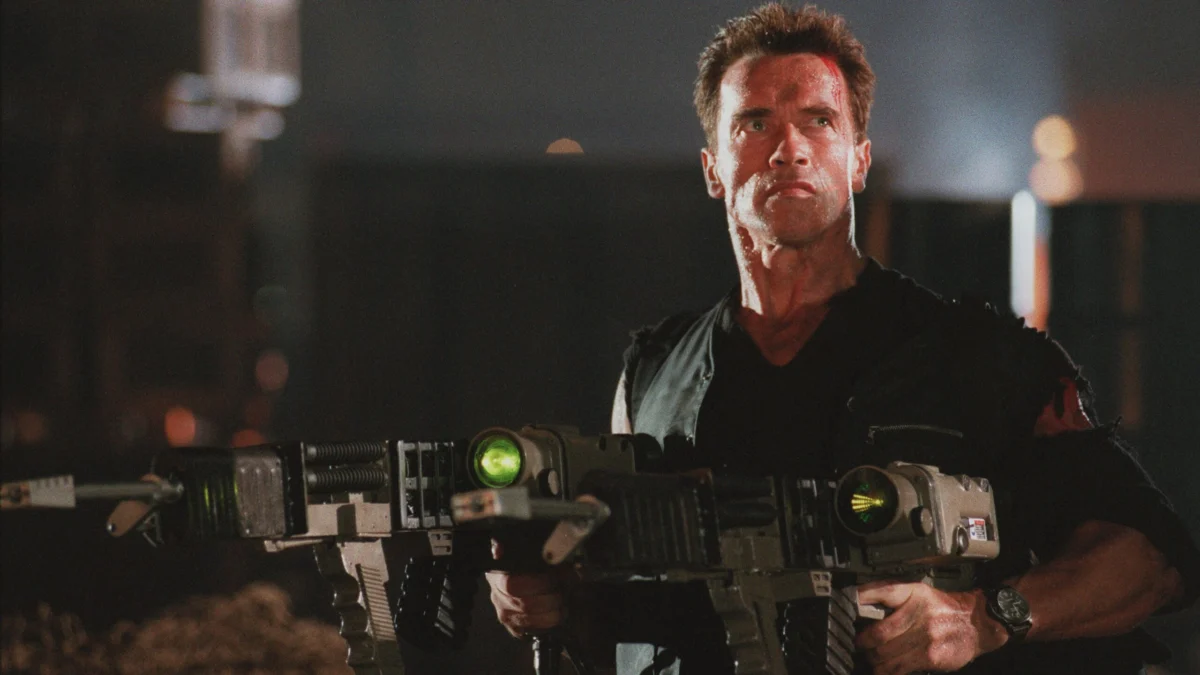
By the mid-1990s, Arnold Schwarzenegger was not merely a movie star; he was a global cultural monolith. Having successfully navigated the transition from bodybuilding icon to Hollywood’s most bankable action hero, he had already battled extraterrestrial hunters, liquidated time-traveling androids, and navigated the trippy, red-hued corridors of his own manufactured memories on Mars. By 1996, the question wasn’t whether an Arnold movie would succeed, but rather how the industry could possibly top the sheer spectacle of his previous outings.
Enter Eraser, the 1996 high-octane thriller directed by Chuck Russell. Now, thirty years later, as the film receives a pristine 4K restoration, it serves as a fascinating time capsule of a bygone era of practical effects, mid-nineties aesthetic ambition, and the peak of the “Arnold vehicle.”
The Genesis: Moving Beyond the Schwarzenegger Formula
In 1996, the action landscape was shifting. While the muscle-bound hero remained the gold standard, audiences were beginning to crave more than just pyrotechnics and one-liners. Chuck Russell, fresh off the massive success of the Jim Carrey-led The Mask, was initially tethered to a different project involving Schwarzenegger: an ambitious, swashbuckling take on the classic Captain Blood. However, as that production hit the inevitable snags of Hollywood development hell, the star approached Russell with a script for Eraser.
The premise was classic high-concept thriller: John “Eraser” Kruger, a U.S. Marshal specializing in "erasing" the identities of high-level witnesses, finds himself embroiled in a conspiracy involving advanced weaponry and internal betrayal. For Russell, the film offered a unique challenge. He didn’t want to simply replicate the carnage of Commando or the futuristic dread of The Terminator.

“Eraser was a wonderful script,” Russell noted in a recent reflection on the film’s 30th anniversary. “All I did was make sure we had a few things I’d never seen before in an Arnold movie.”
Schwarzenegger had actively sought out Russell, having been impressed by the visual inventiveness displayed in The Mask. He believed that Russell possessed the stylistic flair required to evolve his onscreen persona. Russell agreed, but with a caveat: he wanted to pivot Arnold’s role from the unstoppable destroyer to a more nuanced, protective figure—a man who, while capable of immense violence, functioned as a guardian in a world spiraling out of control.
Chronology of a Cult Classic: The Three Pillars of Action
To elevate Eraser above the glut of action movies saturating the 1990s, Russell implemented a three-pronged approach to spectacle. Each element was designed to push the boundaries of what was technically possible at the time.
1. The Railgun: Precision in Hyper-Reality
Long before railguns became the darling of military-tech blogs and a staple of science-fiction shooters like Perfect Dark, they were a fringe concept in physics. Russell discovered during pre-production that while the U.S. Navy had experimented with railgun technology for massive ship-mounted weaponry, the concept of a man-portable railgun remained purely theoretical.

Russell’s vision was a masterclass in “hyper-reality.” He didn’t want the weapon to look like a generic machine gun; he wanted it to feel like a weapon from the future that felt grounded in the present. The result was the iconic dual-railgun setup wielded by Schwarzenegger in the film’s climax. By adding glowing, high-velocity projectile trails, Russell gave the audience a visual shorthand for the weapon’s destructive power.
Interestingly, the film’s design was so compelling that Russell later received an informal, albeit surprising, acknowledgment from individuals within Naval Intelligence. The feedback was simple: he had captured the aesthetic and the theoretical functionality of the weapon with uncanny accuracy.
2. The Zoo Sequence: The Absurdist Pivot
If the railgun represented the film’s attempt to ground sci-fi concepts in reality, the alligator sequence served as the film’s embrace of the absurd. Russell had been struck by a moment in True Lies where Schwarzenegger, unexpectedly and hilariously, finds himself riding a horse. He wanted a similar “what if” moment for Eraser.
The resulting shootout in a zoo, culminating in a face-off between the hero and a massive alligator, remains one of the film’s most enduring images. It is a sequence that defies logic, yet fits perfectly within the heightened reality of the movie. As Russell candidly admits, “It’s a wild scene. I have no apologies for it. It was just fun to do.” The sequence also perfectly showcased the tonal balance of the film—a blend of high-stakes tension and the signature, pithy one-liners that defined the era.

3. The Parachute Descent: The Zenith of Stuntcraft
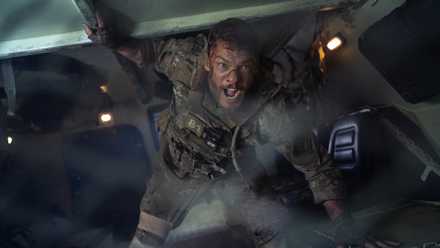
Perhaps the most significant achievement of Eraser is its climactic skydiving sequence. Even three decades later, the scene holds up with a level of visceral intensity that modern, heavy-CGI action films struggle to replicate.
The sequence was achieved through a monumental effort by a world-class team of skydiving experts. They didn’t rely solely on green screens; instead, they deployed cameramen who jumped in freefall alongside the actors, carrying 35mm cameras. The result was a chaotic, dizzying perspective that grounded the viewer in the reality of the fall. Schwarzenegger himself was heavily involved, performing intricate maneuvers on a rope rig to simulate the leap from a falling cargo plane.
Data and Production Reality: The Scale of ‘Eraser’
The production of Eraser was a testament to the sheer scale of mid-nineties filmmaking. With a budget estimated at approximately $100 million, the film was a massive undertaking for Warner Bros. At the time of its release, the reliance on practical effects over digital manipulation was a point of pride.
- Practical Stunts: Over 90% of the aerial sequences were filmed with real skydivers and cameramen.
- Weapon Design: The railguns were custom-built, featuring distinct, non-traditional profiles to differentiate them from standard Hollywood prop guns.
- Box Office Performance: The film grossed over $242 million globally, cementing Schwarzenegger’s status as a box-office titan even as the decade began to lean toward more grounded, gritty thrillers.
Official Responses and Industry Legacy
In interviews marking the 30th-anniversary 4K Blu-ray release, the creative team has been reflective about what the film represents. Schwarzenegger himself has spoken fondly of the collaboration, noting that the physical demands of the role—specifically the rigging and stunt work—were some of the most rigorous of his career.
For Chuck Russell, the legacy of Eraser is not just in its action, but in its ability to marry the sensibilities of old-school stunt work with the burgeoning potential of visual effects. “There’s a lot of stuntcraft in there,” Russell explained. “I think you can sense that people were really falling.”
Critics at the time of the 1996 release were often divided, with many praising the spectacle but questioning the formulaic nature of the plot. However, the film has aged into a fan-favorite, frequently cited by enthusiasts of 90s action as a prime example of the genre at its most imaginative.
Implications for the Modern Action Genre
The release of the 4K restoration of Eraser offers a lens through which we can view the evolution of the action film. In an age where “volume-wall” technology and digital de-aging have become standard, the tactile, sweat-and-grit approach of Eraser feels almost rebellious.
The film suggests that the most memorable action sequences are those that bridge the gap between the possible and the impossible. By grounding high-concept ideas—like miniaturized railguns—in practical environments, the filmmakers created a sense of stakes that purely digital imagery often lacks.

Furthermore, the success of the film highlights the importance of the “Director-Star” partnership. Schwarzenegger’s decision to personally source a director who shared his vision for expanding his range was a strategic move that allowed him to stay relevant as his peers faded from the spotlight.
As Eraser finds its way onto modern 4K displays, it serves as more than just a nostalgic trip. It is a blueprint for how a blockbuster can be both absurd and technically rigorous, how it can embrace the camp of its genre while maintaining a high standard of cinematic craftsmanship. For the next generation of action filmmakers, the film stands as a reminder that sometimes, the most effective way to “erase” the competition is to push the envelope of what is physically, audaciously possible.
 Nana Muazin
 Layla Zulfa
 Basiran
