

Introduction: A Global Order Under Siege
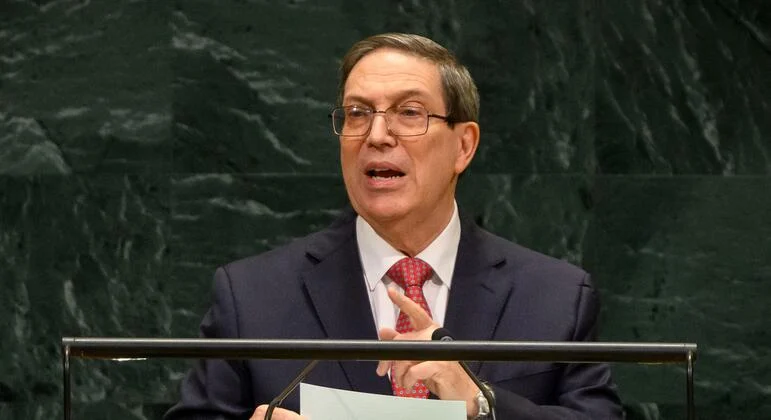
In a blistering address to the 81st session of the United Nations General Assembly, Cuban Foreign Minister Bruno Eduardo Rodríguez Parrilla delivered a stark warning to the international community: the global order is sliding into an era defined by the "law of the jungle." Addressing the assembly, Rodríguez Parrilla painted a grim portrait of a world where fundamental tenets of the UN Charter—most notably the sovereign equality of nations—are being systematically dismantled by a resurgence of expansionism, economic plunder, and unilateral military aggression.
The Foreign Minister’s speech served as a clarion call for the preservation of the multilateral system. He urged member states to reform the United Nations, demanding that the body evolve into a more democratic, effective, and people-centric institution before it loses its relevance entirely. However, the core of his address was a pointed, meticulously detailed indictment of the United States, which he characterized as the primary architect of a destabilizing "economic warfare" campaign against the Cuban people.
Chronology of Escalation: The 2024 Standoff
The tension between Havana and Washington has, according to the Cuban government, entered a uniquely perilous phase since January of this year. While the US-Cuba conflict has spanned over six decades, the Foreign Minister highlighted a strategic shift in Washington’s tactics that has moved beyond traditional trade barriers into what he described as an "energy blockade."
- January – March: The intensification of restrictions on fuel shipments to the island began to manifest in severe domestic shortages. Havana reported that Washington stepped up efforts to intimidate international shipping companies and fuel suppliers, threatening sanctions against any entity facilitating energy transit to Cuba.
- April – June: The logistical bottleneck reached a breaking point. Over 7,000 shipping containers, containing essential goods ranging from food and medicine to specialized medical machinery, were reported stranded in international ports. Many of these shipments had been fully paid for by private Cuban entities, yet they remained undelivered due to the fear of US legal repercussions.
- July – September: The diplomatic friction intensified as the United States continued to pressure foreign investors to withdraw from the Cuban market. Simultaneously, Washington ramped up efforts to undermine the "Cuban Medical Missions"—a hallmark of Havana’s foreign policy—by lobbying host nations to terminate contracts with Cuban medical professionals.
- Late September: The standoff culminated in the Foreign Minister’s appearance at the UN, where he framed these recent months as a calculated campaign of "collective punishment" against the Cuban populace.
Supporting Data: The Human Cost of "Economic Warfare"
The Foreign Minister’s testimony at the UN was underscored by the tangible, often devastating, humanitarian impact of the US blockade. The blockade is not merely a political grievance; it is a systemic obstacle to the daily survival of the Cuban people.
The Logistics of Deprivation
The 7,000 stranded containers cited by Rodríguez Parrilla represent more than mere cargo; they represent a breach in the supply chain of basic life-sustaining resources. The inability to import fuel has caused a ripple effect across the nation, paralyzing public transport, limiting electricity generation, and slowing the distribution of food.
The Impact on Public Health
Perhaps the most emotive aspect of the address involved the disruption of the healthcare sector. The Foreign Minister highlighted that the US policy of blocking specialized medical equipment and medicines constitutes a direct violation of humanitarian norms. By restricting the island’s access to international financing and banking, the US has effectively prohibited Cuba from purchasing the high-tech medical supplies required for oncology, pediatrics, and emergency surgeries.
The Targeting of Human Capital
Cuba’s medical diplomacy is a significant source of revenue and soft power for the island. By pressuring governments to end their reliance on Cuban doctors, the United States is intentionally targeting a pillar of the Cuban economy. Rodriguez Parrilla argued that this is a deliberate attempt to force the state into insolvency by stripping it of its most valuable service exports.
Official Responses and Diplomatic Stance
The Cuban government’s position remains a paradoxical blend of staunch resistance and an expressed willingness to engage. Rodríguez Parrilla explicitly rejected the recurring US narrative that Cuba constitutes a threat to American national security. "Cuba is not a threat; the blockade is!" he stated, emphasizing that the threat to the hemisphere is not an ideological one, but rather the coercive, unilateral nature of US policy.
Conditions for Dialogue
Despite the heightened tensions, Havana has not shuttered the doors of diplomacy. The Foreign Minister reaffirmed that Cuba remains open to a bilateral dialogue with Washington, provided that any potential negotiations are governed by four pillars:
- Sovereign Equality: A recognition of Cuba’s right to determine its own political and social path.
- Respect for International Law: Adherence to the UN Charter as the supreme framework for bilateral relations.
- Non-interference: A complete cessation of efforts to influence or undermine Cuba’s internal governance.
- No Preconditions: The rejection of any demands that require Cuba to alter its constitutional or economic model as a prerequisite for discussion.
Domestic Transformations: Adapting to the Siege
In the face of these external pressures, the Cuban government is not remaining stagnant. The Foreign Minister spoke to the "profound transformations" currently underway within the island’s economic and social framework.
These reforms, adopted by the National People’s Power Assembly, are designed to introduce new economic actors and concepts into the national model. This includes the liberalization of certain sectors, the integration of new business practices, and a pivot toward greater efficiency—all while firmly maintaining the country’s socialist constitutional framework. The stated objective is to meet the urgent needs of the population with "the greatest possible social justice," ensuring that in a time of crisis, the burden of the economic siege is not placed solely on the most vulnerable.
Regional Implications: A Zone of Peace?
Looking beyond the borders of the island, the Foreign Minister’s address served as a critique of US hegemony in Latin America and the Caribbean. He invoked the 2014 proclamation of the region as a "Zone of Peace," a declaration that the current trend of militarization and political intervention threatens to invalidate.
Defending Sovereignty Across the Region
Rodríguez Parrilla extended his criticism to what he described as the "Monroe Doctrine," implying that the United States continues to view Latin America as its exclusive sphere of influence. He reaffirmed Cuba’s solidarity with:
- Small Island Developing States (SIDS): Acknowledging their disproportionate vulnerability to the climate crisis.
- Nicaragua: Reiterating support for the nation amid ongoing political scrutiny.
- Puerto Rico: Expressing solidarity with its struggle for self-determination.
- Reparations: Calling for historical justice for African and Caribbean nations regarding the legacy of colonialism and the transatlantic slave trade.
Conclusion: The "Unrealized Dream"
The concluding remarks of the Foreign Minister served as a grave warning to the United Nations itself. He cautioned that a world where the strong impose their will through intimidation and coercion is fundamentally unsustainable. If the UN fails to uphold the equality of states and allows the "law of the jungle" to supersede the rule of law, it risks becoming an "unrealized dream of great promises."
The address was more than a defense of Cuba; it was a demand for a return to a rules-based international order. As the geopolitical landscape grows increasingly fractured, Cuba’s appeal to the UN serves as a litmus test for the organization’s ability to defend the sovereignty of smaller nations against the overwhelming pressure of global superpowers. Whether the international community will heed this warning or allow the current trajectory to continue remains the defining question of the current diplomatic era.
 Lina Hope
 Asro
Asro
 Layla Zulfa
