

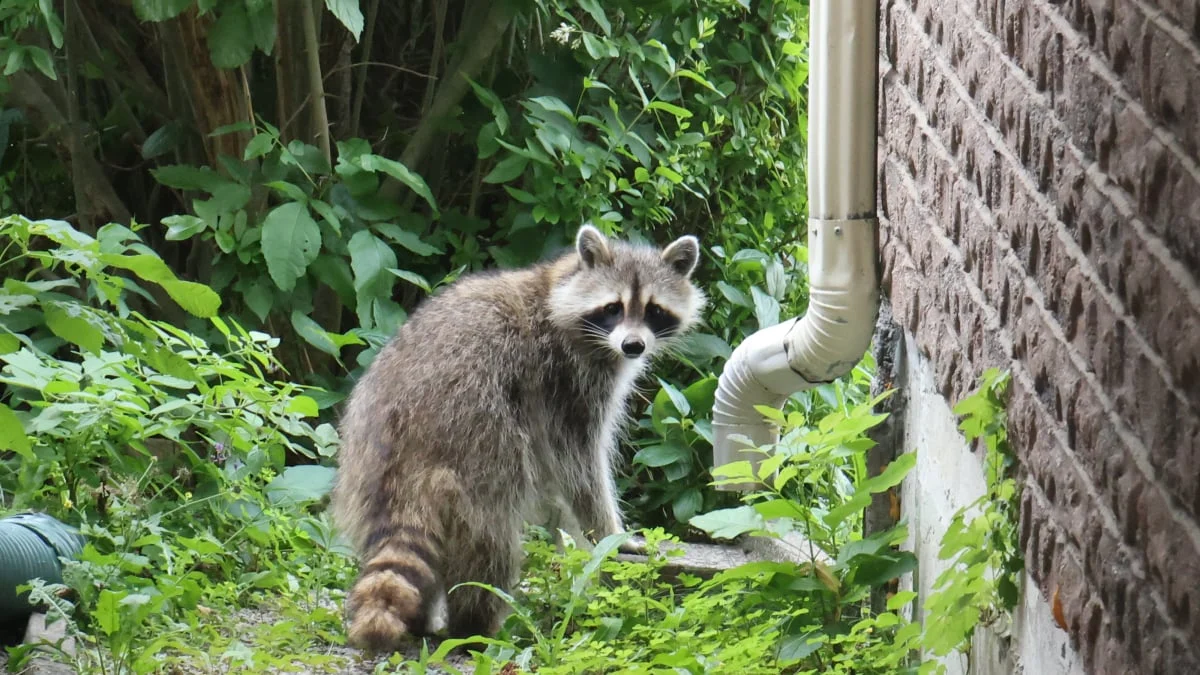
In the quiet, tree-lined streets of Seattle’s Ballard neighborhood, a new urban legend has taken root—not of a ghost or a hidden treasure, but of a raccoon. Known affectionately to the world as “Jimothy,” this uniquely shaped creature has transcended local curiosity to become a bona fide internet celebrity. With his noticeably compressed torso, lack of a visible neck, and waddling gait, Jimothy has captured millions of hearts, spawned a line of merchandise, and even prompted an official Google search animation.
However, as the fervor surrounding the animal grows, a scientific and observational mystery has emerged. Are Seattleites witnessing the life of a single, highly resilient creature, or have they inadvertently stumbled upon a localized phenomenon involving multiple raccoons sharing the same distinctive physical trait?
The Rise of an Icon: How Jimothy Captured the Internet
The “Jimothy” phenomenon began in earnest on July 13, when Seattle resident Kiana Hall was taking a routine stroll through Ballard. Her attention was drawn to a creature scuttling beneath a parked car. Initially, Hall assumed the animal was a stray cat, but as it emerged, the unmistakable mask and ringed tail of a raccoon became apparent. What struck Hall, and subsequently millions of online viewers, was the animal’s physiology: a remarkably short spine and a rounded, compact build.
In an interview with Today, Hall recounted her decision to name the raccoon “Jimothy,” noting that the name simply felt right for a creature with such a singular appearance. The footage she captured was short, candid, and undeniably endearing. Within days, the video had amassed millions of views across platforms like Instagram and TikTok, transforming an ordinary neighborhood scavenger into a symbol of Seattle’s quirkiness.
The “Hot Jimothy Summer” was officially underway. Fans began creating memes, commissioning tattoos, and even printing custom apparel. The obsession reached institutional levels when the University of Washington humorously bestowed an “honorary doctorate” upon the raccoon, and the Seattle Mariners incorporated a costumed Jimothy into their seventh-inning Salmon Run, where he famously defeated his oversized fish competitors.
Chronology of a Raccoon Conundrum
While the viral fame is a recent development, the timeline of Jimothy’s existence has become a subject of intense debate. Following the initial viral surge, local residents began scouring their personal archives—security camera footage, doorbell camera clips, and smartphone photo albums—to find earlier sightings.
The results of this crowdsourced investigation have left researchers and residents baffled. While many sightings appear to align with the current “Jimothy” in Ballard, others date back as far as 2017. If the raccoon spotted in 2017 is the same animal that became a viral sensation in 2024, the math simply does not add up.
In the wild, the average lifespan of a raccoon is remarkably short. While they can live for a decade or more in captivity, wild raccoons face constant threats from vehicular traffic, predators, canine distemper, and malnutrition. Most do not survive past their third or fourth year. Consequently, a raccoon seen in 2017 would be approximately nine years old today, placing it in the “elderly” category for its species. This discrepancy has led to the emergence of the “Multiple Jimothies” theory: the possibility that Ballard is home to a lineage or a cluster of raccoons afflicted with the same congenital spinal deformity.
Biological Context: Understanding Short Spine Syndrome
To understand the mystery of Jimothy, one must look at the biological possibilities. Wildlife experts suggest that Jimothy’s appearance is highly consistent with congenital spinal deformities, commonly referred to as "short spine syndrome."
This condition, while rare in the wild, occurs when the vertebrae are fused or compressed, resulting in a significantly shortened neck and a hunched, compact appearance. Despite these anatomical differences, Jimothy appears to be thriving. Videos show him climbing, foraging for food, and navigating the urban environment with surprising agility.
Wendi Mallo, an animal keeper at Northwest Trek Wildlife Park, provided a professional perspective on the matter. Mallo noted that while the visual evidence is compelling, it is difficult to verify any specific health status without a veterinary examination. Regarding the longevity of the raccoon, Mallo remarked, “Yeah, that seems like a very long-lived raccoon to me for the wild. But who knows, there’s magic in the wild. We’ve just got to look for it.”
The resilience of the creature is not in question, but the statistical probability of a wild animal with a mobility-limiting deformity surviving for nearly a decade remains the central point of contention among experts.
The Scientific and Community Divide
The community of Ballard has become a microcosm of citizen science. On one side are the “Believers,” who point to the consistency of the sightings and the unique nature of the deformity as proof that Jimothy is a singular, legendary survivor. On the other side are the “Skeptics,” led by residents like Rebecca Sorenson, who argue that the temporal gap between the earliest footage and the recent viral clips is too vast to be ignored.
Sorenson, in an interview with FOX 13, voiced the growing frustration and curiosity of the neighborhood: “There’s posts now that say that he was born a year ago and then other people with posts that saw him in 2017. I’m curious now if there are more than one?”
This confusion is compounded by the nature of social media, where old footage is often mislabeled or re-uploaded without context. Without a tagging system or a formal tracking study, it is impossible to distinguish one “short-spined” raccoon from another. Are there multiple individuals, or is there a misidentification of younger, similarly shaped raccoons by well-meaning residents?
Official Responses and Ethical Implications
As Jimothy’s fame has drawn more people to the streets of Ballard with cameras and, in some cases, food, wildlife officials have issued urgent warnings. The surge in human interest poses a significant risk to the animal’s well-being.
Wildlife authorities emphasize that raccoons are wild animals and should never be approached, fed, or handled. The human-animal interface in an urban environment is already fraught with danger; adding a throng of spectators only increases the likelihood of the animal becoming habituated to humans, which often leads to negative outcomes for the raccoon. If a “Jimothy” becomes too comfortable with humans, he may wander into traffic or approach the wrong person, leading to injury or the necessity for state intervention.
Furthermore, officials note that the obsession with "finding" Jimothy creates a hazardous environment for all local wildlife. Increased foot traffic in alleys and near den sites can disrupt the natural behaviors of the local ecosystem. The message from the Washington Department of Fish and Wildlife is clear: observe from a distance, respect the animal’s space, and resist the urge to turn a wild creature into a neighborhood mascot.
The Legacy of the Name
Perhaps the most fascinating aspect of the Jimothy story is how it has evolved into a cultural phenomenon that transcends the animal itself. Whether or not there is one Jimothy or five, the name has become a collective noun—a title, of sorts, for any raccoon in Ballard that exhibits a unique physical profile.
The ambiguity of the situation may actually be part of the appeal. In a world defined by precision and data, the mystery of the “Ballard Raccoon” provides a sense of wonder. If Jimothy is a singular miracle of nature, his story is one of incredible resilience. If he is part of a larger, unrecognized population of short-spined raccoons, the story becomes a fascinating case study in urban wildlife adaptation and genetics.
As it stands, Jimothy remains a symbol of Seattle’s unique character. Whether the internet continues to hunt for the “original” or embraces the possibility of a new generation of Jimothies, the mystery is unlikely to be solved anytime soon. Until a definitive, scientific explanation is provided, the people of Ballard will likely continue to look for the masked face and the unmistakable silhouette, keeping the legend of Jimothy alive for at least one more “Hot Jimothy Summer.”
In the end, the true nature of Jimothy may be secondary to the connection he has fostered. He has brought a community together to observe, document, and care about the wildlife that shares their city, reminding us that even in the most urbanized environments, there is still room for the unexpected, the resilient, and the downright peculiar. Whether one raccoon or many, the spirit of Jimothy has left an indelible mark on Seattle—a city that, for now, seems perfectly content with not knowing the full truth.
 Nana Wu
 Neng Nana
 Reynand Wu
