

By Brian VanHooker
Published: September 27, 2026
Main Facts
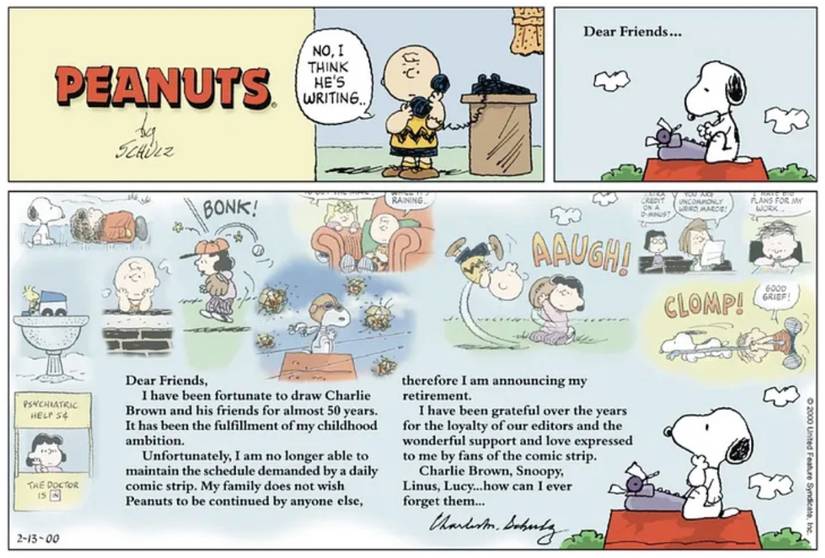
When legendary American cartoonist Charles Schulz passed away on February 12, 2000, at the age of 77, the timing of global pop culture events carried an eerie, poetic resonance. The very next day, Sunday, February 13, the final syndicated strip of Peanuts appeared in newspapers worldwide, drawing the curtain on a remarkable 50-year run that chronicled the bittersweet lives of Charlie Brown, Snoopy, Woodstock, and the rest of the neighborhood gang.
While the sequence felt like a meticulously orchestrated farewell, it was actually a logistical coincidence. Because newspaper comic strips—particularly complex Sunday editions—were drawn and submitted weeks in advance, Schulz’s final strip had been completed long before his death. Yet, the convergence of his passing and the conclusion of his life’s work served as a poignant punctuation mark for a man who spent half a century shaping the emotional landscape of modern comic art.
Over his staggering half-century career, Schulz produced nearly 18,000 individual Peanuts strips. While many relied on recurring gags—Lucy pulling away the football, Linus waiting anxiously in a pumpkin patch, or Charlie Brown lamenting his kite-eating tree—others introduced moments of striking philosophical depth. Among the thousands of panels, one line, published in February 1966, stands out as arguably the most profound utterance in the entire Peanuts canon:

"What’s the good of living if you don’t try a few things?"
Remarkably, despite the timeless wisdom embedded in the quote, evidence suggests that neither the characters within the strip nor Schulz himself fully recognized the magnitude of what had been written.
Chronology: The Evolution of a Masterpiece
February 2000: The Final Curtain
Schulz announced his retirement in December 1999 following a series of strokes and a battle with advancing colorectal cancer. Having completed his final panels shortly after making his retirement public, Schulz was acutely aware that his life was drawing to a close. However, he could not have predicted the exact day of his death down to a 24-hour margin. When his final strip ran on February 13, 2000, it effectively functioned as a quiet, graceful obituary written by the artist himself.
February 1966: The Spelling Bee Arc
To understand the origin of Schulz’s greatest philosophy, one must look back to a multi-week storyline that began on February 2, 1966. Spanning 16 consecutive daily strips (excluding Sunday specials), the narrative centered on Charlie Brown’s decision to volunteer for a school spelling bee.

True to form, Charlie Brown’s optimism was quickly met with humiliation. When his turn arrived at the microphone, he was tasked with spelling the word "maze," which he promptly botched by spelling it "m-a-y-s." Overwhelmed by shame, a defeated Charlie Brown slumped over his desk. When his teacher instructed him to lift his head, a stressed-out Charlie Brown snapped at her, resulting in a brief trip to the principal’s office. Though he later returned to class to offer a sincere apology, the true emotional thesis of the storyline had already been established just one day prior.
December 1969: The Big Screen Adaptation
The spelling bee narrative proved to be fertile ground for storytelling, eventually serving as the foundational plot for the very first theatrical Peanuts feature film, A Boy Named Charlie Brown, which premiered on December 4, 1969. Written entirely by Schulz, the 85-minute film expanded the modest daily comic strip arc into a full-scale cinematic journey, complete with musical numbers and high-stakes national spelling bee competitions.
Supporting Data & Context
To appreciate the scale of Charles Schulz’s artistic output, one must examine the infrastructure of mid-20th-century newspaper syndication:
- 18,000 Strips: Over 50 years, Schulz maintained an almost solitary creative grip on Peanuts, writing and drawing every single daily and Sunday strip without the aid of ghost artists or writing teams—a rarity in the comic industry.
- Lead Times: Sunday color comics typically required a production lead time of six to eight weeks, explaining why the final strip was already in print rooms when Schulz died.
- The Spelling Bee Arc Duration: Running from February 2 to February 20, 1966, the storyline stood out as one of the longest continuous character-driven arcs of that decade, focusing heavily on internal anxiety, failure, and public embarrassment.
Official Responses and Creative Intentions
Within the context of the 1966 strip, the brilliant line was met with characteristic childish misunderstanding. In the second installment of the spelling bee arc, an incredulous Lucy Van Pelt confronts Charlie Brown, demanding to know why he would willingly subject himself to the public humiliation of a spelling bee.
Visibly frustrated by her cynicism, Charlie Brown shouts back:
“Well, what’s wrong? What’s wrong with trying?! I can try, can’t I?”
Before delivering the immortal line:
“What’s the good of living if you don’t try a few things?”
Neither child pauses to acknowledge the profound existential weight of the statement. They remain children—innocent, flawed, and reactive. However, what is more telling is that Schulz himself appears to have overlooked the quote’s singular brilliance.
When adapting the spelling bee arc into A Boy Named Charlie Brown in 1969, Schulz meticulously constructed the screenplay, adding new sequences to flesh out the runtime. Yet, despite expanding on the narrative, he omitted the iconic line entirely. Whether it was cut for pacing, forgotten in the editing process, or simply viewed by Schulz as standard throwaway dialogue, its exclusion highlights how creators can sometimes remain entirely blind to the profound resonance of their own passing thoughts.
Implications: The Legacy of a Simple Question
Decades after its publication, the question posed by Charlie Brown—and conceived by Charles Schulz—transcends the funny pages of mid-century newspapers. It stands shoulder-to-shoulder with the greatest axioms offered by philosophers, poets, and statesmen.

In a cultural landscape often obsessed with guaranteed outcomes, perfectionism, and the avoidance of failure, Schulz’s philosophy defends the nobility of the attempt. Charlie Brown was defined not by his victories—which were few and far between—but by his stubborn, beautiful refusal to stop stepping up to the plate, whether to kick a football, fly a kite, or spell a word.
Charles Schulz tried a few things over his 50-year career, and the world was forever changed as a result. Ultimately, his work leaves readers with a comforting and enduring challenge: What is the point of living out our own stories if we aren’t willing to try a few things along the way?
 Layla Zulfa
 Basiran
