

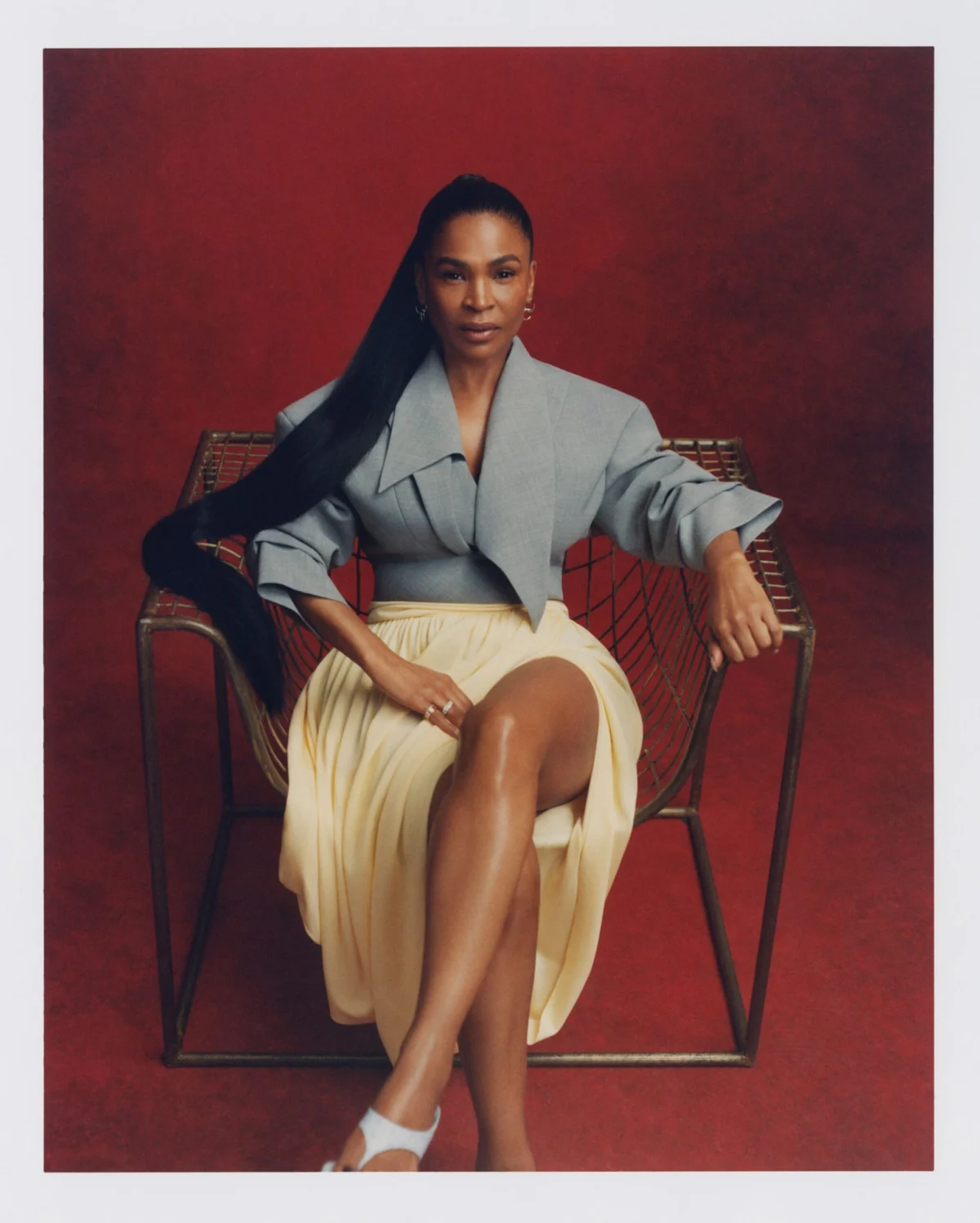
There is a specific, disorienting vertigo that accompanies exiting a darkened movie theater in the middle of a sun-drenched afternoon. The world outside feels jarringly vivid—too loud, too bright, and deceptively tactile. For two hours, you have been a guest in a meticulously curated reality, and as you step back into the ordinary, the remnants of the cinematic experience cling to you like a lingering perfume.
It is within this state of suspended animation that I meet Nia Long for an early lunch in a secluded corner of the iconic Chateau Marmont. I have just finished an advance screening of Michael, the highly anticipated Michael Jackson biopic slated for an April release. The film is still cycling through my mind when Long arrives. She is understated yet undeniably chic, dressed in an oversized blazer, wide-leg jeans, and a Miu Miu baseball cap pulled low. As we settle into our conversation, I am struck by a strange, doubling effect: the woman sitting before me, authentic and grounded, and the woman I just witnessed on screen—Katherine Jackson—are layered like two transparencies held up to the light.
The Art of the Unspoken: Portraying a Matriarch
In Michael, Long’s performance as Katherine Jackson is defined by a masterclass in stillness. The camera lingers on her face during the Jackson 5 rehearsal sequences, capturing a deep, maternal observation. She says almost nothing; she doesn’t have to. While the film is punctuated by Colman Domingo’s bombastic portrayal of Joe Jackson and the uncanny, transformative performance of Jaafar Jackson as his uncle, Long finds a way to make silence the most load-bearing element of the film.

In person, Long is the antithesis of the restrained figure she portrays on screen. She is blunt, deeply intelligent, and possesses a dry, infectious wit. She is, by her own admission, a textbook Scorpio—observant, perceptive, and acutely aware of her surroundings. Yet, in inhabiting the role of Mrs. Jackson, who remains a formidable figure at 95, Long tapped into a well of internal quietude. The word she returns to repeatedly during our lunch is "grace."
"There have been moments in my life where I’ve been required to be more graceful than I’ve ever had to be in the past," Long explains. "And that requires a sense of really being able to dig deep into some sort of self-examination. Like, what do I stand for? What’s important to me, ultimately, regardless of Hollywood, the noise? And number one, for me personally, my children come before anything. And so I think when you look at Michael’s journey, and you look at Katherine’s journey, the only way you thrive and survive is through a tremendous amount of grace." She pauses, reflecting on the weight of the word. "What I think I learned from her is that sometimes grace is really quiet."
A Career Defined by Cultural Permanence
Nia Long occupies a space in the American cultural consciousness that few actors achieve. For an entire generation, she is the "platonic ideal" of 90s excellence—a descriptor that transcends mere physical beauty to encompass a specific, undeniable energy. Whether as Nina in Love Jones, Jordan in The Best Man, or Lisa in The Fresh Prince of Bel-Air, she helped define an era.

When I ask her about the weight of this iconography, she remains characteristically grounded. "My commitment to work is not for accolades or attention, or even to be famous, quite honestly," she says, picking at a salmon salad. "But I do think because of my commitment to truth and purpose, there is a thing—and I don’t know what that thing is—that people see in my work. And it makes them feel good. It makes them feel inspired. It makes them feel like they know me."
In a landscape as notoriously fickle as Hollywood, especially for Black women, Long’s longevity is a testament to her resilience. "There are highs and lows," she admits. "I’m having a great year, but I don’t know what’s happening next year."
Strategy and Self-Preservation
Long’s approach to her career is a blend of artistic integrity and pragmatic business acumen. "The only strategy I have in this game is my bank account," she says with a laugh. "Let’s strategize how we’re going to make money and create generational wealth. That is where I’m strategic."

Yet, once the contract is signed, the work becomes deeply personal. She is notoriously protective of how her characters are presented. "I work hard to make sure that when I represent us, it’s not just someone putting their agenda on me. Whether it’s my hair, my makeup, my wardrobe, or my lines, I ensure it feels true."
This commitment to truth extends to her upcoming projects. With her eldest son in his 20s and her youngest at 14, Long feels a new sense of professional expansion. She is producing more, and she recently wrapped Don’t Ever Wonder, a romantic dramedy that reunites her with Love Jones co-star Larenz Tate. Directed by Eugene Ashe, the film explores the lives of empty nesters. "This is not a continuation of Love Jones," she clarifies. "This is a continuation of love, and of what happens once you’ve had your kids, they’re off to college, and you’re empty nesters. It’s a really honest story."
Navigating Public Scrutiny with Private Clarity
Midway through our lunch, the conversation shifts to the personal. I admit that I am interviewing her while navigating the aftermath of a 12-year relationship ending. Long, leaning in, asks with surgical precision: "Okay, but when was it really over?"

Her question catches me off guard, but it highlights the unflinching clarity she developed following her own high-profile split in 2022. When her personal life became a subject of tabloid fodder, Long faced the ordeal with a public poise that belied the private work of healing.
"The amount of pouring into myself that I’ve done is strong and mighty and intentional," she says. "I’ve now identified the things that I need to work on and the things that I need to heal. But I have also identified what is intolerable."
Her advice for managing the "noise" of public opinion and personal trauma is practical. She suggests writing it all down without the intent to send. "It’s not about another person’s behavior. It’s about your bottom line and the magnitude in which you’re committed to self-love," she asserts. "I don’t think it’s healthy to hold onto things because then you’re just walking around with this burdensome energy. You don’t have to respond to the noise with the undercurrent of your own trauma."

The Memoir: Reclaiming the Narrative
Currently, Long is deep into the process of writing her first memoir—a two-year labor of love she describes as "the biggest, bravest, most challenging" thing she has ever done. The book revisits her formative years, including a pivotal six-year stint in Iowa City, where she was one of the few Black girls in her community.
"In writing this memoir, I realized the impact that experience had on my own view of beauty," she reflects. "I thought I was beautiful because my mother said it and my family said it, but the world told me something different. So to now be a face for Estée Lauder, it’s kind of ironic, because I didn’t feel beautiful until Black Hollywood said I was beautiful."
This realization speaks to the broader labor of Black women in entertainment—the constant, often invisible work of creating their own standards of beauty and worth in an industry that has historically rendered them invisible or fetishized them.

Embracing the Evolution
As we finish our lunch, the conversation turns to aging. Long, at 55, is refreshingly honest about the biological reality. "I’m 55. I’ve got hormonal stuff going on. Your body shifts, changes. It’s a whole new body." She is not interested in the "Black don’t crack" narrative, which she views as a double-edged sword that places undue pressure on women to remain frozen in time.
Instead, she focuses on balance. She enjoys the luxury of high-fashion gowns, but she is equally content eating truffle parmesan fries. Her freedom, she concludes, is not found on a red carpet, but in the small, autonomous choices of everyday life.
"Being able to do what you want to do when you want to do it, because it serves your spirit, not what everyone else thinks you need to be or should be," she says. "You don’t have to have anyone else’s permission to do what you love. I know I have the freedom right now to go home and make a pizza with my son. And I’m going to do it."

As she gathers her things to head home, the "vertigo" of our meeting settles into a sense of profound clarity. Nia Long is not the image stored in amber from 1997; she is a woman in constant, intentional motion—a living testament to the fact that while fame is a transient guest, grace is a permanent home.
 Suro Senen
