

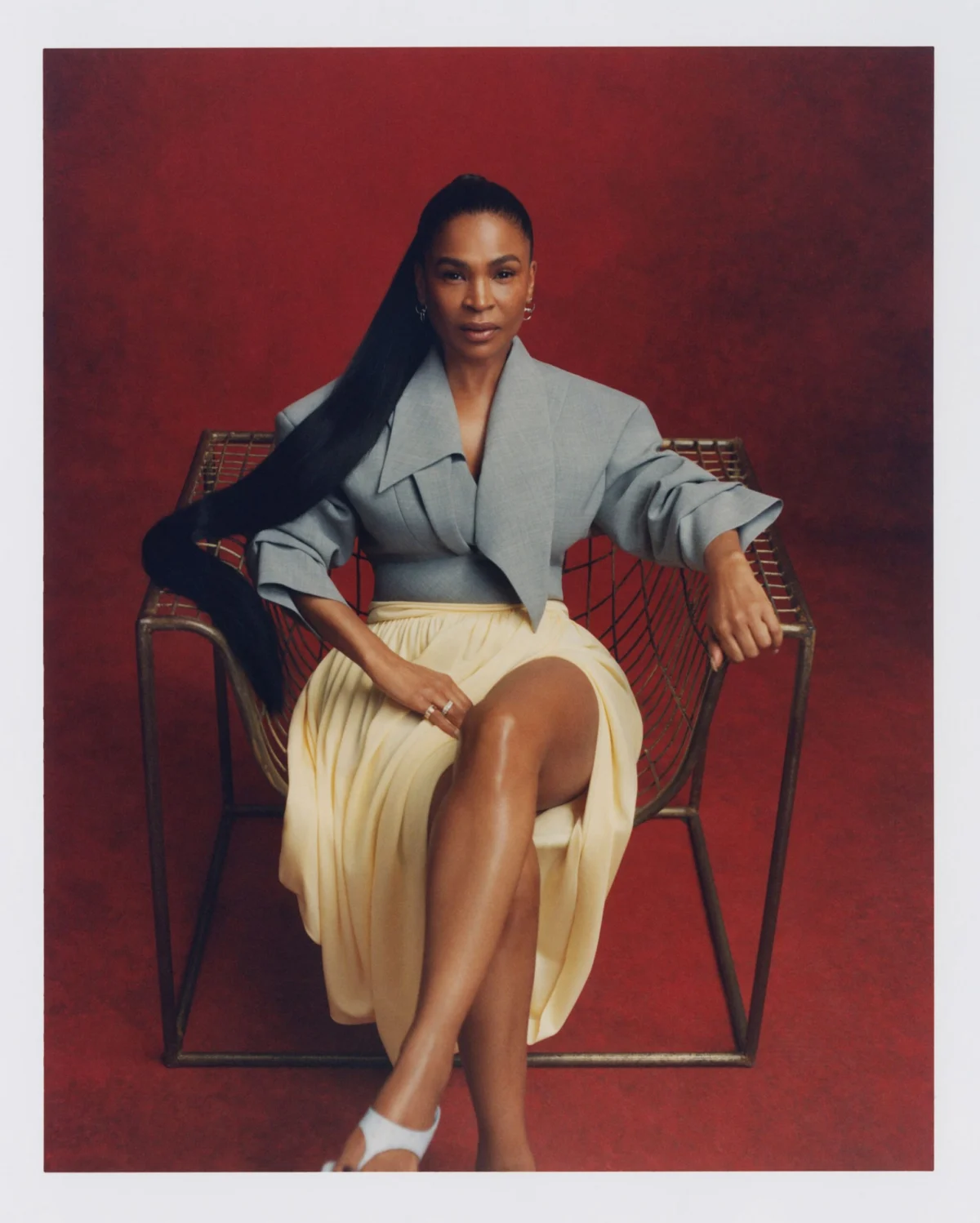
There is a specific, disorienting vertigo that accompanies exiting a darkened movie theater in the middle of a sun-drenched afternoon. The world outside feels jarringly saturated—too bright, too loud, and fundamentally detached from the carefully constructed reality you have inhabited for the previous two hours. You step onto the sidewalk, blinking against the harsh reality of the present, still feeling the faint, lingering perfume of the narrative you just abandoned.
It was in this liminal state of cinematic residue that I met Nia Long for an early lunch at the Chateau Marmont. I had just screened Michael, the highly anticipated Michael Jackson biopic arriving in April, where Long delivers a performance of profound, understated gravity as the family matriarch, Katherine Jackson. As she arrived, looking chic yet remarkably low-key in an oversized blazer, wide-leg denim, and a Miu Miu baseball cap, I was struck by a strange, double-exposed reality: the woman sitting before me, and the woman I had just watched on screen, layered like transparencies held up to the light.

The Art of the "Load-Bearing" Silence
In Michael, Long’s portrayal of Katherine Jackson is defined by a studied, deliberate stillness. The film’s first glimpse of her—observing her sons’ grueling rehearsals—holds on her face for several beats. She says nothing; she doesn’t have to. While the film features the blustering intensity of Colman Domingo as Joe Jackson and the uncanny, transformative performance of Jaafar Jackson as his late uncle, Long anchors the film through a rare, quiet power. She has mastered the art of making silence "load-bearing," proving that in acting, as in life, restraint is often the most visible force in any room.
In person, Long is a fascinating study in contradictions. She is blunt, yet radiates warmth; she possesses a sharp, dry wit and an expansive emotional intelligence. As a Scorpio, she misses nothing. When discussing the experience of inhabiting the role of Mrs. Jackson—who remains a vibrant presence at 95—Long returns repeatedly to a singular, guiding principle: grace.

"There have been moments in my life where I’ve been required to be more graceful than I’ve ever had to be in the past," she reflects. "That requires a deep, uncompromising self-examination. You have to ask, ‘What do I stand for? What is important to me, ultimately, regardless of the Hollywood noise?’ For me, my children come first. When you look at Michael’s journey and Katherine’s journey, the only way you truly survive is through a tremendous amount of grace." She pauses, her expression softening. "What I learned from her is that sometimes, grace is really quiet."
Chronology: A Career of Cultural Iconography
Nia Long occupies a space in the American cultural imagination that few actors achieve. For an entire generation, she is the "platonic ideal of ’90s Fine"—a descriptor that transcends aesthetic beauty to encompass a specific, magnetic frequency. From her breakout roles as Nina in Love Jones and Jordan in The Best Man to her tenure as Lisa Wilkes on The Fresh Prince of Bel-Air, Long’s filmography is a tapestry of moments that define an era.

A Timeline of Evolution
- The Early Years: Raised in a vibrant, artistic household, Long’s childhood took her from Brooklyn to Iowa City. This move, as she details in her forthcoming memoir, forced her to confront her own identity as a young Black girl in a predominantly white landscape.
- The ’90s Ascendance: Long became the face of a new wave of Black cinema, portraying characters who were multifaceted, professional, and deeply human, shifting the needle on how Black women were perceived in Hollywood.
- Longevity and Strategy: Navigating the notorious fickleness of the entertainment industry, Long has remained a consistent force. She views her career not as a pursuit of fame, but as a commitment to truth.
- The Second Act: Now, with her eldest son in his 20s and her youngest at 14, Long is transitioning into a phase of professional expansion. Her recent wrap on Don’t Ever Wonder, a romantic dramedy directed by Eugene Ashe, marks a reunion with Larenz Tate and a pivot toward stories about "empty nesters" and the complexity of mid-life love.
Supporting Data: The Business of Being Nia Long
Despite her iconic status, Long is refreshingly pragmatic about the industry. "My commitment to work is not for accolades, attention, or even to be famous," she says, opting for salmon and a side of mustard as we talk. "But I think because of my commitment to truth and purpose, there is a specific ‘thing’ that people see in my work. It makes them feel inspired. It makes them feel like they know me."
Long admits that the industry remains precarious. "There are highs and lows," she says. "I’m having a great year, but I don’t know what’s happening next year." This uncertainty has fueled a strategic approach to her finances. She laughs, scratching her palm—a superstition she jokes is tied to incoming wealth. "The only strategy I have in this game is my bank account. Let’s strategize how we’re going to make money and create generational wealth. That is where I’m strategic."

Beyond the bottom line, she is protective of her representation. "I work hard to make sure that when I represent us, it’s not just someone putting their agenda on me," she explains. "Whether it’s my hair, my makeup, my wardrobe, or my lines—I am the curator of my image."
Official Responses and Personal Truths
The conversation inevitably turns toward the public scrutiny she faced in 2022, when her private life—specifically a highly publicized cheating scandal—became a matter of national discourse. Her response to the ordeal has been marked by an unflinching clarity.

"The amount of pouring into myself that I’ve done is strong, mighty, and intentional," she says. "I’ve identified the things I need to work on and the things I need to heal. But I have also identified what is intolerable."
When asked about the outpouring of public support she received during that time, Long is grateful but nuanced. "I’m proud of myself for giving so much grace. People make mistakes; it’s life. When the stakes are high, the news is big. I can’t do anything about that, but I don’t have to protect my ego." She offers advice to those struggling with their own heartbreak: "Don’t respond to the noise with the undercurrent of your own trauma. It’s not about another person’s behavior. It’s about your bottom line and your commitment to self-love."

Implications: Writing the Memoir and Redefining Beauty
Long is currently immersed in writing her first memoir, a process she describes as "the biggest, bravest, and most challenging" project of her career. The book delves into her childhood, her relationship with her late father, the poet Doughtry Long Jr., and her complex journey toward self-acceptance.
"I realized the impact that my childhood experience had on my own view of beauty," she admits. "I thought I was beautiful because my mother said it, but the world told me something different. To now be a face for Estée Lauder, it’s ironic, because I didn’t feel truly beautiful until Black Hollywood said I was."

This revelation highlights the labor required to shift beauty standards. "Nineties Fine" was, in many ways, a corrective—a defiance of an industry that often rendered Black women invisible. Now at 55, Long is navigating a new phase of physical and professional evolution. She rejects the "Black don’t crack" trope, which she views as a pressure-filled erasure of the realities of aging. "I’m 55. My body shifts and changes. It’s a whole new body," she says, unapologetically, as she enjoys her meal.
Conclusion: The Ultimate Freedom
As our lunch concludes, and Long prepares to head home for a pizza night with her youngest son, I ask her to define freedom. For her, it is not a destination, but a state of mind.
.jpg)
"Being able to do what you want to do when you want to do it, because it serves your spirit—not because of what everyone else thinks you should be," she says. "Freedom doesn’t require an audience. You don’t need permission to do what you love. It doesn’t have to be on the big stage. It can be in your kitchen. I have the freedom to make a pizza, and I’m going to do it."
In that final sentiment lies the essence of Nia Long: a woman who has survived the public stage, the industry’s whims, and the weight of being an icon, only to find that the most profound grace is found in the quiet, unscripted moments of a life lived entirely on one’s own terms.
 Asro
Asro
 Suro Senen
 Azzam Bilal Chamdy
