

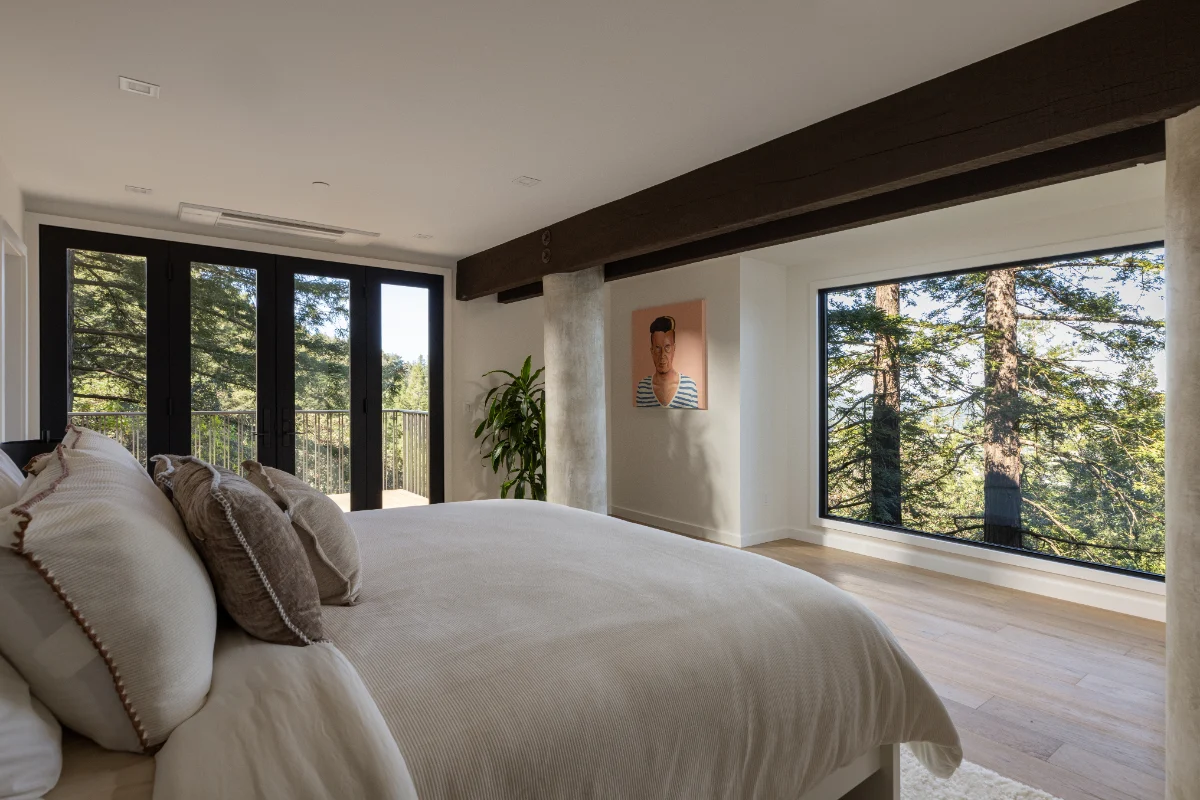
In the lush, vertical landscape of Corte Madera, California, where the fog-kissed peaks of the Marin hills meet the ancient majesty of the redwood forests, a singular architectural marvel has re-emerged. Completed in 1968 by the visionary architect Robert Overstreet, the residence at 238 Summit Drive stands as a testament to the midcentury ambition of harmonizing brutalist geometry with the wild, organic rhythms of Northern California. Following a comprehensive, top-to-bottom restoration that spanned the last year, this cantilevered sanctuary has returned to the market with an asking price of just under $8 million—a figure that reflects both its historical pedigree and its total modernization.
The Genesis of a Geometric Retreat
Robert Overstreet, a San Francisco-based architect celebrated for his uncompromising approach to commercial design and his penchant for unconventional residential forms, spent nearly a decade obsessing over the plans for this hillside plot. For Overstreet, the site was not merely a location; it was a structural challenge. He envisioned a home that did not sit on the landscape but rather existed within it, floating among the towering ferns and redwoods.
Construction on the residence was a labor of love that culminated in 1968. The resulting structure is a bold, cantilevered composition supported by a complex exoskeleton of massive poles that anchor the home to the steep hillside. These vertical supports extend from the forest floor to the roofline, carrying a series of beams that facilitate the dramatic, overhanging decks that have become the home’s signature feature. Hidden at the end of a long, winding private driveway, the house serves as a quiet, private refuge, far removed from the urban density of San Francisco, located just 15 miles to the south.
Chronology: From Midcentury Dream to Modern Masterpiece
The history of 238 Summit Drive is defined by two distinct chapters: the era of its creation and the era of its rebirth.

The Overstreet Era (1958–1968)
For ten years, Overstreet meticulously planned the residence. His goal was to maximize the "treehouse" experience, ensuring that every living space felt as if it were suspended in the canopy. During the late 1960s, the home became a point of fascination for architectural enthusiasts, representing the peak of Northern California’s "mountain-modern" movement.
The Dormancy and Transition (1969–2023)
For decades, the property remained a closely guarded secret of the Marin County hills. While it saw various occupants, the original structural bones remained largely untouched. Over time, however, the house faced the common challenges of its era: shifting soils, aging mechanicals, and a floor plan that, while poetic, did not quite suit the fluid, open-concept lifestyle demanded by the 21st-century buyer.
The Restoration (2023–2026)
In 2023, the property was acquired for $2.26 million by a team led by Schneur Scop of Real Brokerage Technologies. Recognizing the potential to preserve the home’s soul while upgrading its functionality, Scop undertook a "down-to-the-studs" restoration. This was not a mere cosmetic flip; it was a surgical intervention. The team addressed structural quirks, such as uneven flooring and height limitations, while integrating high-end modern amenities. The project concluded in mid-2026, resulting in a residence that feels as though it was built yesterday while retaining the soul of 1968.
Architectural Anatomy: A Study in Light and Balance
Spanning approximately 4,500 square feet, the five-bedroom, five-and-a-half-bath home is an exercise in verticality. The design allows the house to rise three stories through the forest canopy, a feat of engineering that provides a unique vantage point from every room.

The Interior Narrative
The renovation process was deeply respectful of the original aesthetic. Artisans were brought in from Berkeley to meticulously restore the original stained-glass front door, which serves as the home’s primary transition point. Once inside, the visitor is greeted by a series of dramatic glass cube skylights that pierce the roofline, flooding the interior spaces with a soft, refracted natural light that shifts throughout the day as the sun moves behind the redwoods.
The heart of the home is a bespoke Italian kitchen. Designed to meet the standards of a professional chef, the space features frameless, minimalist cabinetry and expansive Calacatta marble surfaces. A massive quartz waterfall island serves as the central gathering point, while a walk-in pantry is hidden behind seamless, pivoting doors, maintaining the home’s clean, geometric lines.
The Living Experience
The bathrooms have been entirely reimagined as private, spa-like retreats. They now feature heated floors, floating vanities that amplify the sense of space, illuminated mirrors, and floor-to-ceiling tile work. These touches serve as a bridge between the raw, rustic exterior and the refined, luxury-focused interior.
Supporting Data and Property Assets
The property at 238 Summit Drive is not simply a residence; it is a sprawling 1.36-acre compound designed for both seclusion and social gathering.

- The Main Residence: 4,500 square feet, 5 bedrooms, 5.5 baths.
- Outdoor Connectivity: The home features seven distinct balconies and decks, allowing for seamless indoor-outdoor living.
- Guest Accommodation: A separate, two-story guesthouse provides additional living quarters, complete with a private kitchen and laundry facilities, making it ideal for hosting or as a home office suite.
- Wellness Facilities: Reflecting contemporary luxury trends, the property includes a dedicated wellness area equipped with a cedar barrel sauna, a professional-grade cold plunge, and an outdoor shower that offers unobstructed views into the redwood grove.
- Infrastructure: The site includes a flat, usable turf field and, in a rarity for such a secluded location, parking for up to 18 vehicles.
The Professional Perspective: An Architect’s View of the Restoration
Schneur Scop, who served as both the project manager and the designer for this massive undertaking, describes the project as a balancing act between preservation and modernization. "The goal was to make it feel like Robert Overstreet would have designed it today, had he had access to current technology," Scop notes.
By addressing the "quirks" of the original design—specifically the low ceilings and the structural irregularities—the team managed to retain the home’s signature silhouette while improving its livability. The success of this restoration lies in the fact that the house still feels like an "architectural experiment," yet one that provides the comfort and security of a modern smart home.
Market Implications: The Value of "Architectural Provenance"
The jump in valuation from a $2.26 million purchase price in 2023 to an $8 million ask in 2026 is significant, but it is not unprecedented in the current high-end California real estate market. This surge reflects a growing trend: the high premium placed on "architectural provenance."
Buyers in the ultra-luxury sector are increasingly looking for homes that offer a narrative. A "cookie-cutter" mansion can be built anywhere; a home that was custom-designed by a notable architect, restored with period-appropriate care, and situated in a unique, irreplaceable natural environment like the redwoods of Corte Madera, is a scarce commodity.

The property acts as a bellwether for the Marin County luxury market. As buyers continue to flee the density of major metropolitan areas in search of "nature-adjacent" living, homes that successfully marry high-design aesthetics with wellness-focused features are seeing record-breaking demand. The inclusion of a dedicated wellness suite and significant guest infrastructure adds a layer of practical utility that makes the property attractive to both primary residents and those seeking a secondary retreat.
Conclusion
238 Summit Drive stands as a bridge between two eras of California living. It captures the idealism of the late 1960s—a time when architects believed they could reshape the environment to enhance the human experience—and filters it through the lens of modern, high-end residential luxury.
Whether it is the play of light through the glass cube skylights, the warmth of the cedar sauna against the backdrop of the redwoods, or the sheer structural audacity of the cantilevered decks, the home is a masterpiece of design. As it heads back to the market, it represents more than just a real estate transaction; it represents the preservation of a piece of Northern California history, ready to be enjoyed by a new generation of design enthusiasts.
 Evan Lee Salim
 Asep Darmawan
 Laily UPN
