

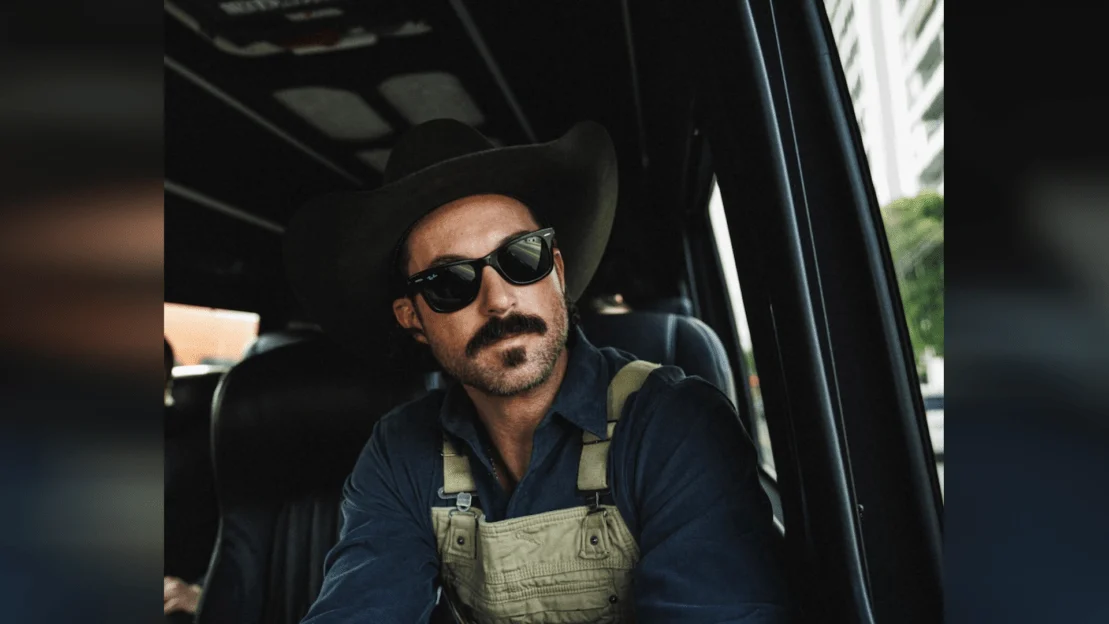
For Riley Green, the concept of “slowing down” is not merely an inconvenience—it is an alien language. At 37, the Alabama-born country music titan is currently navigating the most prolific stretch of a career defined by an unwavering, almost punishing, work ethic. Whether he is selling out arenas on his Cowboy As It Gets tour, topping the Billboard charts with his introspective songwriting, or stepping onto the set of a high-stakes television drama, Green is operating at an altitude few in the entertainment industry ever reach.
Yet, perhaps most impressive is not the volume of his output, but the consistency of his physical conditioning. In an industry notoriously unkind to health, Green remains the gold standard for fitness, balancing a rigorous tour schedule, a demanding acting career, and a commitment to maintaining his trademark six-pack.
The Main Facts: A Calendar at Capacity
The current phase of Riley Green’s professional life is nothing short of a blitzkrieg. Following a triumphant run of sold-out shows across Australia, the North American leg of his 2026 Cowboy As It Gets tour has kept him on the road, while his musical footprint continues to expand.
In June, his hit single “Change My Mind” ascended to the No. 1 spot on the charts, underscoring his status as a radio powerhouse. With the music video for his latest single, “Think As I Drunk,” currently making waves, fans are already looking toward September 18, the highly anticipated release date for his upcoming album, That’s Just Me.
Beyond the recording studio and the stage, Green has pivoted to the small screen. He recently wrapped his first major acting role in Taylor Sheridan’s Marshals, a transition that has added a layer of complexity to his already daunting schedule. Between a co-hosting gig at ABC’s CMA Fest and his recent announcement as a coach on NBC’s The Voice, Green is no longer just a musician; he is a burgeoning media conglomerate.
Chronology of a Meteoric Rise
Green’s path to superstardom was not paved with overnight success; it was built on the foundation of his past as a collegiate quarterback at Jacksonville State. That discipline—the "signal caller" mentality—has served as the blueprint for his musical trajectory.
- Early Career: Spending years working in construction by day and honing his craft as a singer-songwriter by night, Green developed a blue-collar resilience that persists to this day.
- The Breakthrough: His emergence as a multi-platinum headliner was marked by a string of chart-topping hits that established him as a singular voice in contemporary country music.
- The COVID Pivot: During the pandemic, when the world stopped, Green doubled down on his health, constructing a massive home gym that served as the prototype for his current, mobile fitness empire.
- The 2026 Expansion: This year represents the apex of his multi-hyphenate career, as he successfully balanced international touring, the release of That’s Just Me, and his high-profile television debut.
Supporting Data: The Science of the "Bro Split"
Despite the chaos of his schedule, Green’s fitness remains a non-negotiable priority. He categorizes his daily routine into a simple, albeit rigorous, pecking order: songwriting first, fitness a very close second.
His training philosophy is centered on efficiency and intensity. During his tours, he utilizes a condensed, custom-built gym towed behind his tour bus, ensuring that his workout is always accessible. His routine, which he describes as a "classic bro split," is designed for maximum metabolic impact in a minimum amount of time.
"If I’m doing chest, I’m doing bench presses—flat bench, incline bench, and decline pushups—all as quick as I can," Green explains. "Then I’m moving to a circuit of flies and dips. It’s about 30 to 45 minutes, and then I’m out."
This efficiency is complemented by a renewed focus on longevity. Recognizing the wear and tear of a 37-year-old body—including lingering shoulder issues from his football days and the reality of life on the road—Green has integrated core work and intensive stretching into his daily ritual. His core circuit, which includes hanging leg raises and bicycle crunches, is performed primarily on the road to combat the lower back pain that once plagued his mornings.
Official Perspectives: The Artist on the Athlete
When asked about the "Swiftian" levels of his recent successes, Green remains remarkably grounded, attributing his output to a simple, iterative process. Regarding his songwriting, he maintains a pragmatic view: "Write as many songs as you can. If you write 30 mediocre songs, you’re gonna write one good song for about every 30."
His transition into acting provided a rare moment of vulnerability. While he thrives on the high-pressure environment of a concert stage, the collaborative nature of a film set—where dozens of people rely on his performance—offered a new set of nerves. He credits fellow musician and actor Luke Grimes for helping him navigate this new terrain, noting that he drew inspiration from Tim McGraw’s success in 1883 to believe that he, too, could make the leap.
Regarding his physical health, Green is his own toughest critic. He admits that when he is "in the red," his motivation can wane, but he has learned to hack his own psychology. "90% of the battle for me is motivation," he says. "If the gym is right there, I’m probably gonna work out. If I have to go find a Planet Fitness, that becomes a hurdle I might not clear."
Implications: The Legacy of a Multi-Hyphenate
The trajectory of Riley Green’s career offers a compelling look at the modern entertainer. He is a testament to the "athlete-turned-artist" archetype, proving that the skills required to excel on the gridiron—discipline, routine, and a refusal to quit—are directly transferable to the recording studio and the soundstage.
The "Athletic Artist" Movement
Green’s insistence on keeping his hand in sports—whether it’s taking batting practice with the Philadelphia Phillies, hitting home runs in MLB ballparks, or playing 18 holes at Sawgrass—is more than a hobby. It is a vital component of his identity. By remaining physically active, he avoids the creative stagnation that can often haunt long-term touring artists.
Addressing the Physical Toll
The implications for his long-term health are clear: by prioritizing mobility, core strength, and recovery (stretching) over ego-lifting, Green is positioning himself to sustain this level of activity for years to come. He is effectively "fixing his own body," as he puts it, using the same DIY mentality that brought him his success in the music industry.
The Future of the "Green Empire"
As he looks toward the release of That’s Just Me and continues his tenure on The Voice, the question remains: can he sustain this pace? The answer, according to Green, lies in the trailer attached to his bus. As long as he has his gym, his songwriting journal, and his commitment to the "work," the pace is not just sustainable—it is the only way he knows how to live.
In a culture that often demands specialization, Riley Green is carving a path of total integration. He is the songwriter who writes alone, the actor who learns on the fly, and the athlete who refuses to hang up his cleats. For Green, the grind isn’t something to be survived; it is the very engine of his art. As he enters the next chapter of his life, he remains a symbol of the enduring power of the blue-collar work ethic in an era of celebrity excess. He is, quite simply, "just him"—and that, for millions of fans, is more than enough.
 rifanmuazin
 Laily UPN
