

For decades, the name Bimota has occupied a space in the motorcycle world that transcends mere manufacturing. To enthusiasts, the Italian brand is less of a company and more of a philosophy—a boutique atelier where mechanical art meets uncompromising performance. With a tiny, hyper-focused team of just 14 employees, Bimota has historically taken the world’s most potent platforms from Ducati, Yamaha, BMW, and Honda, stripping them down to their essence and rebuilding them into something entirely more exotic.
The latest chapter in this storied history sees the firm entering a new era under the umbrella of Kawasaki. With the unveiling of the KB998 Rimini, Bimota is not just reclaiming its heritage; it is planting a flag in the modern era of WorldSBK racing.

The Genesis of the KB998 Rimini
The nomenclature of the new machine is a masterclass in transparency: “KB” denotes the marriage of a Kawasaki heart with a bespoke Bimota chassis, while “Rimini” pays homage to the manufacturer’s historic Italian hometown. This bike represents more than a new model; it is a homologated race machine designed to dominate on the track while maintaining a (barely) road-legal status.
Following the brand’s integration into the Kawasaki fold, the partnership reached a fever pitch in 2025 when Bimota took over the factory WorldSBK team. The results were immediate. With riders Alex Lowes and Axel Bassani securing podiums early in the season, the KB998 Rimini arrived in the U.S. market with a reputation for speed already firmly established. Before the official American launch, Robb Report was granted an exclusive opportunity to test the machine at Northern California’s legendary WeatherTech Raceway Laguna Seca. The goal: to determine if the racing provenance of this boutique superbike truly translates to the visceral experience of a rider on a public circuit.

Engineering the Exotic: A Deep Dive into the Architecture
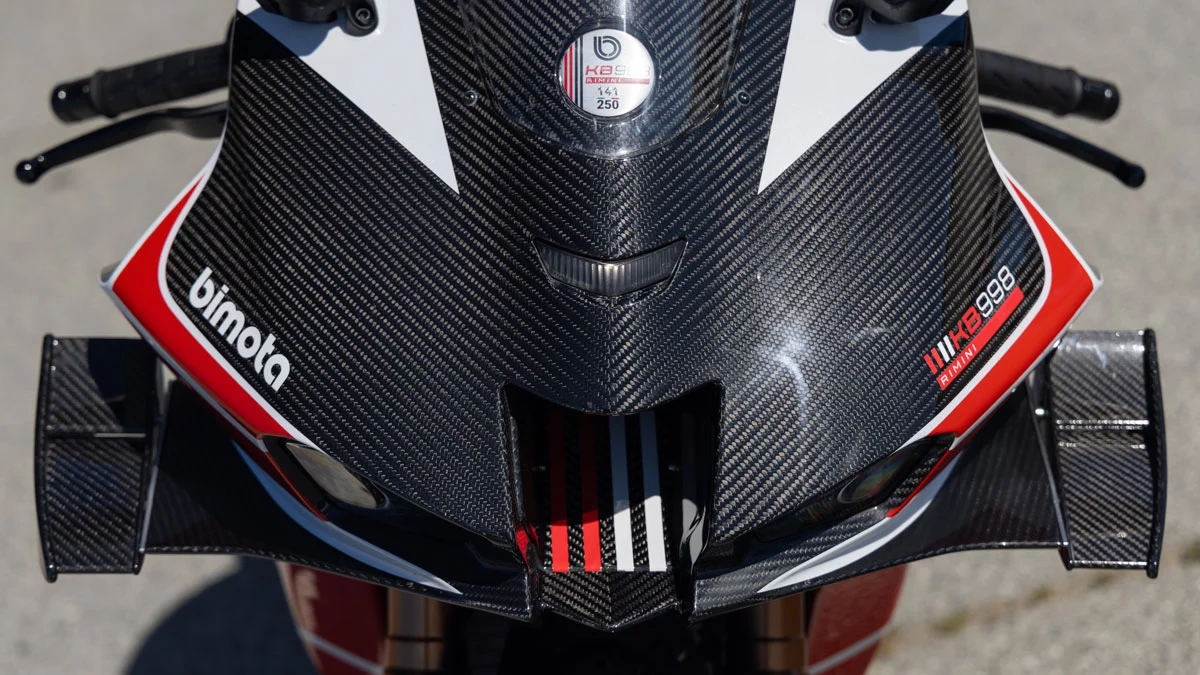
Seeing the KB998 Rimini in the flesh is a stark departure from viewing it in press photography. The machine’s aesthetics are deeply polarizing and incredibly complex; its angular, flowing form requires a specific play of light to truly appreciate the craftsmanship.
The bike is a testament to the "more is more" philosophy regarding premium materials. Carbon fiber is ubiquitous, utilized for everything from the massive, forward-facing air intake to the aerodynamic winglets, body fairings, seat subframe, and even the minimalist license plate bracket. However, it is the structural engineering that truly sets the Rimini apart. The heart of the chassis is a TIG-welded, oval-section, chromium-molybdenum trellis frame—a classic Bimota hallmark. This is complemented by an extensive use of billet aluminum, most notably in the swingarm. In an obsessive quest to shed every gram of weight, even the smallest components, such as the rear axle bolt and nut, have been replaced with high-grade titanium.

Chronology of the Track Experience
Firing up the 998cc inline-four engine inside the Laguna Seca garages was a sensory event. While it lacks the supercharged, explosive brutality of the Kawasaki H2, the power plant—borrowed from the ZX-10RR—is a symphony of high-revving precision. With its titanium headers and an Akrapovič silencer, the bike exhales with a throaty, race-bred roar that drew the attention of even the most die-hard Ducati and Aprilia owners on site.
The First Laps: Nimbleness in Motion
Exiting the pit lane, the immediate sensation is one of surprising agility. Despite its visual bulk and wide front profile, the bike weighs in at a relatively modest 456 pounds wet. Preheated Pirelli Diablo Superbike SC2 tires provided immediate confidence, allowing for aggressive lean angles from the very first corner. The front end feels telepathic, carving into turns with the slightest suggestion of weight transfer.

Suspension and Handling
The bike utilizes Showa suspension derived directly from the technology that powered Kawasaki to seven WorldSBK titles, including a historic six-year consecutive winning streak between 2015 and 2020. Bimota has retuned these components specifically for the Rimini, opting for a lower spring rate, firmer compression damping, and softer rebound. A standout feature is the eccentric rear bolt adjustment, which allows for 30mm of geometry modification without the need for shims or seat removal—a dream for track-day enthusiasts.
Performance Data and Technical Nuance
The KB998 Rimini produces 197 hp and 81.87 ft-lbs of torque. While the power delivery is linear, it is a machine that demands to be kept in the upper echelons of the rev range.

- Peak Performance: The power band hits its stride above 11,000 rpm, screaming toward a 13,750 rpm redline.
- Active Aerodynamics: Unlike Formula 1’s DRS, the winglets on the Rimini actuate under braking to flatten out and reduce nose dive, providing a stable platform for corner entry.
- Braking: The bike is equipped with 330mm Brembo rotors and M50 monobloc calipers. While stopping power is immense, the system showed slight signs of fade after multiple 30-minute high-intensity sessions, suggesting that for true endurance racing, a more robust cooling or fluid management system might be required.
Official Perspectives and Market Position
Bimota’s entry into the $65,000+ superbike segment puts it in direct competition with the Ducati Panigale V4R and the Aprilia RSV4 Xtrenta. While some riders may find the lack of electronic suspension adjustments surprising for a bike at this price point, the company argues that the mechanical tuning is so precise that electronic aids are, in many ways, rendered unnecessary.
"The KB998 Rimini is about the connection between the rider and the machine," a factory representative noted during the event. "We are not trying to mask the ride with excessive software; we are trying to elevate the pure, analog sensation of the track."

Implications for the Future of Bimota
The existence of the "Elite" variant—a further weight-reduced, higher-powered version hand-built by the WorldSBK team—suggests that Bimota is positioning itself as the "Ferrari of the motorcycle world." With only five units of the Elite produced and all of them already spoken for, the brand is successfully manufacturing rarity.
However, the question remains: is the KB998 Rimini a practical proposition? For the average rider, the answer is a resounding "no." The seat is thinly padded, the footpegs are aggressively positioned, and the quickshifter can be temperamental under full-throttle upshifts near the redline. Yet, for the collector and the track-day purist, these are not flaws; they are character traits.

The Verdict
The KB998 Rimini is a bridge between the analog soul of old-school motorcycling and the high-tech performance of the modern era. It is a bike that requires patience, skill, and a willingness to learn its specific personality. By leveraging the reliability of the Kawasaki engine and the legendary chassis-tuning expertise of the Italians, Bimota has created a machine that feels like a collector’s item that is actually meant to be ridden.
As the brand opens its order books through its sole American dealer, Bimota Spirit in Raleigh, N.C., it is clear that the myth of Bimota has not only survived—it has evolved. The Rimini is not just a return to form; it is a bold statement that in a world of mass-produced motorcycles, there is still room for the artisan, the eccentric, and the extraordinary. Whether this platform will define the next decade of superbike racing remains to be seen, but if the laps at Laguna Seca were any indication, the world of performance motorcycling is once again a much more interesting place.
 Ali Ikhwan
 Laily UPN
 Raul Delapena Setiawan
