

In the high-stakes world of professional bodybuilding, the narrative of success is often defined by heavy iron—the grueling grind of barbell squats, deadlifts, and bench presses. However, for Erin Stern, a two-time Figure Olympia champion who dominated the sport in 2010 and 2012, the definition of "peak performance" has undergone a radical evolution. While she remains a titan of the physique industry, her current mission is less about the sheer volume of weight on a bar and more about the quality of movement in everyday life.
Stern, now widely recognized as a mentor and longevity advocate, recently took to social media to share a high-impact, low-equipment training philosophy. Her latest routine ignores the traditional "more is better" approach to weightlifting, focusing instead on agility, mobility, and core resilience. As Stern puts it, these are the very traits that the human body tends to lose as it ages—but they don’t have to be lost forever.
The Chronology of Change: From Stage to Longevity
To understand Stern’s shift, one must first recognize the evolution of the modern fitness athlete. For years, the Olympia stage demanded a specific aesthetic: dense muscle, low body fat, and extreme symmetry. Training for that stage required a heavy reliance on mechanical loading.
However, as Stern transitioned from active competitive bodybuilding to a career centered on client coaching and sustainable wellness, she observed a recurring pattern among those she trained. She noted that while many clients possessed significant muscle mass, they often lacked the "bounce"—the reactive, youthful energy that allows for fluid movement.
Stern’s recent pivot emphasizes a return to foundational movement patterns. By stripping away the heavy free weights, she has returned to a protocol that prioritizes the nervous system, tendon elasticity, and joint health. This approach isn’t just about looking good in one’s later years; it is about ensuring that the body remains a capable, responsive vehicle for the duration of one’s life.
The Pillars of Longevity: Why Agility Matters
In her recent instructional breakdown, Stern highlighted four specific areas of physical decay that typically accompany the aging process: agility, mobility, bounce (elasticity), and core control.
The Role of Elasticity
"Agility, mobility, bounce, and core—these are the traits that we lose with age," Stern stated. The concept of "bounce," often referred to in sports science as plyometric capacity, is essential for maintaining the health of the Achilles tendon and the fascia. Without regular stimulation, these tissues become brittle, leading to a loss of gait speed and a higher risk of injury.
Bone Density and Reaction Time
A critical component of Stern’s workout is the focus on bone density. While weightlifting is famously effective for bone health, explosive movements like Pogo jumps and depth jumps serve a different, equally vital function. These movements trigger osteoblast activity—the building of new bone tissue—through the rapid absorption and release of force. By teaching the body how to land under pressure, Stern is effectively training the "mind-to-muscle" connection, which is the body’s primary defense against falls and sudden impacts.
A Deep Dive into the Protocol
Stern’s "Free-Weight-Free" longevity workout is not a replacement for traditional resistance training, but rather a necessary adjunct. It bridges the gap between raw strength and functional agility. Below is the breakdown of the exercises that Stern utilizes to maintain her elite-level conditioning without the need for a rack of dumbbells.
1. Cable-Assisted High Knees
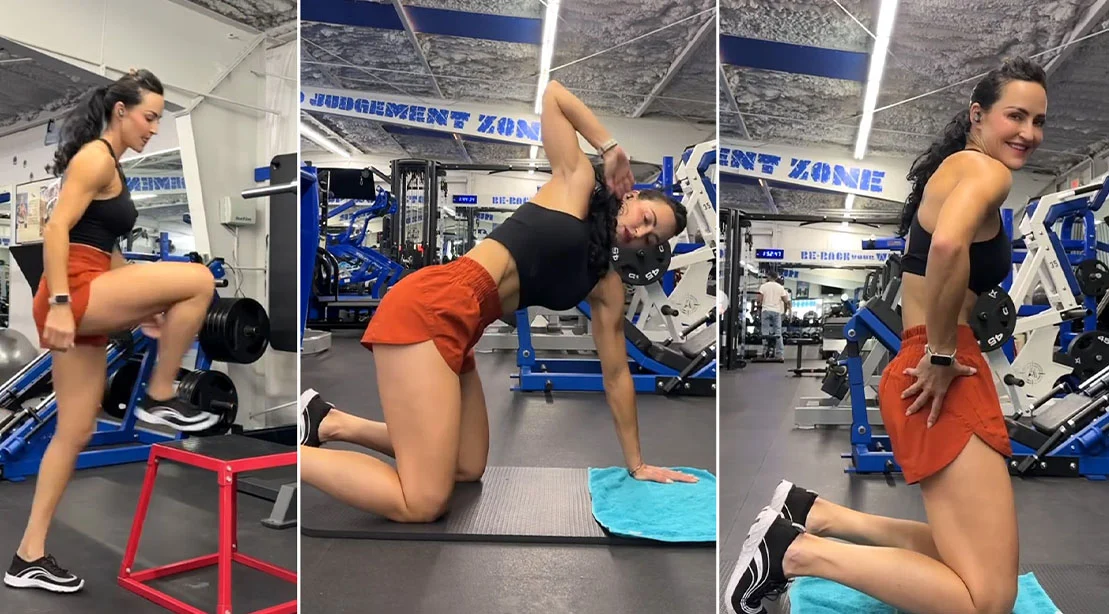
Stern initiates her session by targeting hip flexor health. Using a cable station with a foot cuff, she performs high knees. This move provides a controlled, constant-tension stimulus to the hip flexors, which are notoriously tight in sedentary populations. By strengthening the hip flexors, she ensures that her stride remains powerful and her pelvis remains in a neutral, healthy alignment.
2. Pogo Jumps
For those looking to build fast-twitch muscle fibers, Stern recommends Pogo jumps. These can be performed on the floor or, for added intensity, onto a box or aerobic stepper. The key here is not necessarily the height of the jump, but the speed of the contact. By ensuring both feet touch the platform simultaneously and minimizing ground contact time, the athlete forces the body to utilize the stretch-shortening cycle, which is essential for maintaining youthful movement patterns.
3. Depth Jumps
Depth jumps represent the next level of reactive training. By stepping off a box and immediately launching into a jump upon landing, the athlete trains their reaction time. This is the pinnacle of functional longevity training; it prepares the nervous system to handle the unexpected stresses of real-world movement.
4. Thoracic Spine Rotations
Upper back mobility is the "forgotten" element of fitness. Stern uses mat-based T-spine rotations to counteract the kyphosis (rounding of the upper back) that often occurs with age. By improving rotation in the thoracic spine, she alleviates the burden on the lower back and shoulders, promoting better posture and more efficient movement during daily tasks.
5. Cat-Cow Stretches
Stern incorporates the cat-cow, a staple of physical therapy, to maintain lower back health. This movement serves as a "reset" for the spine, mobilizing the vertebrae and ensuring that the muscles surrounding the lumbar region remain supple rather than locked in a state of tension.
6. The Vacuum
To conclude the session, Stern performs abdominal vacuums. While often associated with the classic bodybuilding era, the vacuum is a functional exercise for the transverse abdominis—the deep core muscle that acts as a natural weight belt. A strong transverse abdominis is essential for spinal stabilization and maintaining a trim, healthy waistline.
Supporting Data: The Case for Mobility-Centric Training
The scientific community increasingly supports Stern’s "less is more" approach for long-term health. Studies on sarcopenia (muscle loss) and osteopenia (bone loss) indicate that while traditional resistance training is the gold standard for hypertrophy, it is often insufficient on its own to maintain the neuromuscular reflexes required for fall prevention in older adults.
According to researchers, the loss of fast-twitch fibers (Type II) is the primary driver of the "frailty" associated with aging. These fibers are the first to atrophy when training is strictly limited to slow, controlled movements. By incorporating plyometric-style work—the "bounce" that Stern advocates—athletes can preserve these vital fibers well into their later years. Furthermore, the emphasis on mobility drills like the cat-cow and thoracic rotations addresses the loss of spinal range of motion, which is a leading contributor to chronic low back pain.
Implications for the Modern Fitness Enthusiast
What does this mean for the average gym-goer? It signifies a shift in the definition of a "good workout." For decades, the measure of success was the weight on the bar. Under Stern’s guidance, the new measure of success is the ease of movement and the resilience of the body.
The implications for the industry are profound. We are seeing a move toward "hybrid training"—a philosophy where the raw strength of the powerlifter meets the fluid agility of the athlete. For those who feel burnt out by heavy lifting or those who are just beginning their fitness journey, Stern’s routine provides a roadmap.
It is important to note, as Stern does, that this is not a permanent abandonment of free weights. Heavy lifting remains the primary tool for muscle protein synthesis and structural integrity. However, by incorporating these mobility and agility drills as a warmup or a standalone session, individuals can protect their joints and nervous systems from the wear and tear of repetitive heavy loading.
Final Recommendations: How to Start
If you are looking to integrate Erin Stern’s longevity protocol into your life, the key is patience.
- Breath Control: Focus on diaphragmatic breathing throughout the movements. This stabilizes the core and prevents the nervous system from becoming overstimulated.
- Slow and Steady: Do not rush the transition from movement to movement. The quality of the stretch or the precision of the jump is far more important than the heart rate.
- Integration: If you are currently training with free weights, use these moves as a high-quality, 15-minute mobility warmup.
- Listen to the Body: As with any longevity program, the goal is to leave the gym feeling better than when you arrived. If a movement causes discomfort, regress the intensity until your mobility allows for a full range of motion.
In a fitness culture that often obsesses over the "newest" supplement or the "heaviest" set, Erin Stern is a reminder that the most valuable asset you own is a body that moves without pain. By focusing on the fundamentals of agility and mobility, you aren’t just training for today—you are investing in the years to come.
 Lina Irawan
 Lina Hope
 rifanmuazin
