

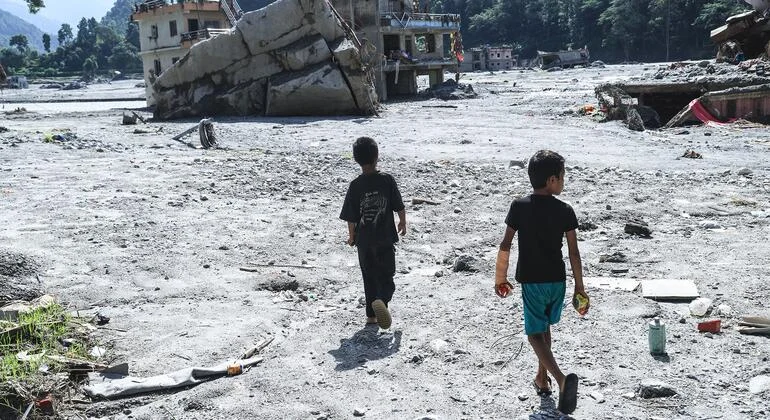
In the wake of the devastating glacier-collapse-induced floods that swept through northern Nepal on August 26, a secondary, often invisible, emergency has taken hold. While the world’s attention remains fixed on the reconstruction of roads, power grids, and water systems in the Rasuwa, Nuwakot, and Dhading regions, humanitarian agencies are warning of a burgeoning mental health crisis. With thousands of children left traumatized, separated from their families, or mourning the loss of their homes and loved ones, the path to recovery is proving to be as much about healing the mind as it is about rebuilding the physical landscape.
The Scale of the Catastrophe: Main Facts
The disaster, triggered by a catastrophic glacier collapse, has left an indelible mark on the Himalayan nation. Over 84,000 Nepalis have been directly affected by the deluge, a population that includes approximately 32,000 children. The physical destruction is staggering: critical infrastructure, including essential transport arteries and educational institutions, has been razed, leaving entire communities isolated and vulnerable.
The human cost is equally grim. Official reports from local authorities in Nepal confirm over 1,300 deaths, with more than 5,000 individuals still listed as missing. Across the border in the Tibetan regions, Chinese government figures report at least 43 fatalities and 519 people missing. These numbers, while chilling, do not fully capture the profound disruption to the social fabric of the region. Among the most vulnerable are the 541 children who remain separated from their families—a status that leaves them at high risk of exploitation and deep psychological distress.
A Chronology of the Disaster
The events of August 26 unfolded with terrifying speed. At 8:37 a.m. local time—a moment that coincided with the beginning of the school day for thousands of children—the glacier collapse unleashed a torrent of water and debris.
- 08:37 AM: The collapse occurs, sending flash floods through the valleys of northern Nepal.
- Initial Hours: Search and rescue operations commence under extreme duress, with roads and communication lines severed by the surging waters.
- Immediate Aftermath: Thousands are displaced; parents and children are separated in the chaos of evacuation.
- Days 1–7: Initial relief efforts focus on life-saving medical care and the identification of missing persons.
- Weeks 2–4: International agencies, including UNICEF and Education Cannot Wait (ECW), begin the transition from emergency search-and-rescue to long-term psychosocial support and temporary educational infrastructure.
- Current Status: Ongoing efforts are focused on reunifying the 541 missing children with their families and providing stable, long-term mental health interventions for the survivors.
Supporting Data: The Anatomy of Trauma
The psychological impact of the disaster is not merely anecdotal; it is supported by clinical observations from medical professionals working in the affected zones. Dr. Shitanshu Dhakal, a medical doctor and mental health advocate based in Nuwakot, has characterized the situation as an "invisible burden."
According to Dr. Dhakal, the children who witnessed the destruction of their schools and the loss of family members are exhibiting classic symptoms of severe trauma. Many are struggling with paralyzing fear, debilitating anxiety, and deep-seated grief. In some cases, the trauma is so acute that children have become selectively mute, unable to articulate the horrors they experienced during the flood.
UNICEF’s data highlights the urgency of the situation:
- 84,000: Total number of people affected.
- 32,000: Children affected.
- 541: Children currently separated from their families.
- 9: Number of schools severely damaged or destroyed, cutting off the primary sense of normalcy for children.
- 13: Number of UNICEF-supported Child-Friendly Spaces currently operating to provide sanctuary and structured play.
Official Responses: A Multilateral Effort
The international community and the Nepalese government have moved to coordinate a response that balances physical aid with mental health services. UNICEF Representative in Nepal, Alice Akunga, has been at the forefront of this advocacy. "Beyond the visible destruction, these floods have left deep emotional scars on children and families," Akunga stated. "Children need mental health and psychosocial support to help them process what happened, regain a sense of security and begin to recover."
The response strategy is multi-pronged:
- Family Tracing and Reunification: A priority mission to bring the 541 separated children back to their guardians. To date, 18 successful reunions have been documented.
- Child-Friendly Spaces: These secure, managed environments allow children to engage in structured activities, helping them process their emotions while providing a reprieve from the chaos of displacement.
- Alternative Care: For children who have lost both parents, UNICEF is facilitating family-based care, prioritizing the child’s long-term stability over institutional placement.
- Financial Support: On Tuesday, the UN’s global fund for education in emergencies, Education Cannot Wait (ECW), announced a $1 million allocation to sustain hope and learning for 17,000 children across the three most impacted regions.
The Long-Term Implications: Why Early Intervention Matters
The scientific consensus on disaster response is clear: the window for preventing long-term psychological damage is narrow. Early mental health intervention is not merely a "luxury" of humanitarian aid—it is a critical necessity to prevent acute stress from metastasizing into chronic, lifelong disorders.
The Educational Imperative
The destruction of schools represents more than the loss of buildings; it represents the loss of a vital support network. Maysa Jalbout, Director of Education Cannot Wait, emphasized that with climate-related emergencies occurring with increasing frequency, the global community must ensure that these temporary crises do not result in permanent learning loss. If children remain out of school for extended periods, the risk of child labor, early marriage, and mental health decline rises exponentially.
Bridging the Funding Gap
Despite the $1 million commitment from ECW, the funding requirements to rebuild the educational infrastructure in Rasuwa, Nuwakot, and Dhading remain significant. The nine destroyed schools require massive investment to be rebuilt to modern, climate-resilient standards. Furthermore, the psychosocial programs require sustained, multi-year funding to ensure that the mental health services provided today continue through the coming years of recovery.
A Call for Sustained Resilience
The tragedy in Nepal serves as a sobering reminder of the human cost of climate-related disasters. As the waters recede and the debris is cleared, the focus must shift to the "invisible victims."
The mental health response must be placed at the center of all recovery efforts. This includes:
- Professional Training: Equipping local teachers and community leaders with the tools for psychological first aid.
- Integration: Ensuring that mental health support is embedded within the educational and healthcare systems rather than treated as a siloed, temporary service.
- Global Accountability: Donors must recognize that the recovery of a child is a long-term process that extends far beyond the headlines of a disaster.
As Dr. Dhakal aptly noted, "Children must be at the centre of the mental health response." The future of these regions depends not just on the strength of their roads and the stability of their power grids, but on the resilience and mental well-being of the next generation. The world has a moral obligation to ensure that the children of Nepal are not left to carry the weight of this disaster alone.
By providing sustained, holistic support, the international community can ensure that these young survivors have the tools not just to recover, but to eventually thrive in the face of an uncertain climate future. The recovery of northern Nepal is a marathon, not a sprint, and the most important work—the work of healing—has only just begun.
 Lina Hope
 Asro
Asro
 Layla Zulfa
