

As of mid-2026, the global podcasting industry has matured into a powerhouse of media consumption and commercial enterprise, officially valued at $9.2 billion. This figure, while impressive, represents a departure from traditional metrics that long underestimated the true financial scale of the medium. For years, industry analysts struggled to capture the full picture of podcasting revenue, often ignoring the nuances of consumer-facing models and the massive shift toward video-first podcasting.
The latest Global Podcast Economy Report from Owl & Co, now in its second edition, has emerged as the definitive benchmark for the industry. By auditing five distinct revenue streams—including advertising, subscription models, licensing, live events, and direct consumer contributions—the report provides a granular look at a sector that is no longer just a "hobbyist" corner of the internet, but a cornerstone of the modern digital attention economy.
Main Facts: Measuring the Unmeasurable
The primary takeaway from the current market landscape is that previous valuations were fundamentally flawed. By failing to account for the meteoric rise of video podcasts—where creators leverage platforms like YouTube and specialized video-hosting services—earlier estimates missed billions of dollars in potential market capitalization.
Owl & Co’s findings indicate that the industry is not merely growing; it is diversifying. The traditional "audio-only" model is increasingly subservient to a multi-platform strategy. Advertisers are no longer just buying "slots" in audio feeds; they are buying integrated partnerships that span video clips, newsletter mentions, and exclusive gated content. This shift has forced a recalibration of how investors, producers, and platforms view the podcasting ecosystem.
Chronology: The Path to Maturity
The journey to this $9.2 billion valuation did not happen overnight. The industry’s trajectory can be traced through several critical phases:
- 2023–2024 (The Correction): After a period of "irrational exuberance" where massive capital was poured into production studios, the industry faced a correction. Companies that prioritized growth over sustainable revenue models saw significant contractions.
- 2025 (The Pivot to Profitability): The focus shifted from sheer download volume to "high-intent" metrics. Podcasters began heavily investing in first-party data, CRM integration, and subscriber-only models.
- Early 2026 (The Video Integration): The barrier between "podcasting" and "YouTube creator" effectively dissolved. The most successful shows adopted a "hybrid-first" approach, where visual production value became as critical as audio fidelity.
- July 2026 (The Current State): The release of the second annual Global Podcast Economy Report confirmed that the industry has successfully stabilized. The focus has moved toward long-term monetization, M&A activity, and the professionalization of the "long tail" of independent creators.
Supporting Data: The Anatomy of the Revenue Streams
To understand the $9.2 billion figure, one must look at how that capital is distributed. The Global Podcast Economy Report segments the industry into five key pillars:

1. Traditional Advertising
While this remains the bedrock of the industry, its nature has changed. Dynamic Ad Insertion (DAI) is now the industry standard, allowing for hyper-targeted regional and demographic delivery.
2. Consumer Revenue (Subscriptions and Memberships)
The shift toward platforms like Substack, Patreon, and independent membership sites has empowered creators to bypass middle-men. This segment has shown the highest year-over-year growth, proving that audiences are willing to pay for premium, ad-free, or bonus content.

3. Video-First Advertising
This is the "missing link" that the new report addresses. With video ads often commanding higher CPMs (Cost Per Mille) than audio-only spots, the monetization of video podcasts on platforms like YouTube and Spotify has unlocked a significant revenue reservoir.
4. Licensing and IP Development
The podcasting medium has become the primary R&D lab for television and film. Studios are no longer waiting for a book to be written; they are scouting the top-performing podcasts for narrative IP. This licensing revenue is now a major line item for independent and network-affiliated shows alike.

5. Live Events and Merchandising
The "parasocial" nature of podcasting has proven to be a goldmine for live experiences. From sold-out theater tours to branded merchandise, the most successful creators have transformed their shows into lifestyle brands.
Implications for the Market: The "Long Tail" and M&A
The most compelling aspect of the 2026 data is the performance of the "long tail." While top-tier shows like The Joe Rogan Experience or The Daily continue to dominate the charts, the aggregate revenue of thousands of mid-sized, niche podcasts is now outpacing the major networks.

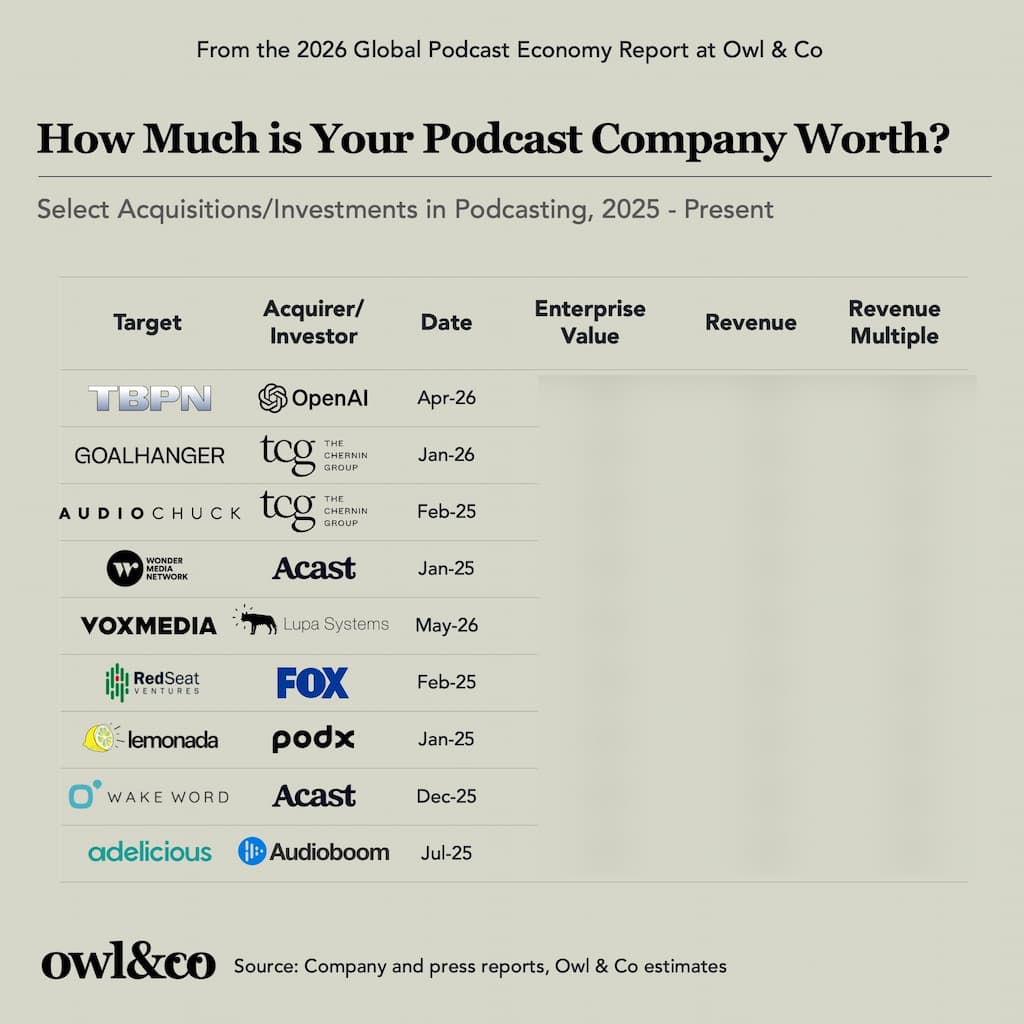
For investors, this shift has significant implications. Acquisitions are no longer strictly about buying "hits." Instead, enterprise value is now driven by:
- Retention metrics: How long an audience stays with a creator across platforms.
- Conversion rates: The ability of a host to drive listeners to a purchase page.
- Data ownership: Companies that own their listener data are commanding a 3x to 5x premium in M&A valuations compared to those reliant solely on third-party platform metrics.
Industry Snapshot: A Diverse Ecosystem
The current landscape is highlighted by a variety of voices and formats that showcase the medium’s versatility. For instance, the Windows Weekly podcast has recently pivoted to address the shifting corporate landscape at Microsoft, specifically analyzing the impact of 4,800 layoffs and the future of the Xbox division. This demonstrates the medium’s role in real-time, deep-dive business journalism.

Similarly, niche but vital content—such as Cry It Out Loud, a non-profit-backed production supporting families dealing with pregnancy loss—highlights how podcasts serve as critical support networks. Meanwhile, Ernstfall: What if Russia Attacks NATO? serves as a prime example of the medium’s capacity for complex, intellectual simulations, bridging the gap between political theory and public discourse.
Official Perspectives and Expert Analysis
Industry experts note that the 2026 report is a "wake-up call" for legacy media companies that have been hesitant to commit to the format. By quantifying the revenue that was previously "hidden" in video and direct-to-consumer models, the report provides a roadmap for sustainable growth.

"The industry has matured," says one analyst familiar with the report. "We’ve stopped measuring success by the number of downloads, which is a vanity metric. We are now measuring success by customer lifetime value and brand equity. That is how you sustain a $9.2 billion industry."
Looking Ahead: The Future of Podcasting
As we move into the second half of 2026, several trends are poised to shape the remainder of the year:

- AI Integration: The use of AI in production—from automated editing and noise reduction to synthetic voice-cloning for global distribution—is lowering the barrier to entry while increasing output quality.
- Increased Regulation: As the industry hits this valuation, it is attracting the attention of regulators. Expect increased scrutiny on data privacy and the transparency of ad disclosures in the coming months.
- Global Consolidation: We are likely to see a wave of consolidation in the European and Asian markets as US-based giants look for new growth opportunities, while international creators continue to produce high-value, localized content that rivals American production standards.
The Global Podcast Economy Report serves as both a scorecard and a manual. It proves that the "podcast boom" was never a bubble; it was the infancy of a permanent, indispensable pillar of the digital media landscape. Whether it is a one-minute tip show helping creators improve their craft or an in-depth geopolitical wargame, the podcasting industry has proven that there is a place for every voice—and, more importantly, a market for every listener.
For those looking to navigate this landscape, the advice is clear: prioritize direct relationships with your audience, diversify your revenue streams beyond simple ad-sales, and, if you are in the business of growth, pay close attention to the metrics that actually matter. The $9.2 billion figure is not the ceiling; it is the floor.
 Asep Darmawan
 Jia Lissa
 Neng Nana
