

The digital landscape has once again erupted in a familiar, albeit controversial, debate: the existence of the "Trump Curse." Following Argentina’s devastating defeat to Spain in the 2026 World Cup Final, social media platforms were flooded with claims that the presence and commentary of President Donald Trump served as a supernatural harbinger of doom for the Argentine squad. While sports historians and data analysts often dismiss such phenomena as mere coincidences, the sheer frequency of high-profile athletic collapses occurring in the wake of the President’s involvement has created a compelling—and increasingly viral—narrative that fans and critics alike are finding difficult to ignore.
The 2026 World Cup Finale: A Stage for Superstition
The atmosphere at the 2026 World Cup Final was electric, charged with the weight of history and the presence of global leaders. However, for many fans of Lionel Messi and the Argentine national team, the day was marred by a sense of impending misfortune.
In a pre-match interview with Fox’s Jenny Taft, President Trump offered what many considered the “kiss of death” for the Argentine captain. “I would say that it’s hard to bet against Messi… I won’t pick sides. I just think it’s very hard to bet against Messi. He’s great,” the President remarked. While seemingly a benign compliment, the internet—well-versed in the lore of the “Trump Curse”—immediately flagged the comments as a bad omen.
Compounding the tension was the President’s simultaneous geopolitical posturing. During the NATO summit in Ankara, Turkey, Trump leveled sharp criticism at Spain, stating, “We don’t want to do any trade with Spain anymore. Spain is a terrible partner in NATO.” By publicly disparaging the eventual victors while offering praise for the favorites, Trump effectively alienated both sides of the match, setting the stage for a narrative of cosmic retribution.
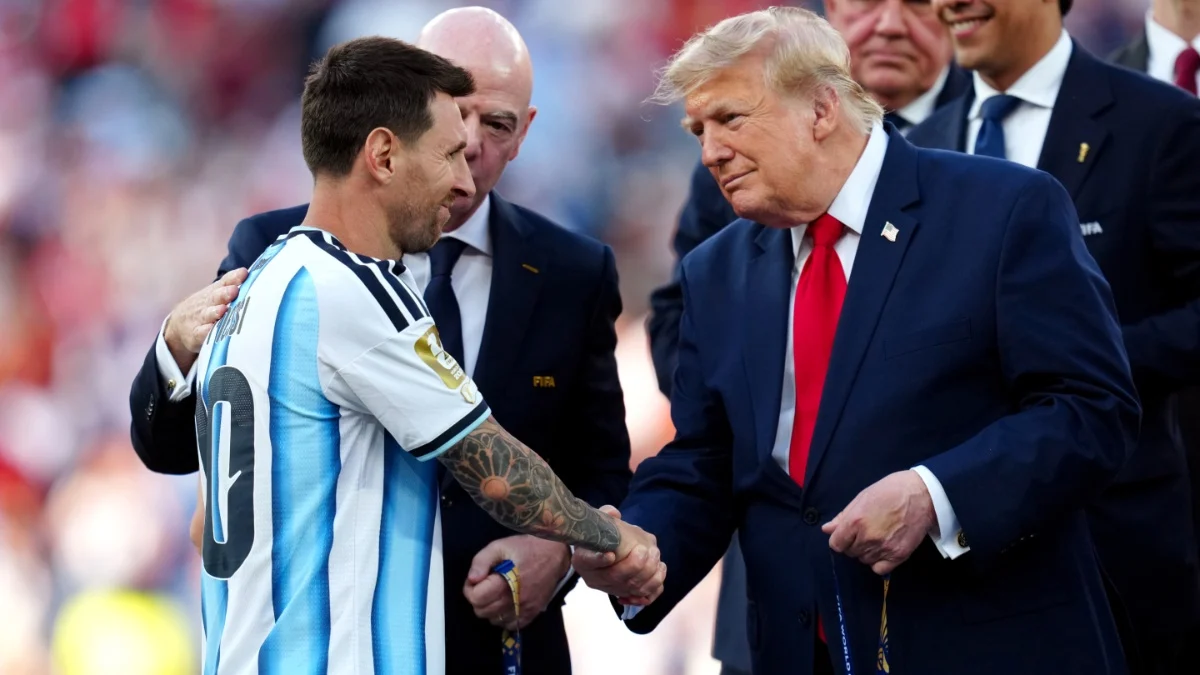
When the President took the field for the trophy ceremony, the reception was stark. Boos cascaded from the stands, a visceral rejection that echoed throughout the stadium. His interaction with Lionel Messi—a brief, perfunctory exchange during the silver medal ceremony—became an instant focal point for social media users, who pointed to the cold chemistry as evidence of the curse in action.
Chronology of the Curse: A Pattern of Sporting Misfortunes
To understand the fervor surrounding the “Trump Curse,” one must look at the timeline of events that have occurred throughout the President’s tenure. The 2026 World Cup loss was not an isolated incident; rather, it served as the latest entry in a growing ledger of professional sporting disappointments.
The USMNT and the FIFA Controversy
Earlier in the 2026 tournament, the U.S. Men’s National Team suffered a bruising 4-1 defeat at the hands of Belgium. The lead-up to this game was rife with political interference. President Trump had personally contacted FIFA President Gianni Infantino to request a review of a red card issued to star forward Folarin Balogun. FIFA’s subsequent decision to suspend the one-game ban sparked international backlash. When the U.S. team ultimately crumbled on the pitch, the Belgian Football Association took to social media to mock the administrative intervention, fueling the sentiment that the President’s involvement had disrupted the team’s natural rhythm and invited misfortune.
The New York Knicks and the MSG Cleansing
The curse narrative found perhaps its most eccentric expression during the 2026 NBA Finals. The New York Knicks, enjoying a historic run, suffered their only loss of the series in Game 3—the only game attended by President Trump. The 111-115 defeat left the Madison Square Garden faithful shell-shocked.
The reaction was immediate and ritualistic. Kazeem Famuyide, a prominent voice in sports media, documented fans congregating outside the arena with sage, attempting to perform a spiritual “cleansing” of the venue. The incident highlighted the desperation of a fanbase convinced that the President’s presence had fundamentally altered the competitive energy of the series.
The 2025 Ryder Cup
The phenomenon also crossed over into professional golf. During the 2025 Ryder Cup, President Trump was a vocal spectator. With the U.S. team trailing, he told reporters with characteristic bravado, “We’re going to get it done. One way or another, we’ll get it done.” The U.S. team went on to lose 15-13, a narrow defeat that many fans pointed to as the direct result of the pressure exerted by the President’s unsolicited optimism.
Supporting Data: Why Fans Believe in the Narrative
Statistical analysis of sporting events rarely accounts for the presence of political figures, yet the "Trump Curse" persists because it taps into the psychological need for narrative structure in sports. Psychologists suggest that the “confirmation bias” plays a significant role here: when a team loses, fans search for an external explanation to mitigate the pain of the defeat.
When the President of the United States—a figure associated with intense polarization—is present, he becomes the ultimate focal point for these frustrations. If a team wins, it is often attributed to the players’ skill. If they lose, the President’s presence becomes a convenient, albeit irrational, scapegoat.
Furthermore, the scale of these events—World Cup Finals, NBA Finals, and the Ryder Cup—ensures that the “curse” is magnified by millions of viewers. A minor regular-season loss rarely gains traction as a supernatural event; however, when the stakes are at their highest, the human desire for a causal link between high-level power and sporting results becomes almost irresistible.
Official Responses and Public Perception
The White House has remained largely silent regarding the “Trump Curse,” viewing it as a trivial byproduct of the President’s high-profile lifestyle. However, sports organizations and team representatives are increasingly wary of the media circus that accompanies his attendance.
In the wake of the 2026 World Cup, several sports journalists have noted that the presence of such a divisive figure can shift the focus from athletic achievement to political theater. For athletes, the added pressure of performing under the gaze of a world leader—especially one who frequently offers public opinions on their performance—is an unconventional challenge that, according to some coaches, can disrupt the locker room focus required for championship-level play.
The Broader Implications: Sports as a Proxy for Politics
The "Trump Curse" is ultimately a reflection of how deeply politics has permeated every aspect of American culture, including the sanctuary of sports. In an era where the lines between the personal, the political, and the athletic have blurred, the President’s involvement in sporting events is viewed by many as an attempt to project authority onto arenas that are traditionally meritocratic.
When these efforts result in failure, the “curse” serves as a social release valve. It allows the public to process disappointment through the lens of irony and folklore. Whether or not one believes in the supernatural, the trend reveals a profound truth about modern society: we are increasingly looking for meaning in the unexpected, and when the President of the United States walks onto the field, the world is watching—not just for the score, but for the story.
As the dust settles on the 2026 World Cup, the legend of the Trump Curse continues to grow. It is a testament to the power of narrative, the weight of public perception, and the enduring, if irrational, human belief that some forces are simply too large to be contained by the boundaries of a playing field. Whether the President will continue to attend high-stakes sporting events remains to be seen, but one thing is certain: wherever he goes, the internet will be watching, waiting to see if the curse strikes again.
Reported by Vritti Johar, with additional analysis and synthesis for comprehensive coverage.
 Neng Nana
 Azzam Bilal Chamdy
 Nana
Nana
