

By Global Fashion & Culture Desk
Published: September 2026
Main Facts
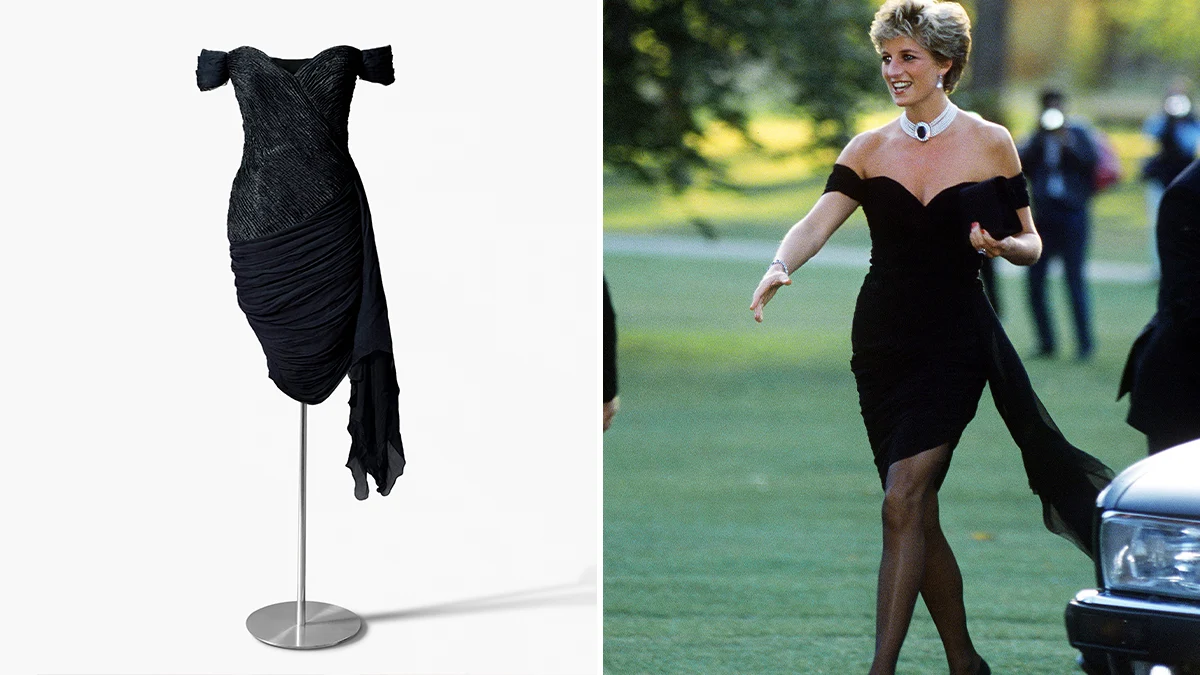
More than three decades after it first redefined the intersection of royalty, high fashion, and personal empowerment, Princess Diana’s legendary "Revenge Dress" is preparing for a landmark return to the public eye. The black Christina Stambolian silk evening dress—universally recognized as one of the most culturally significant garments of the 20th century—is set to be auctioned off by Sotheby’s this December.
The dress, featuring a daring off-the-shoulder, figure-hugging silhouette, is projected to fetch between $150,000 and $300,000 when it goes under the hammer on December 9 at Sotheby’s Breuer Building in New York. However, industry insiders suggest that given its mythical status in fashion history, the final winning bid could far exceed these initial estimates.
Before the live auction, the garment will embark on a high-profile global exhibition tour starting September 18, making stops in international cultural capitals including London, Hong Kong, and Geneva. Adding to the historical provenance of the lot, the winning bidder will also receive a copy of the original 1997 Christie’s auction catalog, personally numbered and signed by both Princess Diana and the dress’s Greek designer, Christina Stambolian. In alignment with the philanthropic spirit that defined Diana’s later years, a portion of the proceeds from the December sale will be donated to the NHS Lothian Charity on behalf of the Royal Edinburgh Hospital.

Chronology: A Timeline of the ‘Revenge Dress’
To understand the immense cultural gravity of the upcoming Sotheby’s auction, one must retrace the precise sequence of events that transformed a simple evening gown into an eternal symbol of resilience.
- Early 1990s: Greek designer Christina Stambolian creates the silk, off-the-shoulder black dress. Princess Diana purchases the garment but keeps it hanging in her wardrobe for years, privately considering the silhouette too daring, bold, and unconventional for a senior member of the British royal family.
- June 29, 1994 (Afternoon): Princess Diana is scheduled to attend a high-profile charity fundraising dinner for the Serpentine Gallery at London’s Kensington Gardens. She initially plans to wear a conservative, traditional gown designed by Valentino.
- June 29, 1994 (Evening): In a last-minute wardrobe pivot that alters royal history, Diana abandons the Valentino option in favor of the Stambolian black number. Aided by her trusted stylist Anna Harvey, who notes that the princess "wanted to look a million dollars," Diana completes the look with black heels, a matching clutch, and a dramatic multi-strand pearl choker centered by a massive sapphire and diamond brooch—a gift from the Queen Mother.
- June 29, 1994 (Night): Simultaneously, across national television, Prince Charles participates in an ITV documentary with broadcaster Jonathan Dimbleby. During the broadcast, the Prince of Wales publicly confesses to committing adultery during his marriage to Diana, confirming his relationship with Camilla Parker-Bowles.
- June 30, 1994: Photographs of Diana smiling radiantly, stepping out of a car and striding purposefully into the Serpentine Gallery, dominate the front pages of virtually every major British and international newspaper, completely overshadowing the Prince’s televised confession. The media promptly dubs the ensemble the "Revenge Dress."
- June 1997: In a monumental act of charity and personal reinvention, Princess Diana hosts a historic auction with Christie’s in New York, selling off 79 of her most iconic gowns to benefit various global charities, including the Royal Marsden Hospital Cancer Fund and AIDS Crisis Trust. An anonymous collector purchases the Stambolian dress.
- September–December 2026: Sotheby’s announces the consignment of the dress for an international tour and subsequent standalone auction in New York, bringing the garment back into the global spotlight nearly 30 years after it was last sold.
Supporting Data and Historical Context
The narrative of the Revenge Dress cannot be separated from the emotional and political climate of the British monarchy in the mid-1990s. By June 1994, the separation of the Prince and Princess of Wales—announced formally in December 1992 by Prime Minister John Major—had devolved into a relentless tabloid war. Every public appearance was dissected, analyzed, and weaponized by the press.
When Princess Diana stepped out of her vehicle at the Serpentine Gallery, she broke multiple unwritten rules of royal protocol:
- Color Protocol: Traditionally, members of the British royal family avoided wearing black in public unless they were in an official period of mourning. Wearing a striking, low-cut black dress directly flouted this royal convention.
- Sartorial Audacity: The dress fell well above the knee and exposed her shoulders and décolletage—a radical departure from the demure, pastel-toned coat dresses and modest tea gowns that defined her early royal wardrobe.
- The Jewelry Statement: By refashioning a piece of the Queen Mother’s heirloom jewelry into a heavy, gothic-adjacent choker, Diana signaled a dramatic reclamation of royal assets for her own modern, independent narrative.
The financial metrics surrounding Diana’s wardrobe have consistently shattered expectations in the secondary market. When the dress was first auctioned in June 1997—just two months before her tragic death in Paris—it fetched a significant sum as part of a lot that raised over $3.25 million for charity. Today, authenticated pieces of Princess Diana’s wardrobe routinely command hundreds of thousands of dollars at auction houses like Sotheby’s and Julien’s, reflecting an enduring global fascination with her life, tragedy, and style legacy.

Official Responses and Expert Perspectives
The announcement of the upcoming Sotheby’s auction has generated widespread commentary from fashion historians, curators, and those closest to the original event.
Morgane Halimi, Sotheby’s Global Head of Handbags and Fashion, emphasized the profound cultural impact of the garment in an official statement released by the auction house:
"On her own terms, Princess Diana turned the dress into one of the most powerful messages she ever made, during one of the most scrutinized and emotionally charged episodes of her life. What became a global viral moment—long before social media made the term mundane—also gave license to anyone, but especially women, to use fashion beyond adornment and much more intentionally and meaningfully: as a shield, a weapon, or both."
Anna Harvey, Diana’s longtime stylist and former British Vogue editor who assisted the princess on the night of the gala, noted in archived accounts that Diana possessed an intuitive understanding of visual communication. Knowing the media circus that would erupt following Prince Charles’s televised confession, Diana recognized that silence could not protect her, but style could project unshakeable confidence.

The anonymous cosigner who acquired the dress at the 1997 Christie’s auction and is now parting with it through Sotheby’s shared a personal reflection on the historic weight of the garment:
"My late husband and I knew that this dress was something special. Princess Diana was walking into the worst night of her life, and you would never know it to look at her. It was an absolute masterclass in grace under fire."
Implications: The Evolution of Fashion as a Tool of Empowerment
The impending sale of the Christina Stambolian dress goes far beyond a simple transaction in the luxury antiquities and fashion market; it speaks directly to how modern society views celebrity, trauma, and autonomy.
1. The Birth of Modern "Revenge" Culture
Long before social media hashtags like #revengedress became standard vernacular for public figures navigating high-profile breakups (most notably mirrored decades later by figures like Emily Ratajkowski, Jennifer Aniston, or Miley Cyrus), Princess Diana established the blueprint. She proved that public vulnerability could be actively countered by unapologetic, high-octane glamour. The dress transformed her from a passive victim of a crumbling royal marriage into the active director of her own public narrative.

2. The Institutionalization of Royal Memorabilia as Fine Art
Historically, royal garments were either dismantled, repurposed, or archived strictly within royal collections. Diana’s decision to auction her own clothes in 1997 democratized royal history, placing iconic pieces into private collections and museums. The 2026 Sotheby’s auction solidifies couture fashion as fine art, where a garment is valued not merely by its fabric, stitchwork, or designer pedigree, but by the historical gravity of the moment it encapsulated.
3. Ethical Collecting and Philanthropy
By tying the auction proceeds to the NHS Lothian Charity on behalf of the Royal Edinburgh Hospital, the sale bridges the gap between high-stakes luxury acquisition and public health philanthropy. This mirrors Princess Diana’s lifelong commitment to charitable causes, ensuring that her legacy continues to fund healthcare initiatives even as her personal garments transition into the hands of elite collectors or museum curators.
As the dress prepares for its grand international tour ahead of the December 9 showdown in New York, the world is reminded once again of why the People’s Princess remains an immortal cultural icon. In the words of fashion critics worldwide, the Stambolian black silk dress is not just a piece of fabric; it is armor sewn into silk, worn by a woman who looked adversity in the eye and refused to blink.
 Evan Lee Salim
 Asep Darmawan
 Laily UPN
