

Main Facts
In the fast-paced, highly synchronized world of modern live music promotion, timing is everything—and sometimes, it is an absolute catastrophe.
Global pop superstar Ed Sheeran currently finds himself in an unprecedented professional predicament: a tour completely devoid of opening acts and, according to recent developments, temporarily stripped of his core backing band. The crisis unfolded after Sheeran bowed to intense public and political pressure, severing ties with his original tour support, rapper Macklemore. The "Thrift Shop" hitmaker had drawn fierce controversy after making pro-Palestine statements during a live set, prompting a swift corporate and cultural backlash.
In a show of solidarity with Macklemore, the remainder of Sheeran’s scheduled opening acts collectively walked away from the tour, leaving the blockbuster trek in operational limbo.
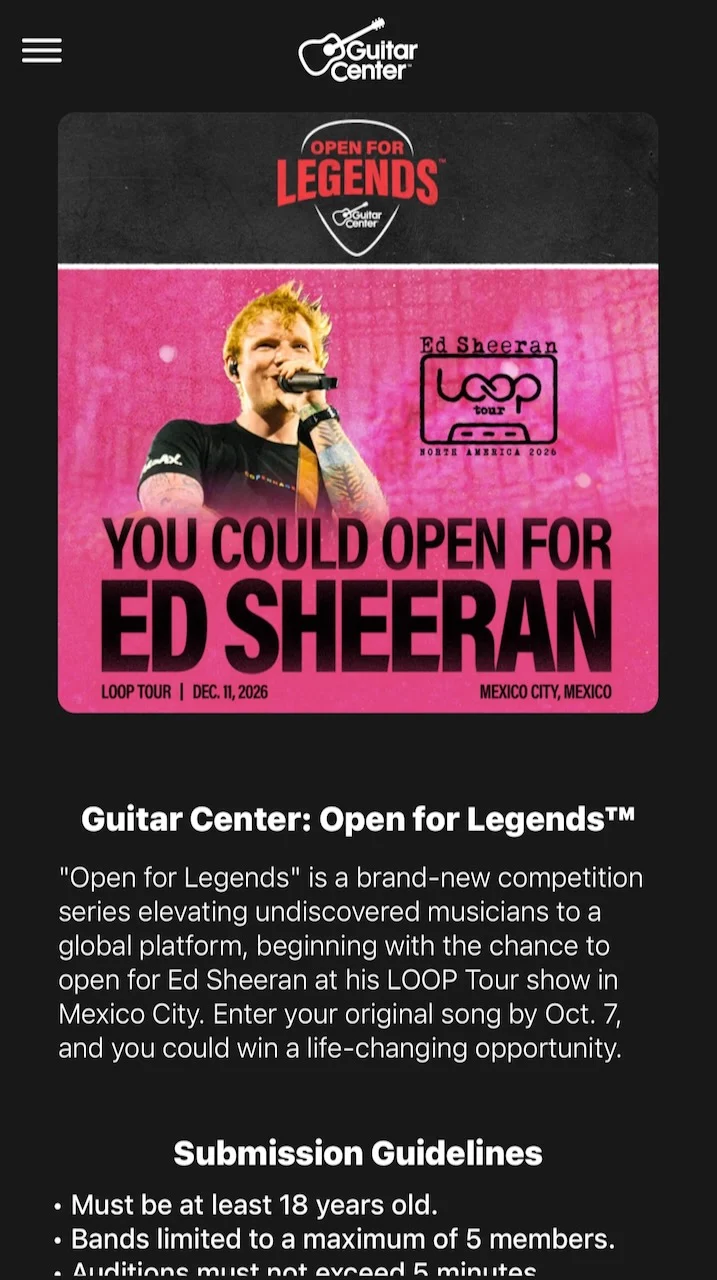
Enter Guitar Center. Weeks prior to the implosion, the retail giant launched a high-profile promotional campaign titled "Open for Legends," offering independent and unsigned musicians the once-in-a-lifetime opportunity to share the stage with a major headliner. That headliner happened to be Ed Sheeran.
Launched on August 19, the contest was conceived as a routine marketing push to discover grass-roots talent. However, in the wake of the mass opener walkout, the campaign’s application page has inadvertently transformed into the most awkwardly timed music industry promotion of the decade. While the competition was designed to spotlight legitimate musical aspirants, the active portal has instead become a viral lightning rod, drawing a wave of satirical, politically charged, and absurdist troll entries from an internet audience watching the Sheeran tour drama unfold in real-time.
Chronology of a PR Nightmare
To understand how a standard corporate contest devolved into an accidental comedy of errors, it is necessary to trace the rapid-fire sequence of events that upended Ed Sheeran’s itinerary.
August 19: The Launch of "Open for Legends"
Guitar Center officially rolls out its "Open for Legends" campaign. The initiative is pitched as a dream come true for bedroom artists, singer-songwriters, and garage bands: submit a performance video through the platform for a chance to win a coveted opening slot on a major arena tour. At this stage, the partnership appears standard, secure, and entirely divorced from geopolitical friction.
Late August: The Macklemore Controversy
Macklemore, serving as a primary support act on Sheeran’s tour, delivers a live performance featuring pointed pro-Palestine remarks. The commentary instantly ignites a firestorm across social media and mainstream news outlets, polarizing fans and drawing fierce scrutiny from various political advocacy groups. Pressure mounts on tour organizers and headliners to distance themselves from the rhetoric.
Early September: The Exodus Begins
Caving to mounting pressure from management, promoters, and external stakeholders, Ed Sheeran makes the executive decision to drop Macklemore from the tour lineup. The removal is swift, but the fallout is immediate and cascading. Rather than viewing the decision as a necessary containment measure, the remaining supporting acts on the bill view it as an act of censorship and bad faith. In a coordinated display of solidarity with Macklemore, every remaining opener abandons the tour within a 48-hour window. Compounding the issue, reports surface that members of Sheeran’s backing band have also stepped back, leaving the "Shape of You" singer with a skeletal production and an uncertain live framework for his upcoming "LOOP" tour dates.
Mid-September: The Guitar Center Awakening
As media outlets and fans dissect the wreckage of the tour roster, observers stumble upon a glaring oversight: Guitar Center’s submission page for the Sheeran opening slot is still live, active, and accepting entries. What was once an aspirational career boost suddenly looks like an open-air casting call for desperate replacements. Internet culture takes the wheel, turning the portal into a viral playground for cheeky, pointed, and wholly unserious submissions.
Supporting Data and the Anatomy of a Viral Troll
While the official metrics regarding how many legitimate artists have applied to the Guitar Center contest remain closely guarded by the corporation’s marketing department, the cultural footprint of the active campaign is measurable by its sheer absurdity.

The Mechanics of the Contest
- Eligibility: Open to unsigned solo acts, duos, and bands residing within designated promotional regions.
- Submission Criteria: Entrants must upload a high-definition video performance demonstrating stage presence, musical capability, and originality.
- The Prize: Historically, these contests package travel accommodations, localized promotional boosts, and a brief, high-visibility opening set in front of thousands of screaming arena fans.
The Internet Strikes Back
Within hours of the tour’s collapse going viral, the comment sections and submission feeds associated with the Guitar Center campaign morphed. Social media sleuths and internet trolls flooded the digital intake valves with tongue-in-cheek entries.
- The Political Satire: Given that the entire crisis stemmed from geopolitical statements made on stage, a subset of applicants submitted performance art pieces addressing foreign policy, irony, and corporate sponsorship.
- The Absolute Novices: Videos featuring tone-deaf ukulele covers recorded in cluttered bedrooms, pets howling into microphones, and avant-garde noise rock acts submitted applications explicitly referencing their willingness to "cross any picket line for clout."
- The Macklemore Tributes: Several anonymous uploads featured artists performing covers of Macklemore tracks while wearing keffiyehs, directly taunting the tour’s management team and daring them to disqualify or acknowledge the entries.
This grassroots digital mockery highlights a growing fatigue with corporate damage control in the music industry. When a global superstar attempts to quietly sanitize a tour roster under pressure, the internet often responds by turning the administrative machinery back against the organizers.
Official Responses and Corporate Silence
As of press time, the corporate entities at the center of this surreal convergence—including Guitar Center’s executive marketing team, Atlantic Records, and Ed Sheeran’s personal management firm—have maintained a deafening silence.
Guitar Center’s Dilemma
For Guitar Center, the situation presents a classic modern public relations trap.
- Option A: Pull the plug. Discontinuing the contest abruptly could be interpreted as an admission of failure, acknowledging that their headliner is radioactive or that the tour is in terminal disarray. It also risks alienating real musicians who spent time and effort crafting legitimate entries.
- Option B: Let it ride. Leaving the page active allows the internet to continue treating the brand as a punchline. Every day the portal remains open while Sheeran lacks an opener, the campaign generates hundreds of thousands of organic, albeit mocking, impressions across X (formerly Twitter), TikTok, and Reddit.
Industry analysts note that corporate automated marketing schedules are notoriously difficult to halt instantaneously, especially when legal terms and conditions tied to sweepstakes laws are involved. Pulling a legally binding contest mid-stream requires careful navigation to avoid class-action breaches or accusations of censorship.
Ed Sheeran’s Management Strategy
Sheeran’s camp has adopted an insulated, head-down approach. Focused heavily on salvaging the structural integrity of the "LOOP" tour, publicists have largely declined to comment on the logistics of replacing an entire support roster. Whether Sheeran will actually pull an unknown artist out of the Guitar Center submissions pool to face a potentially hostile or hyper-scrutinized arena crowd remains to be seen. Industry insiders speculate that the pop star will likely bypass online contests entirely, instead opting for hand-picked, established session musicians or stealthily securing seasoned legacy acts who are insulated from modern socio-political controversies.
Implications for the Live Music Industry
The intersection of Ed Sheeran’s tour implosion and Guitar Center’s ill-timed marketing campaign is more than just a funny internet anecdote; it serves as a case study in the vulnerabilities of modern tour logistics and the hyper-connected nature of 21st-century fandom.
1. The Perils of Political Entanglement in Live Touring
For decades, rock and pop stars navigated controversies by maintaining a neutral stance or issuing carefully vetted PR statements. Today, audiences demand absolute ideological alignment from artists, and conversely, artists find themselves squeezed between corporate sponsors, volatile fanbases, and personal convictions. The Macklemore incident proves that a single statement by a supporting act can trigger a domino effect that destabilizes a multi-million-dollar international enterprise in less than a week.
2. The Weaponization of Corporate Portals
The Guitar Center debacle demonstrates that corporate engagement platforms are entirely defenseless against coordinated internet subversion. When a brand opens its digital doors to user-generated content without real-time human moderation filters capable of navigating unfolding news cycles, the public will inevitably exploit the vacuum. It signals a shift in how fans interact with promotional stunts: rather than participating passively, internet subcultures actively bend corporate tools to voice commentary, express solidarity, or simply manufacture chaos for comedic value.
3. The Future of the "Open for Legends" Concept
Moving forward, major retail and instrument brands collaborating with pop megastars will likely build "kill switches" into their promotional contracts. The ability to instantly freeze, pivot, or scrub a contest page in the event of a sudden tour cancellation or political controversy will become a standard risk-management protocol.
Conclusion
Whether an unsuspecting, highly talented bedroom guitarist from Ohio will actually be plucked from the chaotic wreckage of the Guitar Center submission page to stand beside Ed Sheeran on an arena stage remains one of pop music’s great modern mysteries. What is certain, however, is that "Open for Legends" has achieved a legendary status of an entirely different kind—cementing itself as a masterclass in catastrophic timing, corporate inertia, and the relentless, unpredictable humor of the internet.
 Asro
Asro
 Lina Irawan
 rifanmuazin
