

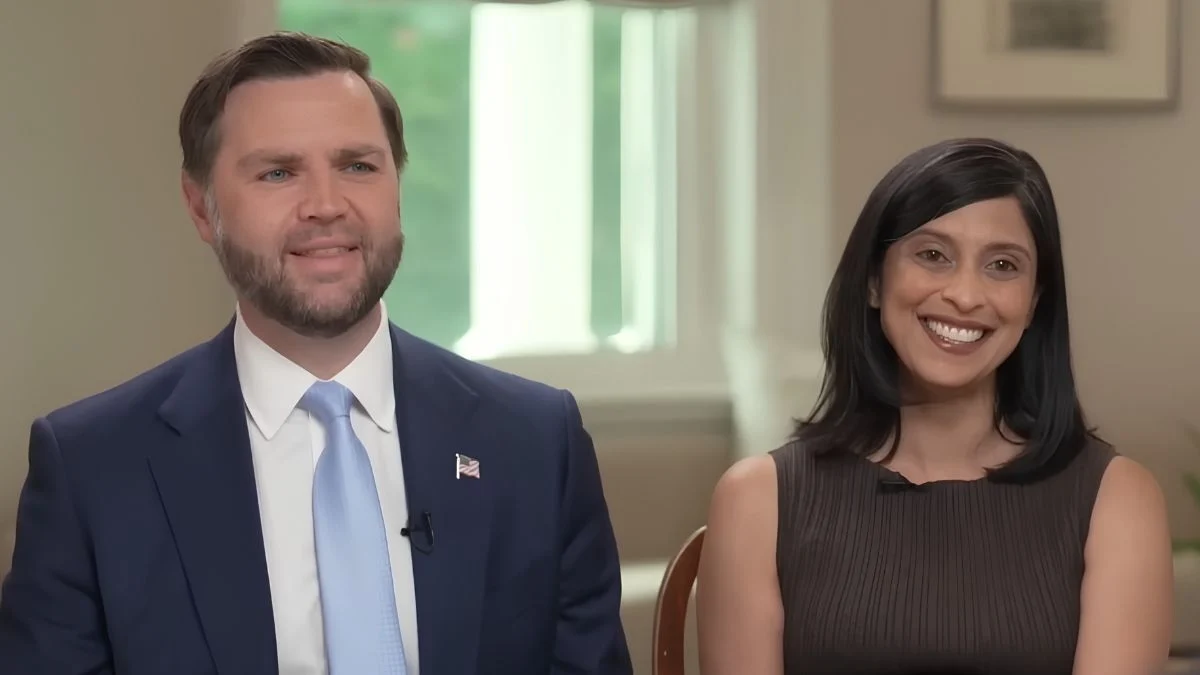
In the high-stakes world of American politics, every choice—from the cut of a suit to the color of a tie—is frequently scrutinized for hidden ideological signals. However, the latest viral moment in the political sphere has inverted this dynamic, turning a bargain-bin maternity dress into a flashpoint for a broader debate on media over-analysis and the relatable habits of the nation’s second family. Vice President JD Vance recently catapulted his wife, Usha Vance, into the spotlight by jokingly suggesting she take the helm of the federal budget, all because she successfully snagged a maternity dress for under nine dollars.
The incident, which began as a lighthearted social media exchange, has evolved into a wider commentary on the intersection of personal fashion, public scrutiny, and the role of the press in interpreting the "aesthetics" of power.
The Chronology of a Viral Fashion Statement
The episode trace its origins to a New York Times profile that examined the evolving image of Usha Vance, currently pregnant with the couple’s fourth child. The piece posited that the sartorial choices made by the Vice President’s wife were not merely matters of personal preference, but carried "deeper political significance." The report suggested that, within the current administration, there exists an "intuitive and strategic understanding of the power of aesthetics," implying that even a simple maternity dress might be a coded message to the electorate.
Usha Vance, known for her sharp legal mind and measured public presence, did not take the analysis lying down. On June 24, she took to X (formerly Twitter) to address the report directly. She shared a screenshot of her receipt, revealing that the coral maternity dress in question—a piece that had been subjected to intense stylistic deconstruction by the media—was purchased from Old Navy for the modest sum of $8.75, a fraction of its original $50 retail price.
"Now that we know the political significance of my $8.75 coral maternity dress from Old Navy," she quipped, "can’t wait to hear what the New York Times has to say about my elastic-waistband pants and compression socks!"
The following day, JD Vance joined the fray, doubling down on the humor. Responding to his wife’s post, he declared: "She bought a $50 dress for $8.75. America: meet your next director of the federal budget!"
Contextualizing the "Second Lady" Aesthetic
The dress in question was worn by Usha Vance during a Father’s Day installment of her YouTube series, Storytime with the Second Lady. The series, which features the Vice President and his wife reading to children, has served as a platform for the couple to project a more domestic, approachable image.
Critics and supporters alike have long debated whether the "Second Lady" role carries an implicit requirement for a specific, often high-fashion, aesthetic. By emphasizing the thriftiness of her wardrobe, Usha Vance signaled a rejection of the expectation that public figures must always be draped in high-end couture. For many observers, this served as a bridge to middle-class voters who navigate the same inflationary pressures that make an $8.75 dress a triumph of personal finance.
The New York Times report had argued that an "unspoken dress code" had developed among the administration, where men are increasingly outfitting themselves in the image of the President. By analyzing Usha Vance’s dress as a part of this broader visual strategy, the outlet inadvertently provided a stage for the Vances to display a level of relatability that is often missing from political discourse.
Official Responses and Public Reaction
The response to the Vances’ social media exchange was swift and polarized, reflecting the current state of American political discourse. Supporters of the Vice President praised the couple for their humor and transparency, framing the incident as a "win" against what they perceive as the out-of-touch nature of mainstream media analysis.
Conversely, the incident sparked a wider debate about the role of the press. Media critics suggested that the Times report, while perhaps over-intellectualizing a maternity dress, was simply following a long-standing tradition of analyzing the public presentation of political spouses. Historically, the fashion choices of First and Second Ladies have been scrutinized for everything from their country of origin to the message they send about national prosperity.
However, the Vances’ decision to focus on the fiscal aspect—the price tag—rather than the design, successfully shifted the narrative from "ideological signaling" to "economic practicality." By choosing to engage with the report via humor, they neutralized the potential for a negative news cycle and instead humanized their brand.
The Implications of "Thrift Store Diplomacy"
The long-term implications of this incident are twofold. First, it highlights the increasing power of social media as a tool for political figures to bypass traditional media outlets. By posting the receipt directly, Usha Vance effectively "fact-checked" the media’s interpretation of her clothing in real-time, stripping the Times report of its analytical gravity.
Second, the incident underscores the precarious nature of political optics in a volatile economy. In an era where many Americans are feeling the squeeze of high prices, a public figure demonstrating that they, too, shop for sales creates a powerful, albeit subtle, political bond. When JD Vance jokingly labeled his wife the "director of the federal budget," he was tapping into a common voter desire: a government that is as careful with the nation’s money as a busy mother is with her family’s shopping budget.
This "thrift store diplomacy" serves as a reminder that in the modern political arena, the most effective communications strategy is often the one that feels the most authentic. By owning the narrative—and the receipt—the Vances demonstrated that they understand the optics of the moment better than those attempting to analyze them.
A Broader Look at Political Fashion Analysis
While the New York Times report was the catalyst for this specific exchange, it is worth noting that the history of political fashion is rife with such moments. From Jackie Kennedy’s pillbox hats to Michelle Obama’s integration of high-street brands like J.Crew into her wardrobe, fashion has always been a proxy for the broader goals of an administration.
The difference in this instance is the speed at which the "meaning" of the fashion was challenged. In the past, such analyses would go unanswered, leaving the public to accept the media’s interpretation of the clothes. Today, with platforms like X, the subject of the profile can provide their own context, turning an investigative piece into an interactive conversation.
The Vances’ response suggests a new tactical approach: if you cannot stop the media from writing about you, ensure you are the one defining the terms of the conversation. By leaning into the absurdity of assigning "political significance" to a $8.75 garment, the couple effectively mocked the premise of the inquiry, making the original report appear unnecessarily heavy-handed.
Conclusion: The New Frontier of Political Communication
As the political cycle continues to accelerate, the lines between personal life and public policy will continue to blur. The "maternity dress saga" may seem trivial to some, but it provides a masterclass in modern crisis management and public relations.
Whether the Vances’ humorous approach will translate into long-term political capital remains to be seen. However, for now, they have successfully navigated a potential "gotcha" moment by weaponizing transparency and humor. As for the $8.75 dress, it has moved beyond the realm of maternity wear; it has become a symbol of a new, more combative, and decidedly more informal era of American political engagement.
In the end, Usha Vance’s message was clear: she is not interested in being a prop for media analysis. She is, however, perfectly happy to share a good story, a laugh, and a bargain-hunting tip—and in the world of modern politics, that might just be enough to resonate with the American public.
 Neng Nana
 Azzam Bilal Chamdy
 Nana
Nana
