

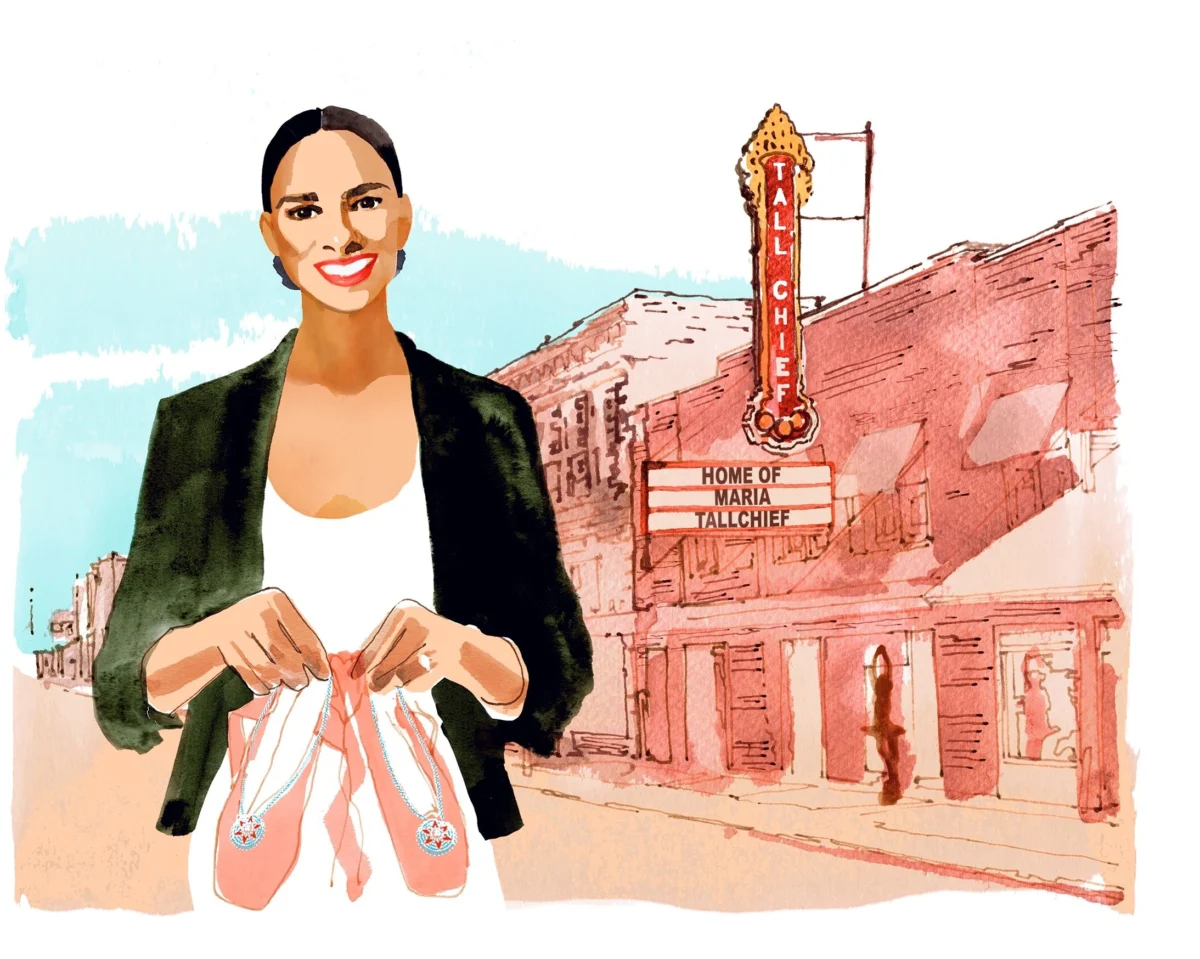
For most of her career, Misty Copeland has been a nomad of the stage. As one of the world’s most recognizable dancers, her life has been defined by the transient nature of touring—a blur of airports, dressing rooms, and hotel suites across the United States. Yet, despite her exhaustive travel schedule, she admits that the opportunity to truly experience the landscapes she visits is often elusive. That changed in 2023, when a research trip to Fairfax, Oklahoma, transformed from a professional obligation into a profound journey of cultural reconnection.
Seeking to uncover the roots of Maria Tallchief—the Osage woman who shattered glass ceilings to become America’s first prima ballerina—Copeland stepped into the heart of the Osage Nation. What she found was not merely historical archives, but a living, breathing landscape that fundamentally altered her perspective on her craft, her country, and her own identity.
A Pilgrimage to the Roots of American Ballet
The Historical Significance of Maria Tallchief
To understand the gravity of Copeland’s visit, one must first recognize the stature of Maria Tallchief. Born in Fairfax in 1925, Tallchief rose to prominence in the 1940s and 50s, eventually becoming a principal dancer with the New York City Ballet. Under the direction of George Balanchine, she redefined the possibilities of classical dance, becoming the first Native American to hold the title of prima ballerina. Her legacy is not just one of technical perfection; it is a story of indigenous resilience against the backdrop of the "Reign of Terror," a dark period in Osage history characterized by systemic exploitation and violence.
The Atmospheric Arrival in Fairfax
Copeland’s arrival in Fairfax was marked by the raw, untamed elements of the Oklahoma plains. “It was dark, humid, and pouring rain when we arrived,” she recalls. The setting, characterized by an expansive, open horizon, felt visceral. For a dancer accustomed to the controlled environments of proscenium stages, the Osage landscape offered a different kind of grounding. She describes the land as having a voice of its own, an ancient quality that lent a sense of profound historical weight to the soil beneath her feet.
Chronology of a Journey: From Theater to Tradition
The Tall Chief Theater: A Sanctuary of Memory
The town of Fairfax retains a cinematic, almost nostalgic aesthetic, evocative of an Old Hollywood set. Central to this landscape is the Tall Chief Theater, a structure erected by Maria’s father in 1928. During her visit, Copeland was guided through the space by Maria’s nephew, Russ Tallchief, and her daughter, Elise Paschen.
The theater, with its wood-paneled walls and high, barn-like ceilings, served as a time capsule. Within these walls, the group shared intimate narratives of Maria’s early life—specifically, her precocious start as a dancer. Learning that Tallchief was en pointe by the age of five provided Copeland with a tangible connection to the legend, allowing her to visualize the trajectory of a girl from a small Oklahoma town who would eventually command the world’s most prestigious stages.
The Commemorative Coin and Ceremonial Dance
The culmination of the trip occurred when the Chief of the Osage Nation invited Copeland to the unveiling of a commemorative coin honoring Maria Tallchief. This event moved beyond the formalities of a public ceremony and into the realm of spiritual and artistic communion.
As the rain intensified, the ceremonial drum began to beat—a rhythmic pulse that dictated the atmosphere of the day. The male dancers of the Osage Nation, adorned in intricate, vibrant headdresses, began a traditional stomp dance. Copeland, ever the observer of movement, was struck by the raw physicality of the performance. "I can remember their skin [in the rain], the way their muscles moved and changed shape to the music," she notes. It was a moment where the lines between classical ballet and traditional indigenous dance blurred, highlighting the universal language of human expression.
Supporting Data: The Cultural Fabric of the Osage Nation
The Osage Nation is not merely a historical footnote; it is a vibrant, contemporary community. The recent global focus on the Osage, spurred by literature and cinema (such as David Grann’s Killers of the Flower Moon), has brought a renewed interest in the resilience of its people.
According to cultural historians, the Osage dance traditions serve as a repository of historical memory. The movements performed during the coin ceremony are not simply artistic; they are acts of preservation. For an artist like Copeland, witnessing this connection to heritage offers a stark contrast to the often-insular world of European-based classical ballet. The data of this experience—the rhythm of the drums, the visual language of the headdresses, and the communal pride—constitutes a "deep" America that is often overlooked in the pursuit of national narratives.
Official Perspectives and Community Reception
The invitation extended to Copeland by the Osage leadership signifies a bridge between two distinct spheres of American dance. By welcoming a figure as prominent as the former American Ballet Theatre principal to witness their customs, the Osage Nation asserted the importance of their ongoing cultural narrative.
“There is gravity to being welcomed like that,” Copeland reflects. This reception was not merely a courtesy; it was an act of cultural sharing. It allowed for a synthesis of perspectives: the ballerina who has navigated the institutional hierarchies of classical dance, and the community that has nurtured its traditions despite centuries of external pressure. This dialogue serves as a reminder that the stories of individuals like Maria Tallchief are not isolated incidents of success, but are inextricably linked to the collective history of their people.
Implications: A Shift in Identity
The implications of this trip for Copeland have been internal and profound. For someone who has spent her life performing in the service of art, the experience in Fairfax recalibrated her relationship with her own homeland.
The Re-evaluation of "American" Identity
Copeland acknowledges that the trip "changed" her. Before her arrival in Oklahoma, her perception of American history was largely filtered through her own professional experience. Afterward, she began to view her country through a lens of depth and continuity. The realization that these deep, rich, and historically layered communities exist beneath the surface of the modern United States fostered a new sense of pride.
A Legacy Continued
As Copeland prepares for her own projects—including curating the Joyce’s Ballet Festival and continuing her advocacy for the next generation of dancers—the influence of the Osage Nation remains a guiding force. By honoring the pioneers who came before her, such as Tallchief, and by engaging with the indigenous roots of the land, she is shifting the narrative of American dance. It is no longer just about the elite performance on a New York stage; it is about the stories that constitute the very fabric of the country.
Conclusion: Dancing Through History
Misty Copeland’s journey to Fairfax was more than a research trip; it was an acknowledgment of the debt owed to those who paved the way. In the pounding rain of Oklahoma, amidst the rhythmic stomping of dancers, she found a connection to her heritage and a deeper understanding of the land.
As the author of Firebird Waltz and a leading voice in the arts, Copeland is now carrying these stories forward. Her experience serves as a powerful testament to the necessity of looking backward to move forward—of recognizing that the most profound performances are not always the ones found in a theater, but those that honor the history, the land, and the communities that make the American experience so complex and enduring.
Misty Copeland is a former principal dancer at the American Ballet Theatre and the curator of this year’s Joyce’s Ballet Festival in New York City (August 4–16). Her children’s book, "Firebird Waltz," is available as of August 25. This article appeared in the July/August 2026 issue of Condé Nast Traveler.
 Asro
Asro
 Siti Muinah
