

By Neil Price
Published in Art Review / Special Exhibition Analysis
Main Facts: A Global Epicenter for Late-Capitalist Critique
TORONTO — At the World Economic Forum in Davos, Switzerland, Canadian Prime Minister Mark Carney delivered a stark diagnosis of our current global condition, declaring that humanity is “in the midst of a rupture, not a transition.” This phrase anchors the intellectual framework of Things Fall Apart, the sprawling, ambitious fourth iteration of the Toronto Biennial of Art (TBA).
Curated by Allison Glenn—whose upbringing in Detroit, crossing back and forth into Canada through Windsor, profoundly shaped her transnational perspective—the 2026 edition brings together more than 30 artists and collectives. Eschewing the conventional centralization of mega-exhibitions, Glenn has expanded the Biennial’s footprint. For the first time, works are installed not only across 13 diverse venues in Toronto proper, but also in remote and high-profile international outposts, including Anchorage, Alaska, and New York City’s Times Square.
Building upon the Biennial’s longstanding thematic engagement with water, Glenn takes the Great Lakes as her primary cartographic and metaphorical point of departure. By utilizing these shared aquatic lifelines, the exhibition asks what contemporary artists who grapple with "rupture" can teach a fractured global public about histories, contested borders, and human movement. The timing could hardly be more poignant; with Canada–United States diplomatic and economic relations at an unprecedented historic low, an international exhibition anchored around cross-border shared waterways offers a timely meditation on neighborly interdependence and geopolitical friction.
Yet, despite its breathtaking scale and intellectual ambition, Things Fall Apart invites rigorous debate. While it offers a provocative, discursive exploration of how artists respond to our late-capitalist epoch, its uncritical reliance on the concept of "rupture" raises fundamental questions about historical continuity, colonial foundations, and who actually bears the weight of systemic collapse.
Chronology and Geographical Scope: A Multi-Sited Odyssey
The unfolding of the Toronto Biennial of Art is an exercise in geographical and chronological juxtaposition, moving fluidly from historic traumas to contemporary geopolitical flashpoints across more than a dozen distinct sites.
The Historical and Institutional Anchors
- The Art Gallery of Ontario (AGO): Serves as a major anchor, housing collaborative installations that bridge past atrocities with contemporary landscapes.
- The University of Toronto Art Centre (UTAC): Acts as the exhibition’s primary central venue, hosting immersive, body-engaged installations and spatial interventions.
- The Royal Ontario Museum (ROM): Hosts monumental textile works within its Crystal Court, engaging directly with institutional collections of artifacts, masks, and ancestral objects.
Expanding Beyond the Borderlands
- Scarborough Gurdwara (Scarborough, Ontario): Integrates permanent, site-specific architectural spaces dedicated to spiritual endurance and communal memory.
- Mercer Union: Features contemporary single-channel video works addressing illicit trade, economic blockades, and border volatility.
- Extended Footprints (Anchorage and Times Square): Project the Biennial’s themes into international and Arctic domains, running concurrently through December 20.
The exhibition’s timeline stretches from the historical traumas of the Middle Passage and the underground railroad, through mid-century American school desegregation battles and Inuit forced migrations, all the way to modern-day supply chain disruptions in the Persian Gulf.
Supporting Data and Artistic Encounters
The most affecting works across these varied sites treat histories of rupture not as settled narratives to be safely cataloged, but as living, imaginative encounters to be conjured through sensory and bodily participation.

Tracing the Afterlife of Slavery: Dawoud Bey at the AGO
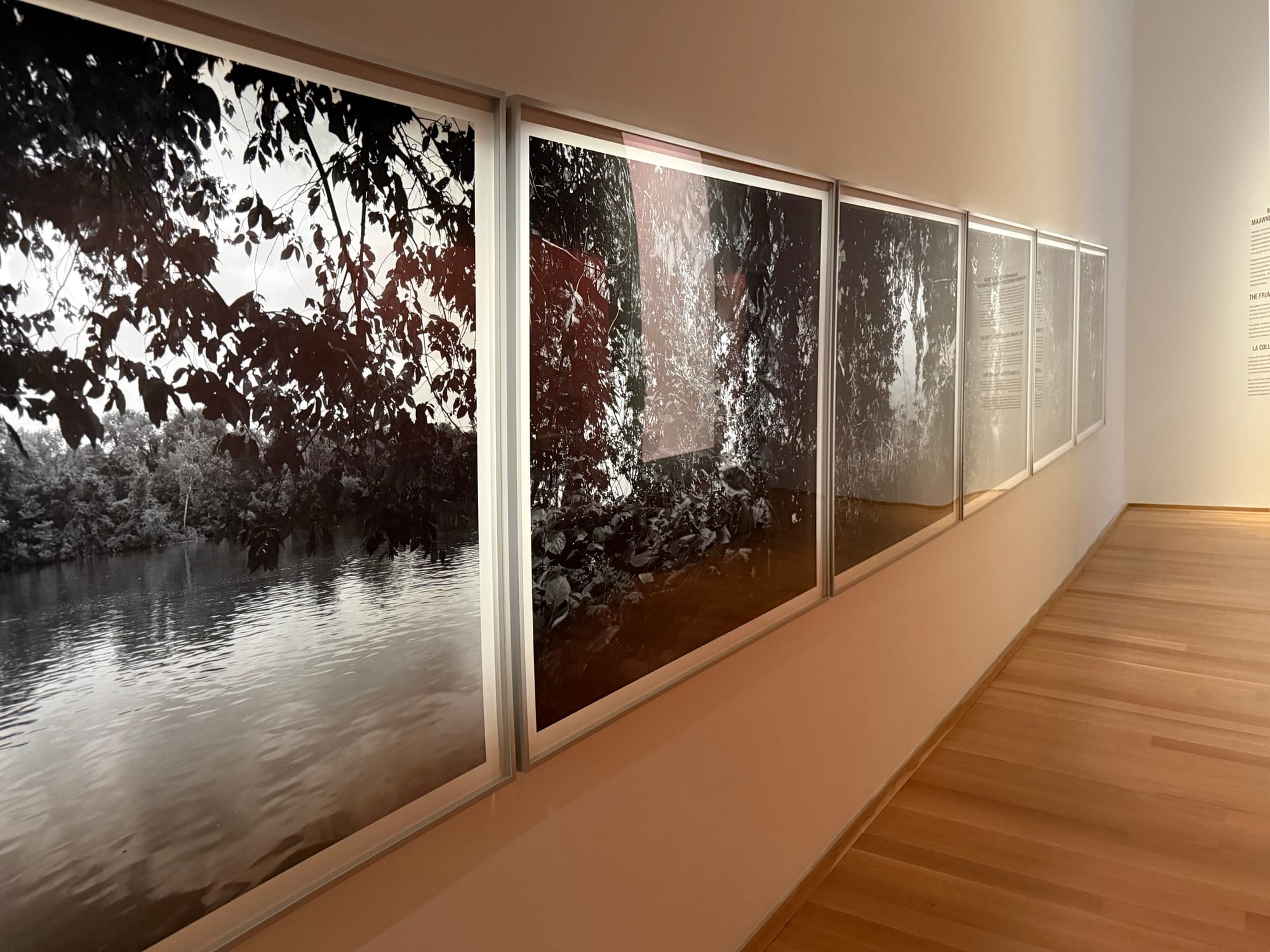
At the Art Gallery of Ontario, veteran artist Dawoud Bey presents Material Histories, Living Landscapes. Bey tightly curates photographs from three distinct landscape series around his haunting two-channel video 350,000 (2023). This visual centerpiece is flanked by sculptures and ritual objects drawn directly from the AGO’s permanent collection, originating from Nigeria, Ghana, and the historical Kingdom of Kongo.
The resulting installation creates a striking sonic and visual call-and-response across the Middle Passage. It vividly elucidates the ways the generational afterlives of chattel slavery continue to permeate the physical world. The film’s point-of-view camera movement through dense, claustrophobic woods—accompanied by the sound of heavy breathing and high-contrast, black-and-white images of gnarled landscapes and decaying historical homes—suggests that the historic and ongoing fight to live free from racialized violence remains profoundly urgent.
Reimagining Archives and Reprogramming Memory: Antonio Obá at UTAC
At the University of Toronto Art Centre, Brazilian artist Antonio Obá constructs an immersive, participatory environment. For Jardim (2022–26), Obá strings rows of delicate brass bells across the entire length of a gallery corridor, forcing visitors to physically brush against them as they navigate a processional path. The work only produces sound when human bodies move through it, emphasizing that memory is an active process—repeatedly reperformed rather than stored as an inert, unchanging artifact.
This processional path culminates in A Folia: travessia (The Revelry: A Crossing, 2026), a monumental painting that boldly reimagines Douglas Martin’s iconic 1957 news photograph of 15-year-old Dorothy Counts bravely integrating a hostile high school in Charlotte, North Carolina. In Obá’s revisionist rendering, the abusive white crowd that jeered, spat at, and harassed Counts is entirely replaced. Instead, she is surrounded by a protective, celebratory assemblage resembling both a supportive political march and a New Orleans-style street carnival.

Obá’s intervention transforms a painful, isolated chapter of American history into a restorative alternate reality. He invites viewers to mentally step into the frame, surrounding Counts with courage, solidarity, and love—urging us to abandon fear and hatred in pursuit of a collective future.
Somatic and Intergenerational Knowledge: Wen Liu and Taqralik Partridge
Shifting from historical macro-narratives to intimate, personal scales, a second cohort of artists explores knowledge held within the human body, organic materials, and ancestral practices.
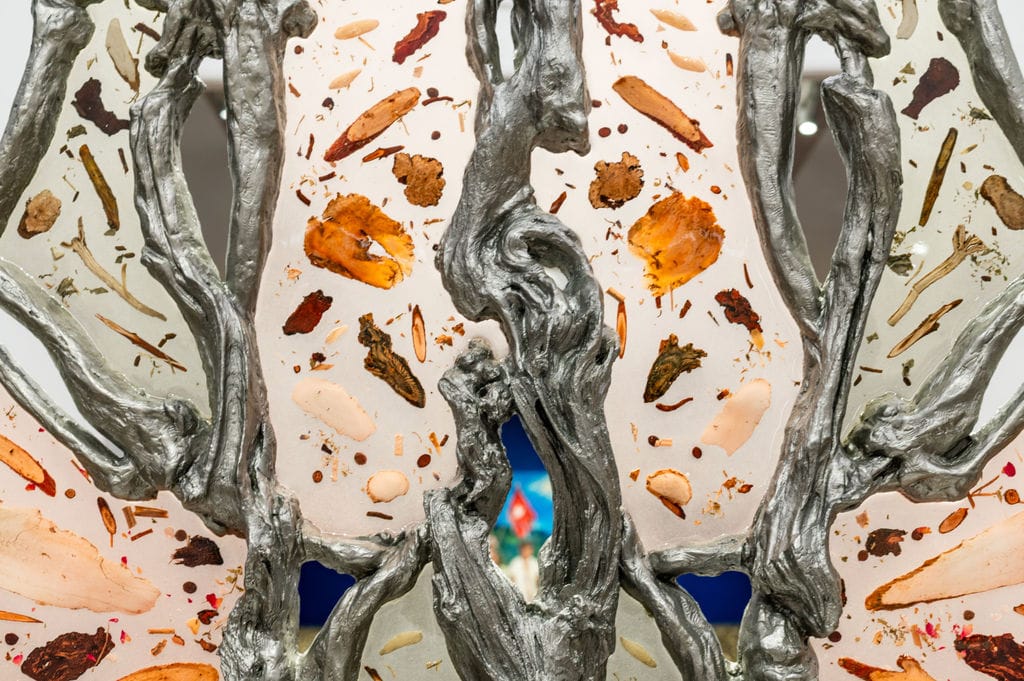
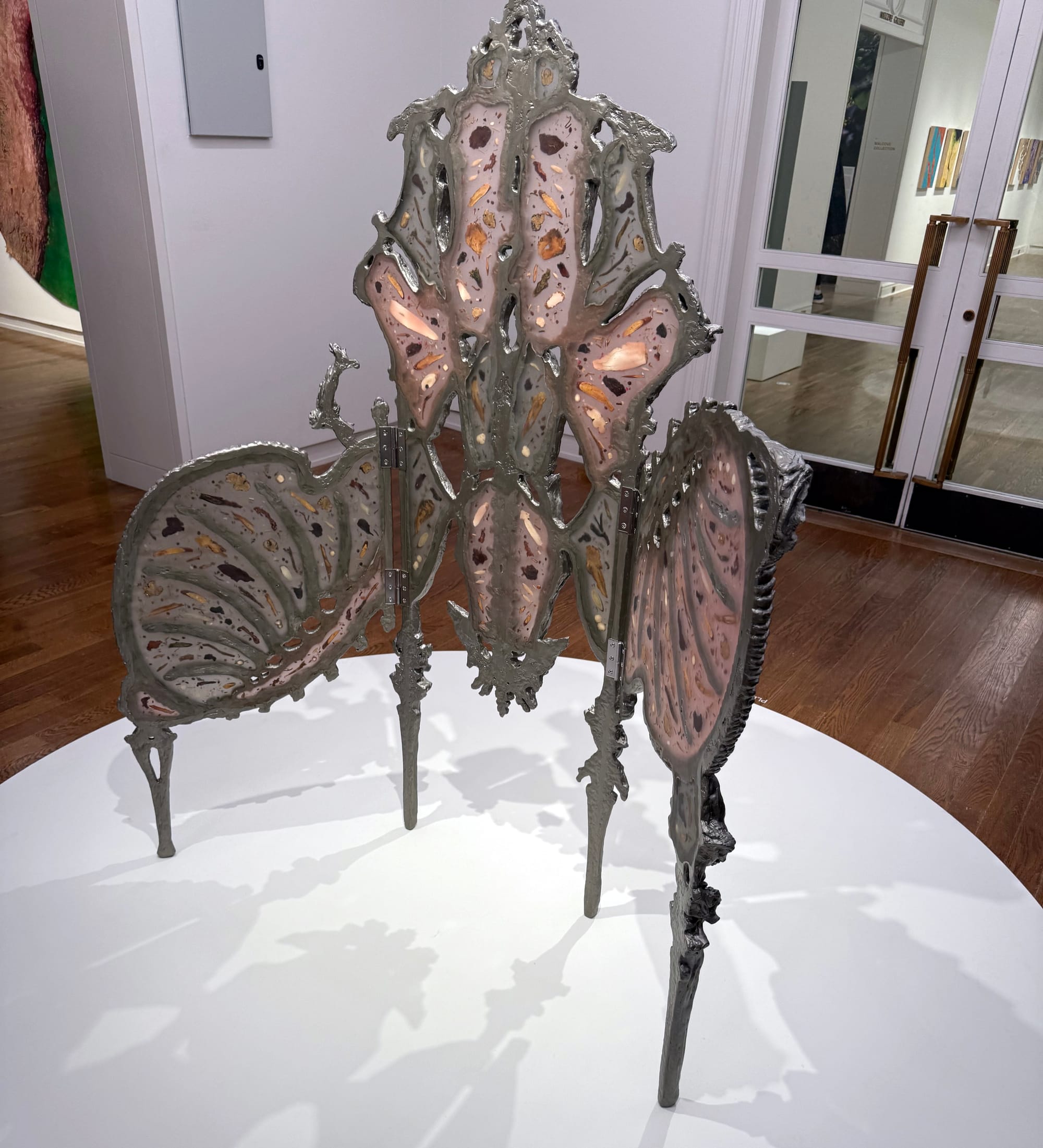
Wen Liu’s In Light, Where Edges Yield (2025) is a human-scale, steel-and-resin sculpture structured around an abstracted spinal column. Suspended within this framework are traditional Chinese herbal medicines prescribed to the artist following her father’s death. Illuminated from within, the herbs glow like stained glass, proposing that the human body acts as a vital repository of familial and cultural memory—one that can illuminate our individual experiences and carry us through periods of intense personal disruption.
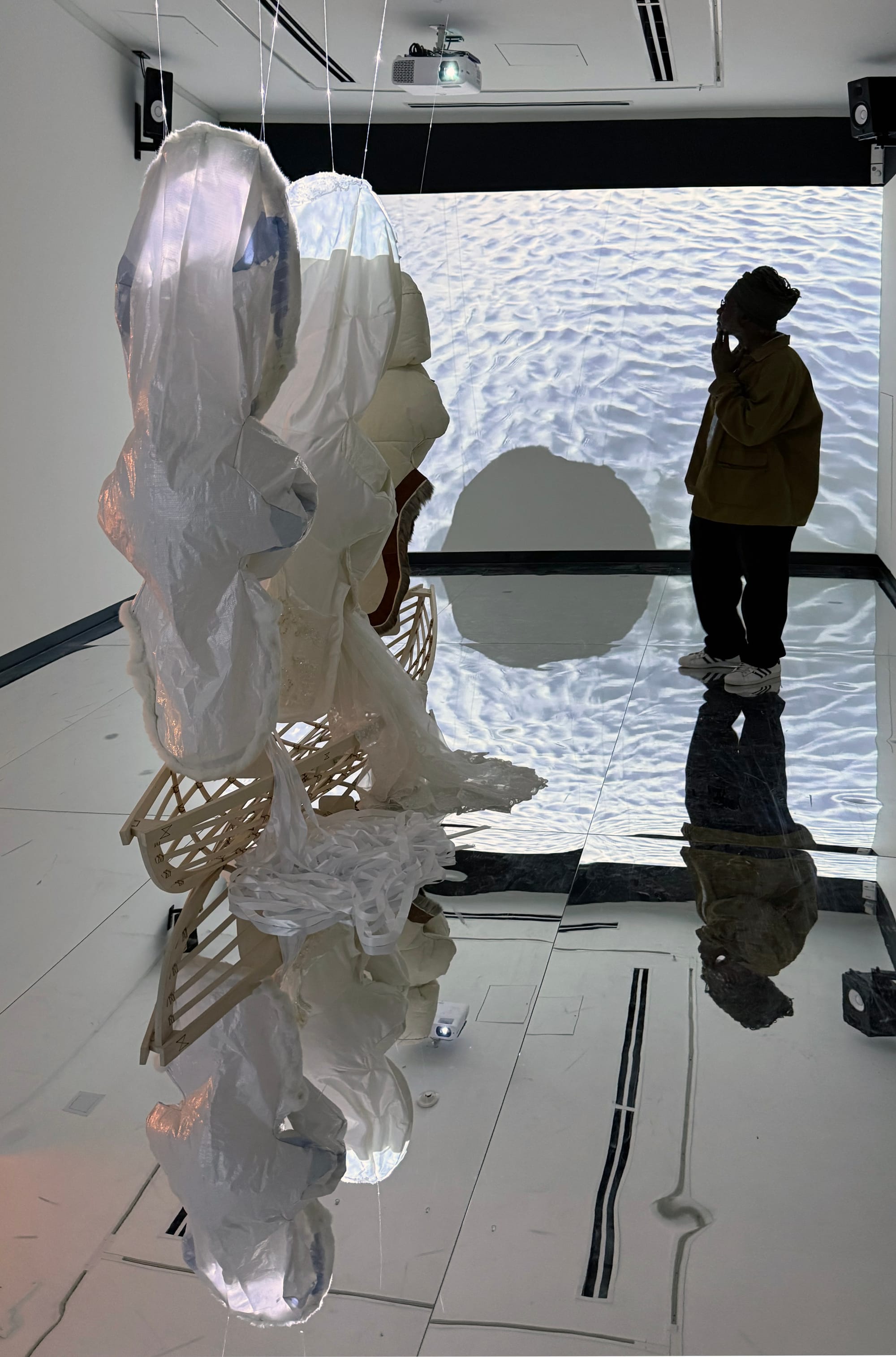
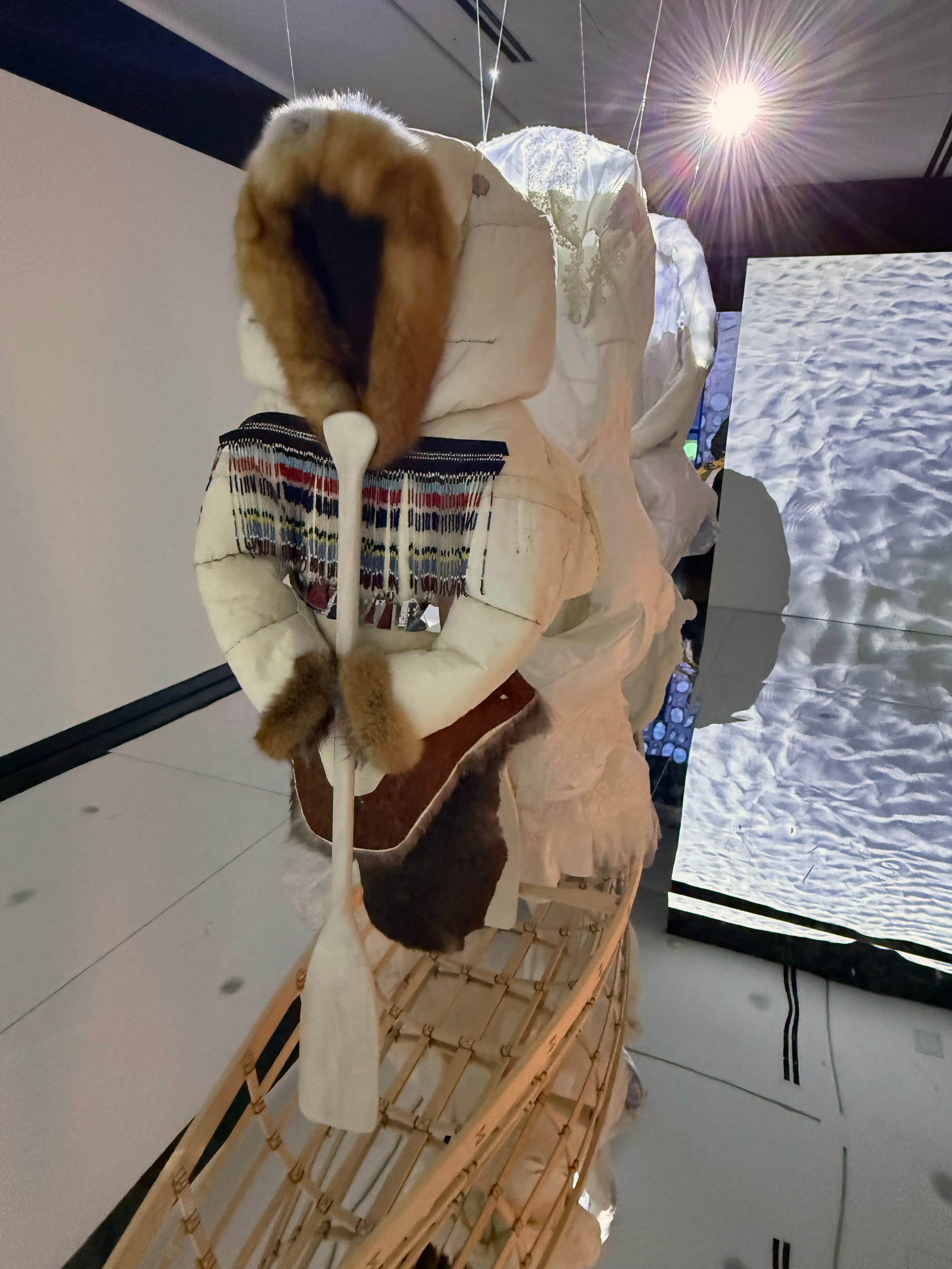
Similarly, Taqralik Partridge’s umiakkut (by boat) (2026) revisits a harrowing migration: the journey her grandmother and siblings undertook across the Hudson Strait aboard a traditional umiaq, an open skin-boat utilized by Indigenous Arctic peoples. Installed within a mirrored, immersive room, Partridge reconstructs the vessel using found materials, meticulous sewing, and intricate beadwork. A soundtrack featuring the voice of an elder relative blends with ambient recordings of water, passing down intergenerational knowledge that serves as an essential survival guide in an era of cascading ecological devastation.
Geographies of Reunion: Raphaël Barontini and Nirbhai Singh Sidhu
Bridging spatial divides, two monumental works reunite communities and histories that were violently severed by empire and diaspora.
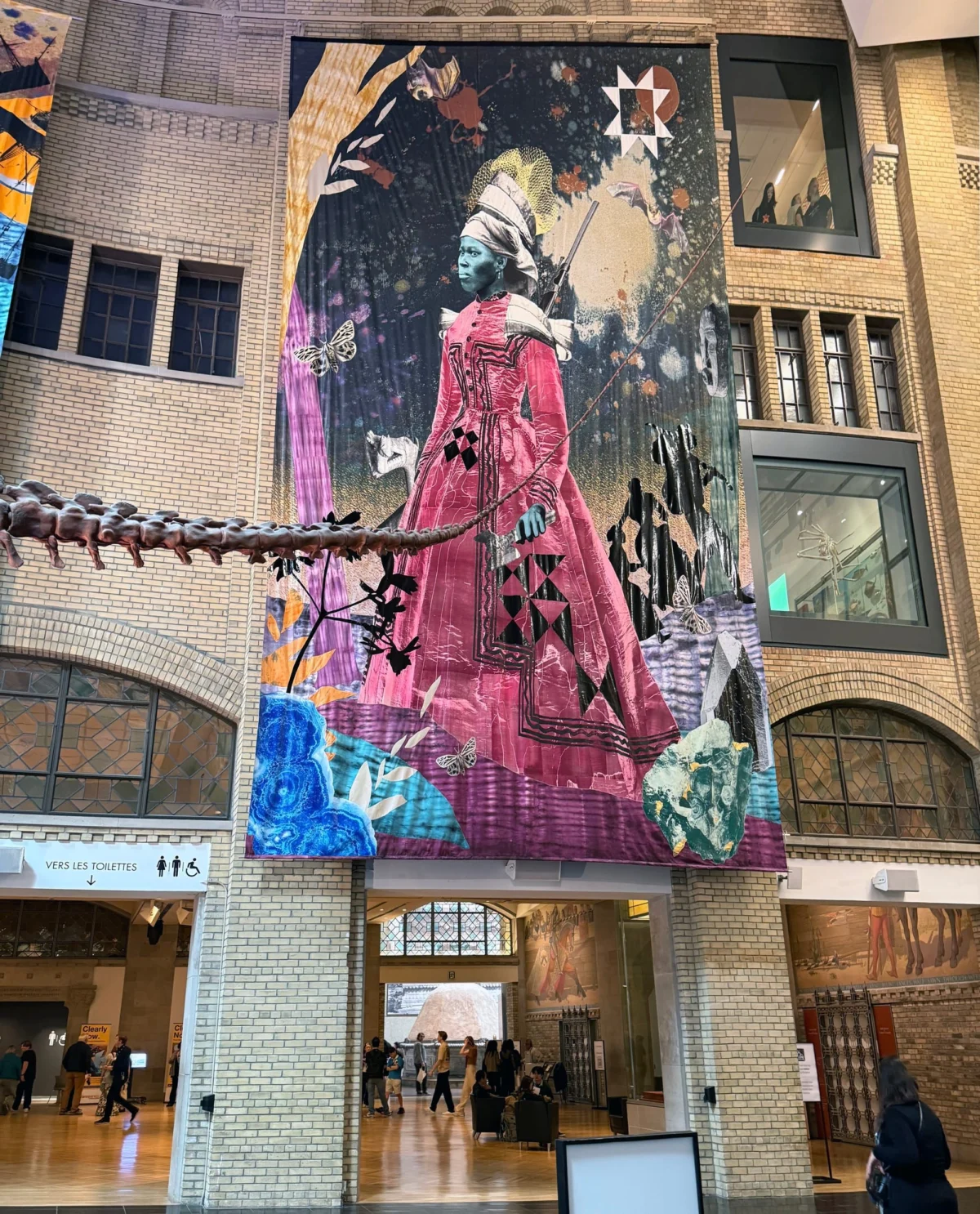
At the Royal Ontario Museum’s Crystal Court, Raphaël Barontini suspends massive, cascading textile panels that merge iconography from masks and sacred objects found within the museum’s collections into a sweeping allegory of the Americas. Follow the North Star — a Tribute to Harriet Tubman (2026) weaves together Caribbean aesthetics—honoring anti-slavery heroines, water deities, and mythical figures—with the clandestine history of the Underground Railroad. The work frames liberation not as a localized event, but as a continuous, collective struggle transcending geographic borders and bridging the physical and spiritual realms.
Concurrently, in the suburban town of Scarborough, Nirbhai (nep) Singh Sidhu presents A Deathless Potential In Remembrance By You (2026). Constructed at the Scarborough Gurdwara using sacred earth transported directly from Sirhind, Punjab, the permanent architectural pavilion is designed for simran—the Sikh meditative practice of stillness, contemplation, and deep listening. Blending bricks, structural steel, and flowing water, Sidhu binds ancestral paths of spiritual awakening directly to the physical architecture of immigrant survival.
Geopolitical Resilience: Rouzbeh Akhbari at Mercer Union
Moving outward to examine geopolitical and macroeconomic systems, Rouzbeh Akhbari’s 30-minute film Of Wool and Diesel (2026) at Mercer Union tracks the perilous, informal sheep trade operating around the Strait of Hormuz. The work intimately connects pastoral shepherds and wandering flocks to illicit smugglers and desperate moneychangers. Produced as active warfare in Iran threatened to permanently shut down regional trade routes, Akhbari’s lens refuses to treat rupture as absolute enclosure. Borders may close, and official economic corridors may collapse, but human ingenuity, persistence, and cross-border exchange stubbornly endure.
Official Responses and Curatorial Intent
Curator Allison Glenn has defended the expansive, decentralizing strategy of Things Fall Apart as a necessary reflection of a multipolar, hyper-connected world under stress. In her catalog essays and public talks, Glenn emphasizes that the exhibition does not seek to offer neat resolutions to the multiple crises of our era. Instead, it creates platforms where localized artistic practices can converse with global systemic failures.
Institutional partners, including the Art Gallery of Ontario and the University of Toronto, have echoed these sentiments, highlighting the importance of public engagement during periods of profound civic alienation. Representatives from the Toronto Biennial of Art have noted that extending the exhibition’s physical footprint into non-traditional venues—such as community religious spaces and public thoroughfares like Times Square—is a deliberate effort to democratize contemporary art discourse and bring difficult conversations regarding climate, migration, and sovereignty directly to the public square.
Critical Implications: Questioning the Narrative of "Rupture"
Despite the undeniable brilliance of individual installations, Things Fall Apart faces significant structural and conceptual headwinds.
From a logistical standpoint, the sheer physical distance spanning across more than 13 disparate Toronto venues—combined with a dizzying thematic breadth that leaps from Inuit Arctic migration to underground smuggling rings in the Persian Gulf—makes it exceptionally difficult for visitors to hold the exhibition together as a unified whole.
However, the deepest intellectual critique of the Biennial lies in its foundational premise. The term "rupture," as invoked by Prime Minister Mark Carney and adopted by the curatorial team, fundamentally presupposes a prior state of unity, stability, and global order. Throughout its catalog essays and wall texts, the exhibition remarkably fails to adequately interrogate or problematize this assumed prior unity.
As viewers navigate the powerful works of Bey, Barontini, and others, a persistent, uncomfortable question arises: Was there ever a historical moment since the advent of modernity—which remains inextricably bound to chattel slavery, colonial extraction, imperial conquest, forced migration, and indigenous genocide—when the so-called global world order did not feel utterly ruinous to those on its underside?
For marginalized populations across the globe, what elites and institutions label as a sudden "rupture" is often nothing more than the daily, foundational reality of modern capitalism finally catching up to the centers of power. The rupture may feel unprecedented only because it is newly felt by those who spent centuries designing the world to suit their own comfort.
Despite this conceptual blind spot, Things Fall Apart succeeds brilliantly on a micro-level. By refusing to lapse into passive mourning over what has broken, the participating artists demonstrate how imagination, somatic memory, and communal solidarity can forge enduring pathways through the ruins of our present epoch.
“Things Fall Apart,” the fourth iteration of the Toronto Biennial of Art, remains on view at venues across Toronto and select international locations through December 20. Further program details and ticketing information can be accessed via the official Toronto Biennial of Art website.
 Evan Lee Salim
 Suro Senen
 Nana Wu
