

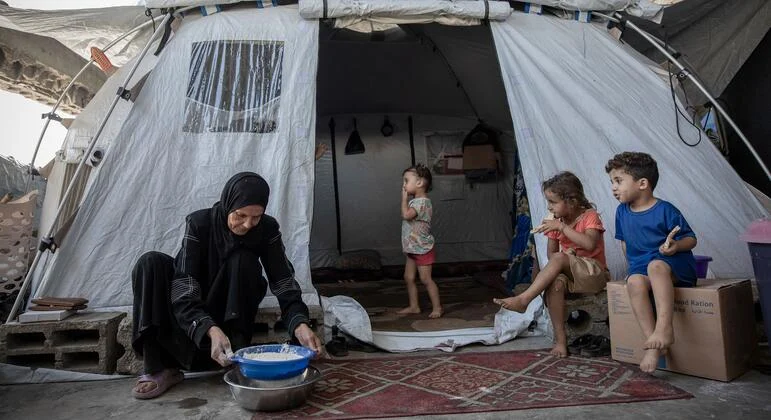
As the conflict in Gaza enters a harrowing new phase, the humanitarian situation has deteriorated into what international observers describe as a “perfect storm” of structural collapse, systemic violence against aid workers, and an imminent weather crisis. With hundreds of thousands of families bracing for their fourth winter living in makeshift, precarious tents, the infrastructure of survival is failing. Simultaneously, the West Bank is witnessing an unprecedented surge in state-sanctioned and settler-led violence, while the systematic erasure of the free press has left the region in a state of information darkness.
The Humanitarian Stranglehold: Aid Operations Under Siege
The United Nations Office for Project Services (UNOPS) has issued a dire warning regarding the safety of humanitarian corridors in Gaza. In a recent statement, Executive Director Jorge Moreira da Silva confirmed that UNOPS convoys and premises were targeted in three separate incidents over a single week.
These incidents represent a disturbing trend of total disregard for the protected status of humanitarian organizations. Da Silva detailed a series of harrowing events: close-proximity explosions threatening the lives of transport teams, the arbitrary detention of drivers at military checkpoints, and the calculated firing of small-arms rounds into a UNOPS guesthouse.
"The safety of UNOPS staff has been compromised too many times," Da Silva stated, emphasizing that all parties to the conflict possess an absolute legal obligation under international humanitarian law to ensure the security of aid workers. However, as of late 2026, the environment in Gaza has become functionally ungovernable for aid agencies, who are now forced to operate under the constant threat of lethal force.
A Chronology of Increasing Risk
- Early Week: Multiple UNOPS convoys are halted at checkpoints, resulting in significant delays for critical fuel and food deliveries.
- Mid-Week: A UNOPS guesthouse sustains direct small-arms fire, forcing a temporary cessation of operations in the affected sector.
- Late Week: Proximity explosions near humanitarian distribution hubs cause a pause in the handover of medical supplies to local health clinics.
The Looming Winter Catastrophe
While the headlines are dominated by combat, a silent, secondary crisis is unfolding on the ground. A comprehensive shelter assessment conducted by the UN indicates that roughly 950,000 people are currently residing in displacement sites categorized as having a "medium to high risk" of catastrophic flooding.
As the rainy season approaches, the standard of living for these displaced populations has hit a nadir. Families are currently sheltering in deteriorated tents that offer negligible protection against the plummeting temperatures, high winds, and torrential rains.
Despite the blockade and extreme funding shortfalls, the UN and its partners have attempted to mitigate the damage. Recent data shows that in the last week, teams successfully delivered food, blankets, winterized clothing, and essential fuel. Furthermore, educational initiatives—a small, vital attempt at normalcy—resulted in the distribution of school bags to over 8,000 children, while 300 classrooms were furnished to support approximately 60,000 students. Yet, these efforts are increasingly viewed as a “drop in the ocean” compared to the scale of the destruction.
Escalation in the West Bank: A Region at a Boiling Point
While Gaza remains the focal point of the global crisis, UN Secretary-General António Guterres has expressed "deep alarm" regarding the spiraling violence in the West Bank. The recent Israeli offensive in Hebron has further destabilized an already volatile region.
Associate Spokesperson Daniela Gross, speaking on behalf of the Secretary-General, emphasized the UN chief’s condemnation of the violence. "He is deeply alarmed by the intensifying violence in the West Bank. He condemns the violence. And he also firmly opposes the settler attacks in the region," Gross stated during a daily briefing in New York.
The Human Cost: A Statistical Overview
The data provided by the UN Office for the Coordination of Humanitarian Affairs (OCHA) paints a grim picture of the period spanning from January 2025 to September 2026:
- Palestinian Fatalities: 331 individuals killed, including 77 children.
- Displacement: More than 42,000 Palestinians forced from their homes.
- Israeli Fatalities: 21 individuals killed in the West Bank during the same period.
- Settler Violence: A staggering 3,684 recorded attacks by Israeli settlers resulting in direct physical injury or property damage.
The sheer volume of settler attacks—averaging several incidents every single day—has created a climate of fear and economic paralysis for Palestinian communities, who are increasingly unable to access their agricultural lands or travel safely between towns.
The War on Information: Media Under Attack
Perhaps the most chilling development in the conflict is the systematic dismantling of the Fourth Estate. Francesca Albanese, the UN Special Rapporteur on the situation of human rights in the Palestinian territory occupied, recently delivered a virtual briefing that highlighted the “unprecedented” scale of violence against journalists.
The briefing itself was a testament to the constraints on international oversight; Albanese was unable to attend in person due to travel sanctions imposed by the United States.
The Erasure of the Press
According to UN sources cited in Albanese’s report, nearly 300 journalists and media workers have been killed since the escalation of hostilities. Furthermore, over 100 media professionals have been detained, with widespread, credible reports of torture occurring within the detention facilities.
The physical infrastructure of journalism has been almost entirely eradicated:
- Infrastructure Loss: Approximately 150 media centers and offices have been destroyed, representing 80% of Gaza’s total media capacity.
- West Bank Suppression: Over 139 separate attacks on journalists have been recorded in the West Bank alone.
- Foreign Access: The ongoing ban on foreign journalists entering Gaza remains in effect, effectively preventing independent verification of the conflict’s most egregious crimes.
Albanese noted that the lack of accountability—exemplified by the unresolved killing of journalist Shireen Abu Akleh—has created a culture of total impunity. "The update is impunity," she remarked, noting that the cycle of violence is fueled by the knowledge that perpetrators will not face legal consequences.
However, the report also offers a broader critique of regional governance. Albanese acknowledged that the suppression of journalists is not solely the domain of the Israeli military; she documented instances of intimidation and repression of Palestinian journalists by both Hamas in Gaza and the Palestinian Authority in the West Bank.
Implications for the Future: A Legal and Moral Vacuum
The convergence of these events—the targeting of aid workers, the collapse of shelter infrastructure, the intensification of violence in the West Bank, and the systematic silencing of the press—points toward a broader regional destabilization.
The international community finds itself at a crossroads. The reliance on humanitarian aid in the absence of a political solution has proven to be an unsustainable model. As the winter sets in, the vulnerability of the displaced population will only increase, potentially leading to mass casualties due to exposure and disease, rather than direct combat.
Furthermore, the destruction of the media infrastructure means that the world’s ability to witness the unfolding catastrophe is being fundamentally curtailed. When the history of this period is written, the silence of the international community, paired with the active destruction of the record, will be cited as a primary failure of 21st-century diplomacy.
As Secretary-General Guterres and other UN officials continue to plead for a de-escalation, the reality on the ground remains defined by the absence of the rule of law. Without a fundamental shift in the protection of civilian infrastructure and an end to the culture of impunity, the humanitarian, social, and political consequences for the region will likely reverberate for generations.
The coming months will be a test of whether international institutions retain the relevance to protect the most vulnerable or if they will continue to be relegated to the role of chroniclers of a widening disaster. For the families in the tents, the clock is not just ticking—it is counting down to a winter that many are ill-equipped to survive.
 Basiran
 Muslim
 Ammar Sabilarrohman
