

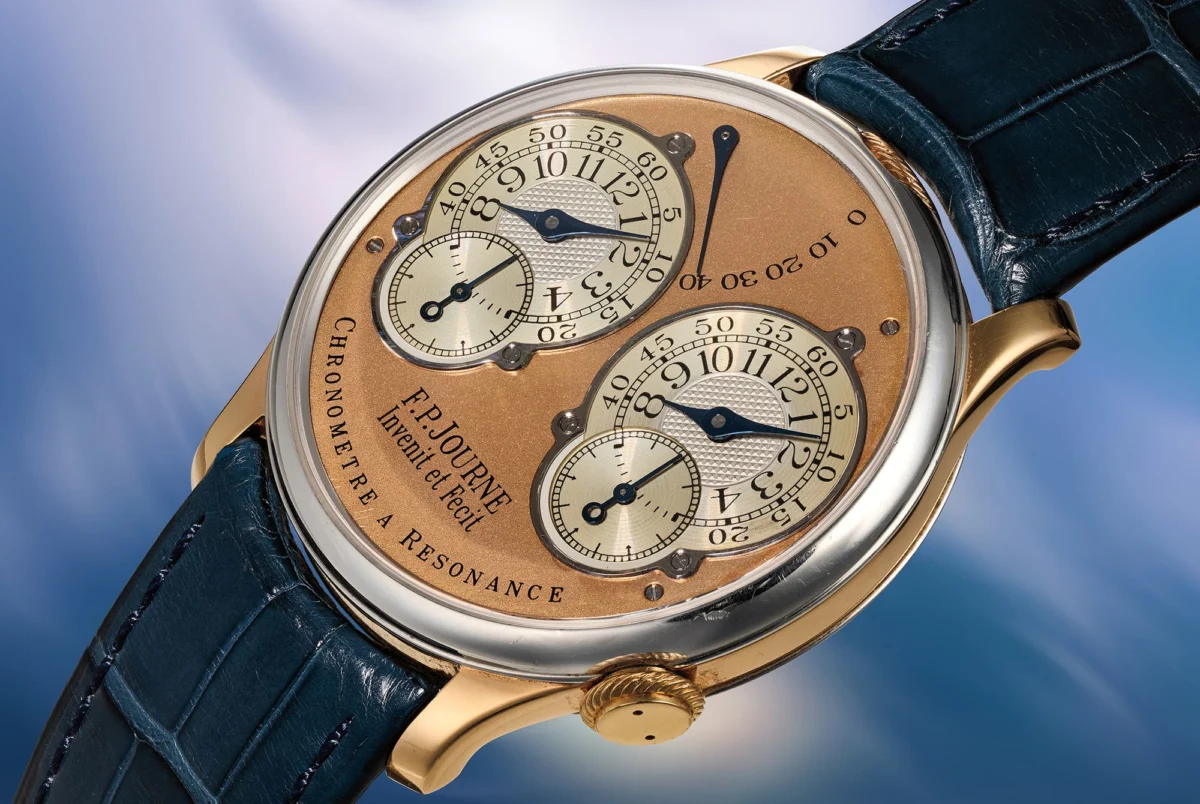
If there was ever any lingering debate regarding the status of François-Paul Journe as the preeminent independent watchmaker of the modern era, that conversation has been definitively settled. This past weekend, at the Phillips New York: Watch Auction XIV, the horological world witnessed a seismic shift in market valuation. The F.P. Journe Chronomètre à Résonance “Souscription, No. 007” hammered home at a staggering $13.92 million, shattering records and establishing a new paradigm for independent watchmaking at auction.
This historic sale does more than simply inflate the price tag of a rare timepiece; it cements the 21st century as an era defined by the rise of the individual visionary over the established, multi-generational conglomerate.
The Magnitude of the Sale: A New Benchmark
The $13.92 million result is not merely the highest price ever achieved for an F.P. Journe timepiece; it represents the most expensive watch ever sold by an independent maker at a commercial auction, as well as the highest price ever fetched for a 21st-century watch. The intensity of the moment was palpable, as the bidding war reached its fever pitch in just nine minutes, leaving the room stunned as the gavel fell.
To understand the scale of this achievement, one must look at the previous records. Before this weekend, the ceiling for independent watches was anchored by the legendary Philippe Dufour. His Grande & Petite Sonnerie wristwatch commanded $5.7 million at Christie’s in 2023, while a private sale of another Dufour Grande & Petite Sonnerie fetched $7.63 million via A Collected Man in 2021. Journe’s “Souscription No. 007” has effectively nearly doubled the previous public record, signaling a massive revaluation of what collectors deem “blue-chip” assets in the independent watchmaking space.
The Intellectual Architecture of the Résonance
To appreciate the value, one must appreciate the science. Introduced in 2000, the Chronomètre à Résonance was more than a commercial product; it was the translation of one of horology’s oldest and most complex intellectual curiosities into a wearable format.
The phenomenon of resonance—where two oscillating bodies synchronize through shared vibrations—had fascinated thinkers since the 17th century. The Dutch polymath Christiaan Huygens first observed that two pendulum clocks mounted on a common support would eventually beat in perfect unison. Later, Abraham-Louis Breguet, the father of modern watchmaking, experimented with the concept in pocket watches, seeking to leverage the effect to improve chronometric stability.

For centuries, however, the concept remained largely theoretical or limited to oversized desk clocks. François-Paul Journe succeeded where others had failed: he miniaturized the physics of resonance for the wrist. By positioning two independent balance wheels and escapements in such close proximity that they exert a subtle, mutual influence, the watch achieves a shared rhythm that theoretically cancels out positional errors and enhances precision. It is a masterpiece of both aesthetics and engineering, solving a problem of physics that few even realized was a challenge.
A Chronology of Faith: The “Souscription” Era
The true provenance of No. 007 lies in the humble beginnings of the F.P. Journe manufacture. Between 1999 and 2000, before the brand was a global sensation, Journe faced the universal challenge of the independent artisan: securing capital to turn vision into reality.
Taking a page from the playbook of his idol, Breguet, Journe offered a series of 20 early Résonance watches to a select group of "founding clients" through a subscription model. These collectors were asked to provide upfront deposits to fund the production of the first pieces. In hindsight, these were not just transactions; they were acts of profound faith. These 20 individuals were wagering on an unknown watchmaker, betting their capital on a man who had yet to prove his viability on the global stage.
The Souscription pieces became the cornerstone of the brand’s mythology. No. 007 is particularly significant, as it is one of only two known examples cased in platinum and pink gold, featuring a matching pink gold dial. Having remained in private hands for over two decades, its appearance at Phillips marked its public debut, providing the market with a "fresh to market" rarity that collectors dream of.
The Paradox of Success: Official Perspectives
While the auction world celebrates the $13.92 million figure, the mood within the F.P. Journe manufacture itself is notably more measured, even conflicted. The brand’s leadership has long expressed concern regarding the volatile, speculative nature of their auction results.
Pierre Halimi, F.P. Journe’s longtime manager for the Americas, offered a sobering perspective on these eye-watering figures during a discussion at Miami Art Basel. “The prices are just stupid,” Halimi remarked. “They are just way too high and we are not happy about this.”

Halimi’s frustration stems from a deep-seated fear of the "asset-only" collector. When watches become hyper-inflated, they cease to be instruments of mechanical art and instead become commodities traded for profit. “It brings a breed of collectors or people that buy it for assets, and assets only,” Halimi explained. “And this is the danger because these people are more interested in the price than the value.”
For the brand, the danger is twofold: the reputational risk of being the flavor of the month, and the alienation of true horological enthusiasts who can no longer afford to acquire pieces that have been priced out by investors looking for a hedge against inflation.
Implications for the Future of Independent Watchmaking
The sale of the “Souscription No. 007” marks a turning point in the hierarchy of the luxury watch market. For years, the market was dominated by the "Big Three"—Patek Philippe, Audemars Piguet, and Vacheron Constantin—alongside Rolex. Today, the focus has shifted toward the "Independents." Collectors are increasingly seeking out watches that reflect the soul and signature of a single creator.
However, this transition comes with significant implications:
- The Institutionalization of Risk: The subscription model, once a desperate necessity for Journe, has now become the gold standard for independent watchmakers. It allows for creative freedom, but it also ties the maker’s reputation to the secondary market performance of those initial pieces.
- Asset vs. Art: The auction houses are now arguably the most influential players in the horological ecosystem. By achieving $13.92 million for a single watch, they have permanently altered the baseline expectation for what an "important" watch is, potentially creating a bubble that favors speculation over appreciation.
- The Preservation of Craft: As prices climb, the pressure on independent makers to scale production or succumb to outside investment increases. The challenge for someone like François-Paul Journe will be maintaining the uncompromising, boutique nature of his work while the world demands more of it than he can possibly supply.
A Legacy of Trust
Ultimately, the story of the Chronomètre à Résonance “Souscription No. 007” is not about the money, despite the staggering headline. It is a story of long-term validation. Twenty-six years ago, twenty individuals signed their names to a dream. They didn’t have the guarantee of a brand name or the security of a centuries-old history. They had only the word of a brilliant, intense, and uncompromising watchmaker.
The auction result is a testament to the fact that, in the world of fine horology, trust is the most valuable currency of all. While the price may have startled the brand’s management, it serves as an undeniable monument to the legacy Journe has built. He has proven that in an age of mass-produced luxury, the most valuable commodity is the human ingenuity that refuses to cut corners. Whether the market settles or continues its upward trajectory, No. 007 will remain a symbol of the day the independent watchmaker finally moved to the center of the stage.
 Evan Lee Salim
 Asep Darmawan
 Laily UPN
