

In the annals of 20th-century American art, few pivots are as seismic or as misunderstood as Philip Guston’s abandonment of high-minded abstraction in favor of a gritty, cartoonish figuration. For years, the art world looked upon this transition—which fully manifested in the late 1960s—with a mixture of bewilderment and hostility. Yet, a new exhibition at Hauser & Wirth, Life With P. – Philip Guston: Paintings and Drawings 1964–1978, offers a vital corrective. It re-contextualizes Guston not merely as a renegade painter, but as an artist deeply embedded in the poetic avant-garde, finding his greatest strength and support system in his wife, the poet Musa McKim.
The Genesis of a Radical Shift
The trajectory of Philip Guston’s career underwent a profound metamorphosis following his 1968 relocation to Woodstock, New York. Moving with his wife, the artist and poet Musa McKim, and their teenage daughter, Guston sought a reprieve from the stifling expectations of the New York School. Having spent decades as a titan of Abstract Expressionism, Guston began to dismantle his own visual language.
The resulting shift was radical. Gone were the lyrical, atmospheric swaths of color that had defined his earlier reputation. In their place emerged a raw, stark world of hooded figures, detached limbs, cigarettes, and everyday detritus rendered in a style that critics of the era dismissively labeled "cartoonish." However, this was not a descent into superficiality; it was a desperate, honest attempt to grapple with the fractured reality of the late 20th century.
Chronology: The Road to Woodstock
To understand the weight of the work currently on view at Hauser & Wirth, one must look at the timeline of Guston’s withdrawal and subsequent rebirth:
- 1964–1967: A period of intense questioning. Guston began to strip his drawings down to the barest, most essential lines. He began to feel that the "purity" of abstraction was a form of self-imposed exile from the human condition.
- 1968: The move to Woodstock. This physical displacement acted as a psychological catalyst. Freed from the immediate scrutiny of the Manhattan gallery scene, Guston began collaborating with a local circle of poets, most notably Clark Coolidge.
- 1970: His debut exhibition of these new figurative works at the Marlborough Gallery. The critical reception was notoriously brutal. Critics such as Hilton Kramer famously accused him of "mandarin masquerading as a stumblebum."
- 1970–1980: The "Poetic Decade." Despite the vitriol of the art establishment, Guston found a sanctuary among poets. He illustrated covers for mimeographed poetry journals and small-press books, finding in verse a shared ethos: that "Style is death," a sentiment echoed by Robert Kelly.
The Vital Role of Musa McKim
While history has often focused on Guston’s male peers, the Life With P. exhibition highlights the indispensable presence of Musa McKim. McKim was not merely a spouse; she was a foundational force in Guston’s life and a creative partner who understood the risks of his aesthetic migration.
McKim’s influence is woven into the very fabric of the works on display. The exhibition makes a compelling case that Guston’s move toward intimacy—the rendering of domestic scenes, the vulnerability of the body, and the preoccupation with mortality—was a direct reflection of his partnership with her. She was the one who witnessed the daily grind of his process, the frustration of the "bare line," and the courage required to endure professional ostracization.
Supporting Data: The Poetic Affinities
Guston’s rejection of the "High Art" establishment was not a rejection of intellectual rigor, but a realignment of his allegiances. He sought the company of poets like Bill Berkson, William Corbett, and Clark Coolidge because their work mirrored his own desire to strip away the artifice.
The exhibition demonstrates how Guston’s drawings during this period mirror the minimalism of Coolidge’s early poetry. Both men were obsessed with the mechanics of their respective crafts—the line on paper, the sound on the page—while simultaneously trying to reach a place of absolute sincerity. The drawings Guston provided for these poets were not "illustrations" in the commercial sense; they were visual dialogues. They were acts of generosity that solidified his bond with a community that valued the "truth" of the object over the "prestige" of the gesture.
Official Responses and Critical Re-evaluation
The art world’s initial response to this period of Guston’s work is one of the most famous cautionary tales in modern criticism. However, the perspective of time has been kind to Guston. Contemporary scholars now view these paintings as the precursors to the "New Figuration" that would define much of the late 20th century.
During the exhibition’s opening, representatives from the Estate of Philip Guston emphasized that the goal of this show is to move beyond the "scandal" of his style change and focus on the vulnerability inherent in his work. "We are looking at an artist who was willing to lose his audience to find his soul," one curator noted. The current reception highlights that what was once considered "crude" is now understood as deeply human, a testament to the enduring power of his red-and-pink color palette, which serves as a stark, sweet mask for the existential dread beneath.

Implications: The Legacy of the "Two Hearts"
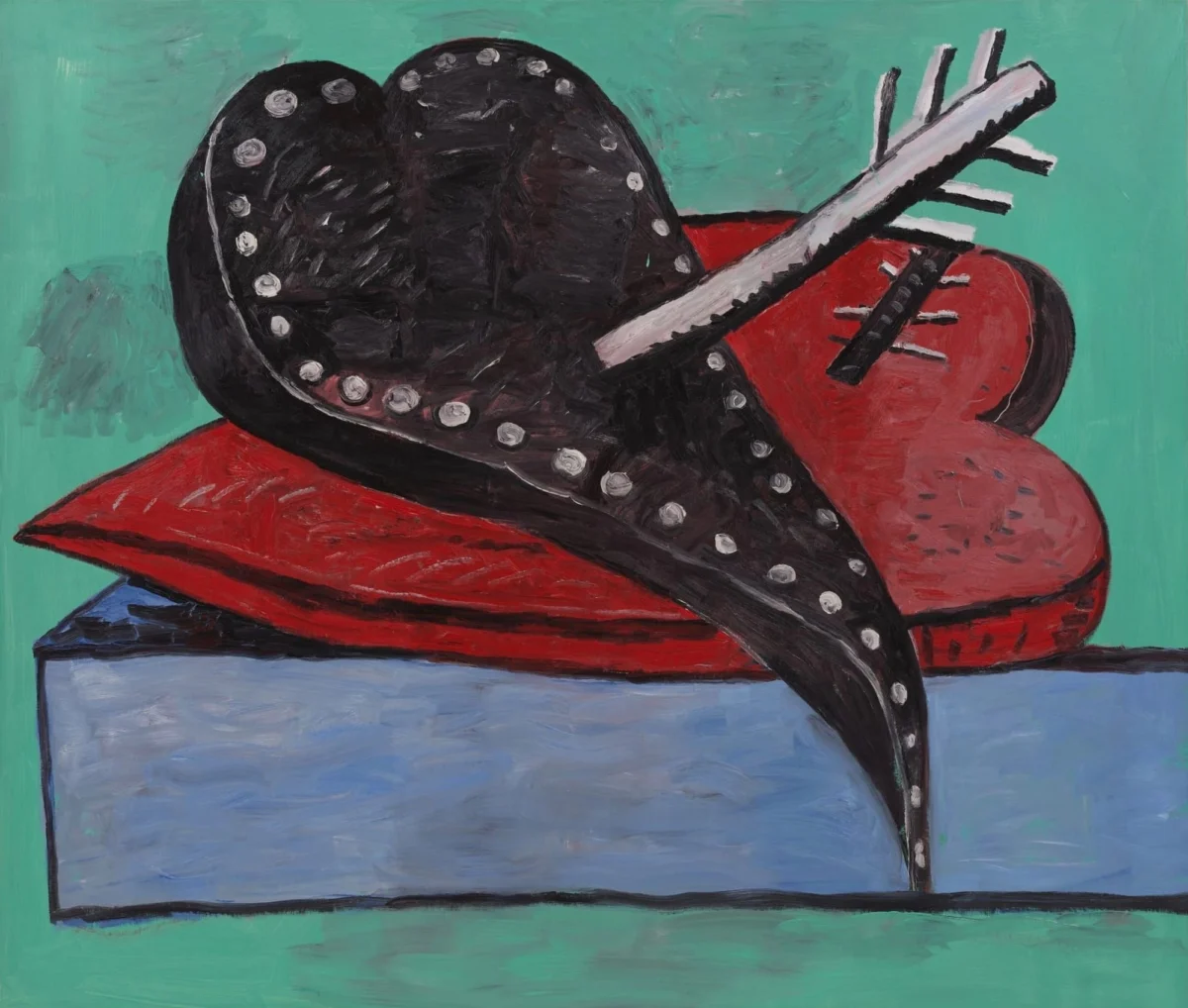
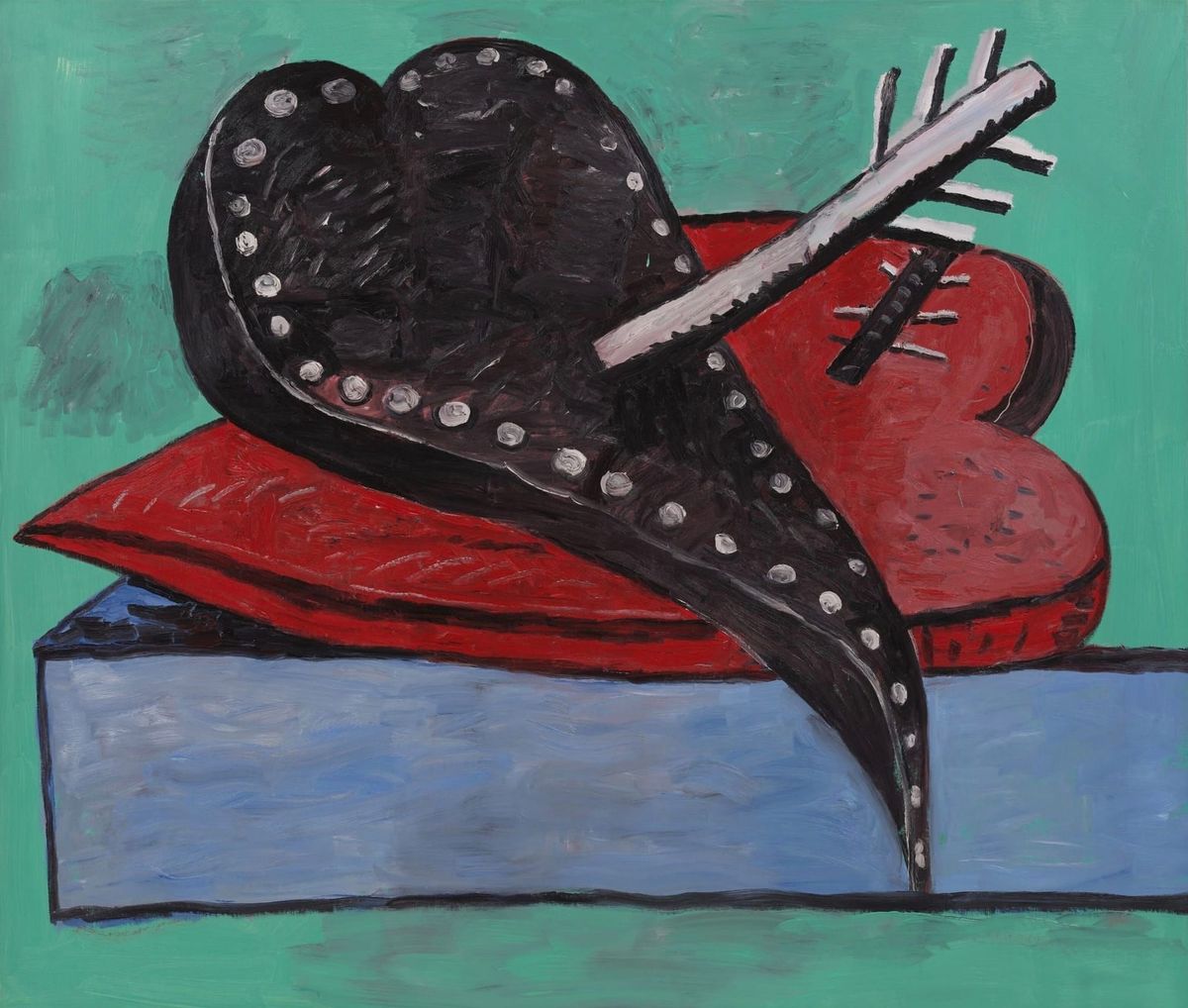
The centerpiece of the current show features three large easel paintings that serve as a testament to the couple’s bond. Untitled (1976), with its floating, red-headed figure, captures a state of constant, wide-eyed observation. Blue Cover (1977), depicting the couple in bed, is a quiet, devastating meditation on the fragility of existence.
Perhaps most striking is Two Hearts (1978). By placing a black, arrow-pierced heart alongside a stitched red heart, Guston created a visual poem about the scars of a long life shared. The painting is a culmination of his efforts to make art that is both "lush and forlorn."
The Lessons for Future Generations
The implications of the Life With P. exhibition are clear:
- The Necessity of Risk: Guston’s transformation serves as a reminder that an artist’s primary duty is to their own development, even at the cost of commercial viability.
- The Interdisciplinary Dialogue: The relationship between visual art and literature remains one of the most under-explored aspects of the 20th-century avant-garde. Guston’s work proves that painting can speak directly to poetry, and vice versa.
- Domesticity as Subject: By elevating the domestic sphere—the bed, the kitchen, the relationship—to the level of high, tragic drama, Guston expanded the boundaries of what figurative painting could achieve.
Conclusion
Philip Guston’s work from 1964 to 1978 was never about a decline in skill, as his detractors once claimed. It was about a stripping away of the ego. In the silence of his Woodstock studio, with the support of Musa McKim and the encouragement of his poet friends, Guston reached into the core of his own mortality.
Life With P. does not merely display paintings; it maps the interior life of a man who was brave enough to stop pretending. By focusing on his drawings and his partnerships, the exhibition invites us to see the "cartoonish" figures not as jokes, but as the most honest self-portraits of the 20th century. For those who still view Guston through the lens of his early abstraction, this show is a necessary, and deeply moving, reckoning.
 Basiran
 Muslim
 Evan Lee Salim
