

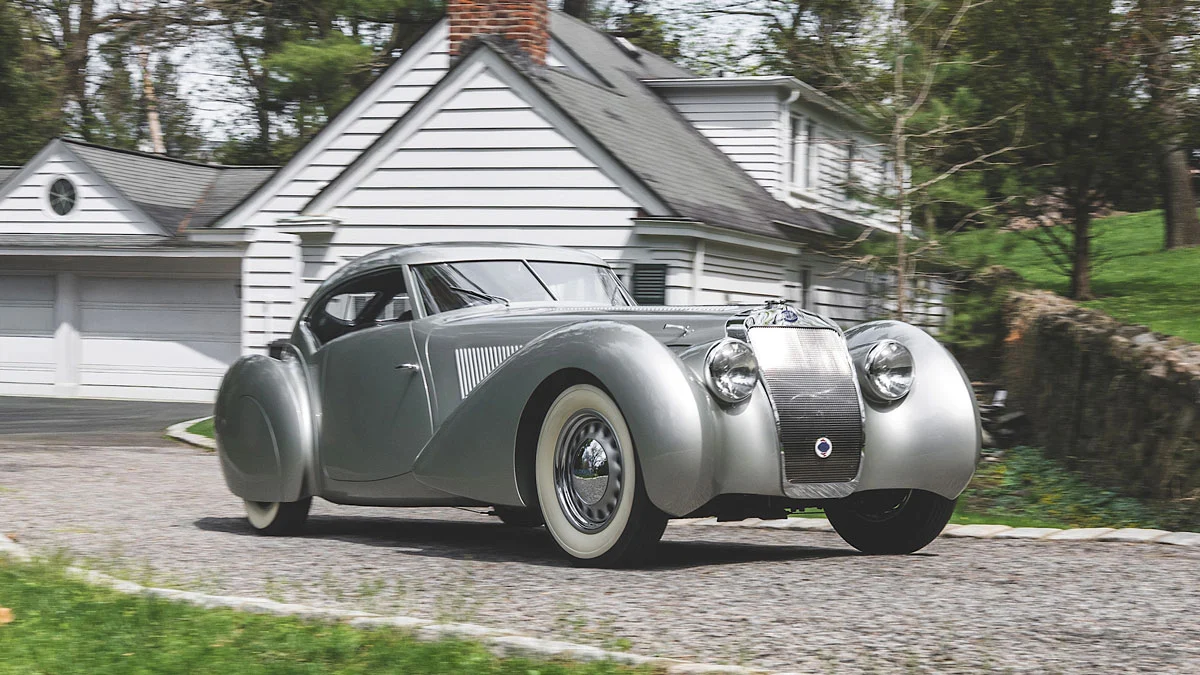
In the rarefied world of high-end automotive collecting, few titles carry the weight and prestige of "Best of Show" at the Pebble Beach Concours d’Elegance. Since the inception of the event in 1950, only 74 vehicles have earned this crowning achievement. Among this elite fraternity, the 1937 Delage D8-120 S Aerodynamic Coupe, a masterpiece of Parisian coachbuilding, stands as a singular testament to the marriage of engineering precision and avant-garde aesthetic design.
This August, the automotive world turns its gaze toward the Monterey Peninsula, where RM Sotheby’s will host its landmark Monterey Auction at the Monterey Conference Center from August 13 through 15. The highlight of the event—a vehicle that has not appeared on the open market in decades—is the very car that captured the top prize at Pebble Beach in 2005. Its arrival at auction is, by all accounts, a watershed moment for the collector car market.

A Legacy of Elegance: The Genesis of the D8-120 S
To understand the significance of this Delage, one must look back to the twilight of the French coachbuilding era. The D8-120 S was not merely a car; it was a defiant statement of luxury and performance during a time of immense geopolitical transition.
The vehicle features a potent 4.75-liter straight-eight engine, housed within a chassis specifically engineered for "S" (Sport) status. Compared to the standard D8-120, the S variant benefited from a lowered suspension, a reduced curb weight, and upgraded, oversized brakes to handle the increased power output. However, the true genius of the vehicle lies in its skin. Shaped by the visionary French designer Georges Paulin—one of the earliest pioneers to utilize wind-tunnel testing for automotive aerodynamics—the long-tailed, custom aluminum-and-steel body redefined the visual language of the 1930s.

The car’s history is as colorful as its design. As research from the RM Sotheby’s team confirms, the founder of the marque, Louis Delâge, originally intended to debut the prototype at the 1937 Paris Salon. When his application to the official show was rejected due to a timing technicality, he bypassed the bureaucracy entirely. He and the coachbuilder Marcel Pourtout simply drove the car to the Grand Palais and parked it at the entrance, turning the machine into an impromptu, headline-stealing exhibit. It subsequently became the personal daily driver of Louis Delâge, cementing its status as a cornerstone of the brand’s history.
A Turbulent Mid-Century Odyssey
The life of a collector car is rarely a straight line. By 1953, the Delage had endured the wear and tear of nearly two decades of use and was involved in a minor accident. It was sent to the legendary coachbuilder Saoutchik for repairs. For reasons that remain a subject of debate among historians, Saoutchik opted to deviate from the original Pourtout vision. The car received a blunter, more upright nose and a flat windshield, and its distinctive twin rear windows were replaced by a single, unified piece of glass.

This modified iteration of the car eventually made its way into the hands of William A. Raidy, a prominent newspaper magnate who utilized the vehicle for grand tours across France before eventually exporting it to the United States. Following Raidy’s stewardship, the car passed to William Maas, a New York-based experimental filmmaker, and later to the noted collector Alfredo Brener. Through these years, the car maintained its reputation for performance, yet its original, flowing aesthetic—the very essence of Paulin’s design—remained buried under the modifications of the 1950s.
The Resurrection: Restoring a Masterpiece
The modern history of this Delage began when it entered the collection of Sam and Emily Mann. A New Jersey-based couple with an unrivaled eye for prewar, coachbuilt automobiles, the Manns had pursued the vehicle for nearly a decade. When Brener finally agreed to part with the car—which was, by that point, in dire need of a comprehensive restoration—the Manns seized the opportunity.

The restoration was a monumental task, entrusted to the experts at Stone Barn in Vienna, New Jersey. The project spanned over two and a half years, serving as an archaeological endeavor as much as a mechanical one. By consulting original design photographs and the archival records of the Pourtout firm, the restoration team meticulously reversed the Saoutchik modifications. The process involved reclaiming the delicate curves of the front end, reinstalling the iconic curved windshield, and restoring the complex twin rear-window configuration.
When the car finally debuted in its original glory at the 2005 Pebble Beach Concours d’Elegance, it was not merely accepted; it was celebrated. It swept the field, earning the Best of Show award and subsequently winning "Best of the Best" at the inaugural Louis Vuitton Classic in New York. Sam Mann has often described the vehicle as the "cream of everything" he has ever owned, representing the "purest example of the automobile as art."

The Market Implications: A New Generation of Collectors
The offering of such a vehicle, as part of a 22-lot dispersal from the Sam and Emily Mann Collection, signals a shift in the high-end collector market. The collection also includes other legendary pieces, such as the 1935 Duesenberg JN Convertible once owned by Clark Gable.
Harvey Stanley, director of private sales for RM Sotheby’s, believes the market for prewar coachbuilt cars is currently undergoing a fascinating evolution. "This is nothing less than a coachbuilt masterpiece," Stanley says. "When you ask if a Pebble Beach Best of Show award adds to the collectability, the answer is one thousand percent. It is the ultimate accolade, adding immeasurably to the car’s provenance."

Perhaps most intriguing is the profile of the prospective buyer. While prewar cars have historically been the domain of older, established collectors, Stanley notes that he would not be surprised to see the gavel fall for a buyer in their 40s. "I think the market is changing," he suggests. "There is a palpable resurgence in interest for prewar cars that are truly special. Younger collectors are beginning to recognize that when you own a car like this, you aren’t just buying a vehicle—you are buying a golden ticket to the world’s most exclusive events."
The Value of Excellence
The "ticket" to which Stanley refers is literal in the world of high-end concourses. A car with the history and pedigree of this 1937 Delage is an automatic entry into the most prestigious gatherings, from Villa d’Este in Italy to the hallowed 18th fairway at Pebble Beach.

As the auction date approaches, estimates for the Delage range between $5 million and $6 million. This valuation accounts not only for the mechanical rarity of the 4.75-liter straight-eight engine but also for the intangible value of the car’s provenance. It is a piece of French history that bridged the gap between functional transport and fine art.
For the successful bidder, the acquisition will be more than a transaction; it will be an act of preservation. In a world increasingly dominated by digital assets and mass-produced luxury, the 1937 Delage D8-120 S Aerodynamic Coupe serves as a reminder of an era when design was an act of bravery and engineering was a pursuit of beauty. Whether it finds its way into a private museum or returns to the show circuit, one thing is certain: the Delage will continue to command the respect of anyone who appreciates the confluence of history, wind-tunnel innovation, and the uncompromising pursuit of the perfect line.
 rifanmuazin
 Laily UPN
 Suro Senen
