

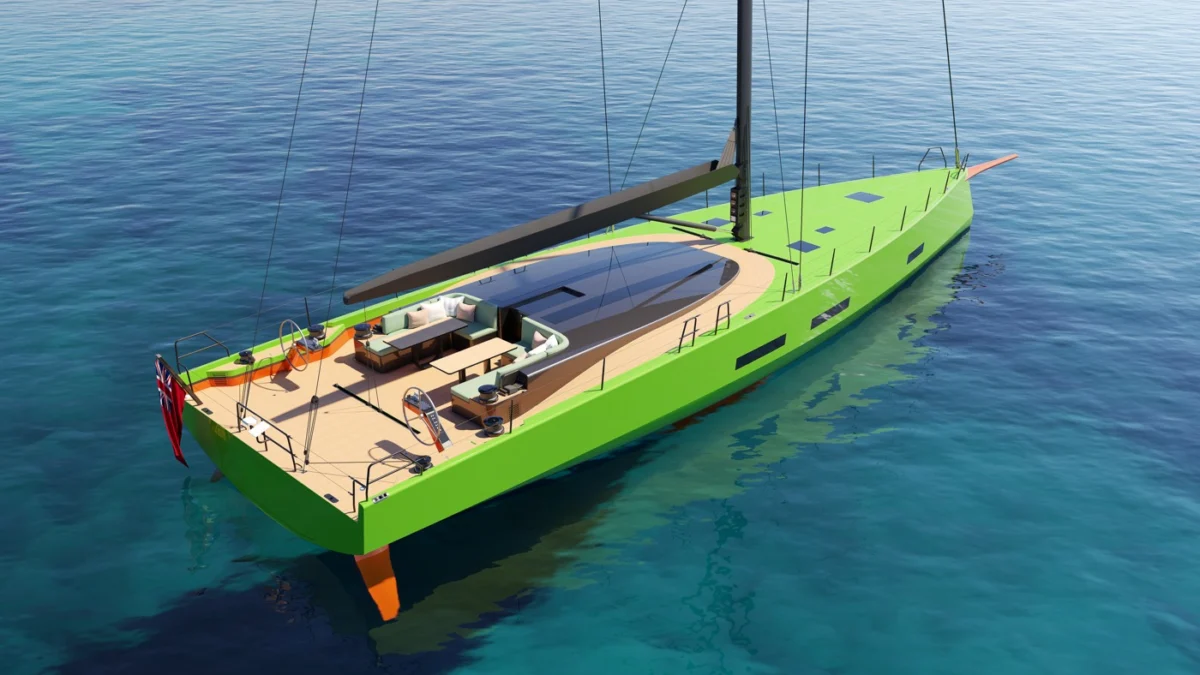
In the rarefied world of high-performance sailing, where engineering precision often dictates a sterile, utilitarian aesthetic, the Finnish shipyard Baltic Yachts has dared to pivot. With the unveiling of the first hull in its new 80 Café Racer series, the legendary yard is not merely launching a boat; it is launching a manifesto on how to marry extreme technical capability with unapologetic, avant-garde personality. The result is a vessel that brings a distinct Miami Vice flair to the open ocean, proving that one need not sacrifice performance for panache.
The Genesis of the 80 Café Racer: A New Era for Baltic
The 80 Café Racer stands as the sophisticated, high-octane sibling to the already celebrated 68 Café Racer. While its predecessor established the "Café Racer" philosophy—a concept centered on ease of use, rapid deployment, and pure sailing enjoyment—the 80-foot iteration scales these virtues into a larger, more versatile platform.
Designed by the renowned naval architect Javier Jaudenes, the 80 Café Racer is a masterclass in modern composite construction. The vessel was brought to life through rigorous Computational Fluid Dynamics (CFD) analysis, further refined by the data-heavy insights of North Sails’ Virtual Wind Tunnel. Every line of the hull, every curve of the appendages, and the very weight distribution of the carbon-fiber structure have been optimized to ensure that the boat is as fast as it is striking.
The primary mission of the 80 is to bridge the gap between "weekend warrior" sailing and competitive, rail-down regatta racing. To achieve this, Baltic has introduced a dual-rig configuration system, allowing owners to choose between a setup optimized for shorthanded, breezy family cruising and a high-performance race rig designed for a full professional crew.
Chronology of a Concept: From Sketch to Sea
The journey of the 80 Café Racer is a testament to the methodical pace of high-end yacht building. The project began with the success of the 68, which forced the Baltic design team to consider: What happens when we apply this "ready-to-sail" philosophy to a larger, more complex scale?

- Initial Concept Phase (2024): Preliminary naval architecture by Javier Jaudenes focuses on the power-to-weight ratio. The decision is made to utilize advanced lightweight carbon-fiber composites to maintain the agility of a smaller boat at an 80-foot scale.
- Engineering and Simulation (2025): The partnership with North Sails’ Virtual Wind Tunnel begins. This phase is crucial for ensuring the boat’s performance under various wind conditions, specifically looking at how to maintain speed without needing a massive, specialized crew.
- Construction and Customization (2026): The first hull enters the production cycle. It is during this period that the "Miami Vice" aesthetic is finalized, with the bold green livery selected to distinguish the first unit from the traditional, often monochromatic, palette of the sailing world.
- The Launch (Summer 2027): The scheduled delivery date for Hull No. 1. This marks the transition from design dream to reality, signaling the beginning of sea trials and the start of the 80-foot series production.
Technical Specifications: Data-Driven Performance
At the heart of the 80 Café Racer lies a commitment to lightweight engineering. By utilizing advanced carbon-fiber construction throughout the hull and deck, Baltic has ensured that the displacement remains low enough to provide exhilarating performance in light to moderate airs, while remaining stiff enough to handle the pressures of a full-rigged race.
The versatility of the vessel is perhaps its most impressive feature. The two available rig configurations aren’t just minor adjustments; they are fundamental shifts in the boat’s personality. The "cruising" configuration focuses on sail handling efficiency, utilizing push-button hydraulics to allow a solo sailor or a small family to manage the vessel with ease. Conversely, the "racing" configuration emphasizes sail area and mast stiffness, intended for those who wish to contest the leaderboard in some of the world’s most prestigious sailing circuits.
The hull itself is a study in hydrodynamics. Jaudenes has crafted a shape that promotes early planing, reducing drag and allowing the yacht to hit impressive speeds while maintaining stability. The use of a T-keel configuration ensures a low center of gravity, which is essential for the "rail-down" performance that characterizes this series.
A Visionary Interior: Redefining Luxury at Sea
If the exterior of the first hull—finished in a vibrant, high-gloss green—is an homage to the neon-soaked energy of the 1980s, the interior is where the true artistic expression begins. Moving away from the traditional, often dark wood veneers of classic sailing yachts, the first unit of the 80 Café Racer utilizes a "loft-style" approach to maximize volume and light.
The main saloon is an open-plan expanse. It features bold floral-patterned upholstery, vivid orange accents that catch the natural light from the overhead hatches, and a contrasting blue galley that feels more like a modern apartment in a design district than a ship’s kitchen.

Moving into the owner’s suite, the theme continues with a deep-blue bedframe as the centerpiece, set against walls adorned with abstract fish motifs. Even the bathroom, often an afterthought in yacht design, is treated as a design focal point, illuminated with warm, vibrant orange hues.
Baltic Yachts, in collaboration with the design house Design Unlimited, has ensured that this bold look is not a requirement, but an invitation. "It shows just how confident and expressive this concept can be and invites the next owner to take it somewhere completely their own," says Mark Tucker of Design Unlimited. For those who prefer a more traditional aesthetic, the shipyard offers a deep catalog of finishes, textures, and fabrics, ensuring that every 80 Café Racer remains a bespoke reflection of its owner’s personality.
The Flexibility of the Platform
The customization extends beyond mere aesthetics. A key highlight of the 80 series is the flexibility of the galley and saloon layout. Recognizing that every owner uses their yacht differently, Baltic allows for:
- Open-Plan Loft: Ideal for social interaction and entertainment, keeping the galley in direct view of the main saloon.
- Semi-Enclosed Galley: Provides a clear division between the culinary workspace and the social area, offering more privacy during extended voyages.
- Fully Enclosed Galley: The most traditional configuration, offering a dedicated space for complex meal preparation while keeping the saloon as a quiet, undisturbed sanctuary.
Whether an owner opts for sprawling sofas for relaxed entertaining or modular armchairs that can be reconfigured for different social settings, the underlying architecture of the 80 remains consistent: a focus on making the experience of "just going sailing" as effortless as possible.
Implications for the Future of Yachting
The 80 Café Racer is a bellwether for a broader shift in the sailing industry. For decades, the trend has been toward massive, crew-dependent "superyachts" that often feel disconnected from the act of sailing itself. Baltic Yachts is steering in the opposite direction. By emphasizing the "Café Racer" philosophy—speed, accessibility, and personal expression—they are attracting a younger, more design-conscious demographic.

This yacht is not designed to sit at anchor in a marina for weeks on end; it is designed to be sailed, frequently and hard. The ability to switch between cruising and racing modes means that the owner does not have to own two different boats to satisfy two different desires. This efficiency is the ultimate luxury in a world that is increasingly conscious of resource management and time.
Furthermore, the bold color palettes—the red, the neon yellow, the deep blue, and the green—challenge the industry’s reliance on "safe" colors. By proving that a high-performance carbon-fiber yacht can look as good in a designer magazine as it does on a racecourse, Baltic is effectively expanding the definition of what a modern sailing yacht can be.
As we look toward the delivery of the first hull in 2027, the 80 Café Racer stands as a beacon of innovation. It is a reminder that in the intersection of engineering and art, there is always room for a little bit of personality. Whether you are navigating the coastal waters of the Mediterranean or competing in a local regatta, the Baltic 80 is designed to ensure that you arrive in style, at speed, and with a smile. The era of the "boring" high-performance boat is officially over.
 rifanmuazin
 Laily UPN
 Suro Senen
