

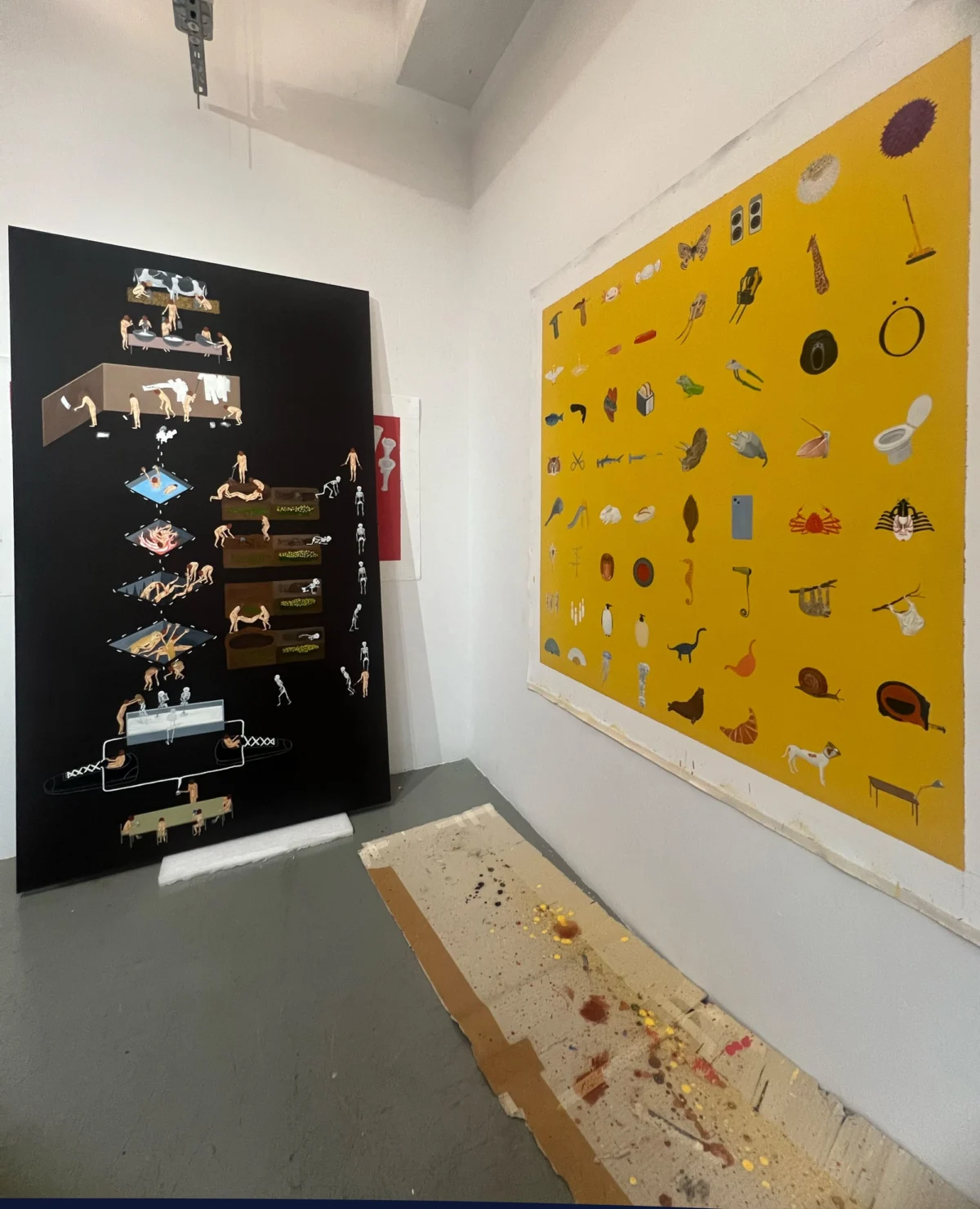
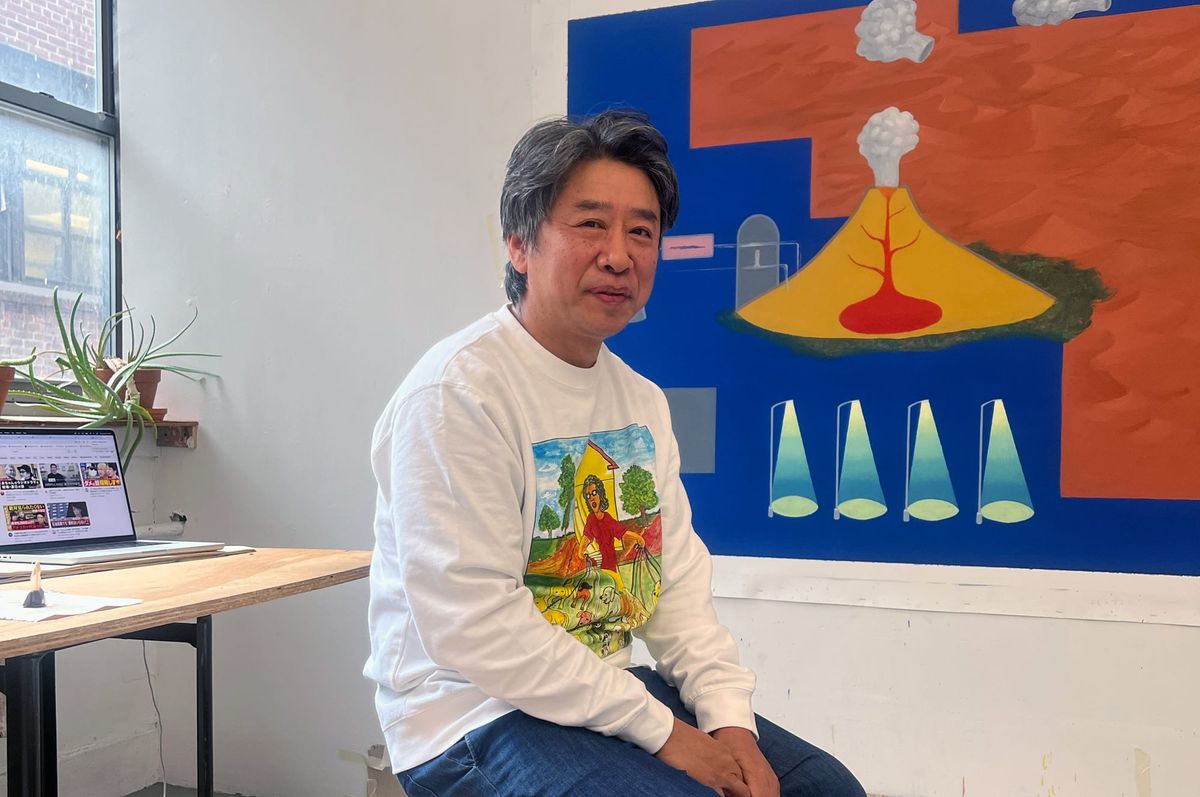
In the quiet, sparse confines of his studio, artist Akira Ikezoe sits amidst a few unfinished canvases. Dressed in a t-shirt designed by the Cevallos Brothers—a nod to his recent inclusion in the Greater New York survey at MoMA PS1—Ikezoe cuts a figure of focused, understated productivity. Over the past few years, he has emerged as a singular voice in contemporary art, with works appearing in prestigious international venues, including the Sharjah Biennial and the 2026 Whitney Biennial. Yet, despite his rising profile, his artistic process remains deeply rooted in the primal, often chaotic, experience of daily life.
Ikezoe’s work is characterized by a "cartoonish earnestness" that masks a profound, often unsettling, investigation into the environmental and industrial catastrophes defining the 21st century. Through oil paintings that depict anthropomorphic animals—frogs, bears, and raccoons—navigating complex, diagrammatic industrial systems, Ikezoe is mapping the uncomfortable friction between human technological ambition and the natural world.
Main Facts: The Intersection of Industry and Myth
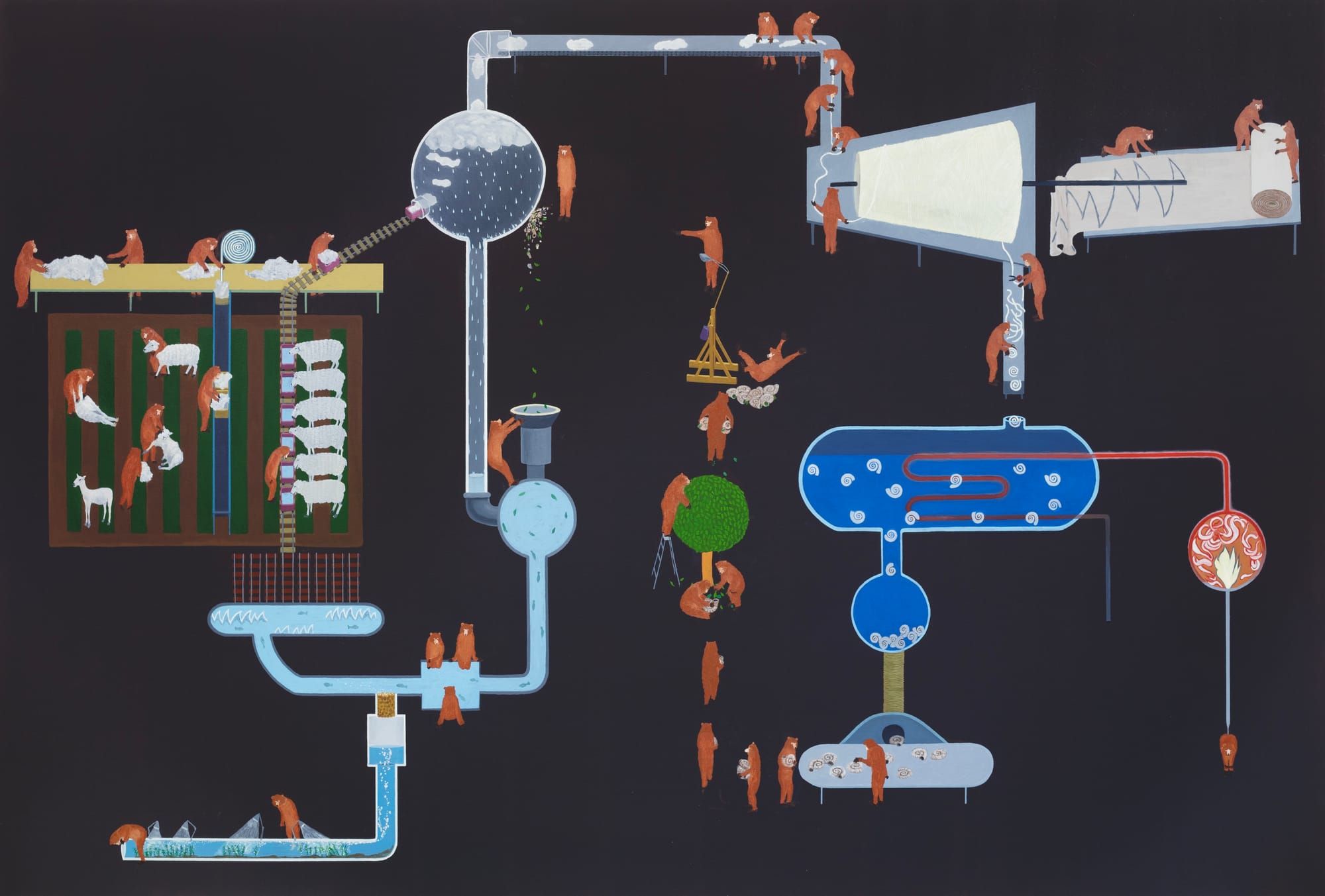
Akira Ikezoe’s practice is built upon the subversion of technical imagery. For years, he has utilized found flowcharts, industrial blueprints, and engineering diagrams as the structural foundation for his compositions. These materials, typically relegated to the utilitarian sphere of corporate or scientific labor, are repurposed as the stages upon which his anthropomorphic creatures act out their surreal, often cyclical, existences.
His work is not merely illustrative; it is a critique of the "energy systems" that underpin modern civilization. For instance, in his contributions to the Sharjah Biennial, Ikezoe paired diagrams of nuclear power plants that had suffered catastrophic failures with the animals native to those specific regions. In these works, Chornobyl is depicted as being operated by bears, while the Three Mile Island site is shown teeming with raccoons.

This shift toward animal subjects was, in part, a pragmatic response to cultural censorship—he notes that his earlier works focused on human nudity, which was restricted in Sharjah—but it proved to be a pivotal aesthetic breakthrough. The animals serve as avatars for the endurance of life in the wake of human failure.
A Chronological Perspective: From Kochi to the World Stage
Ikezoe’s path to the international art circuit began in Kochi, Japan, where he was raised by parents who were deeply connected to the natural world. Their penchant for hunting, collecting specimens, and spending weekends in the mountains provided him with a foundational intimacy with wildlife that informs his work to this day.
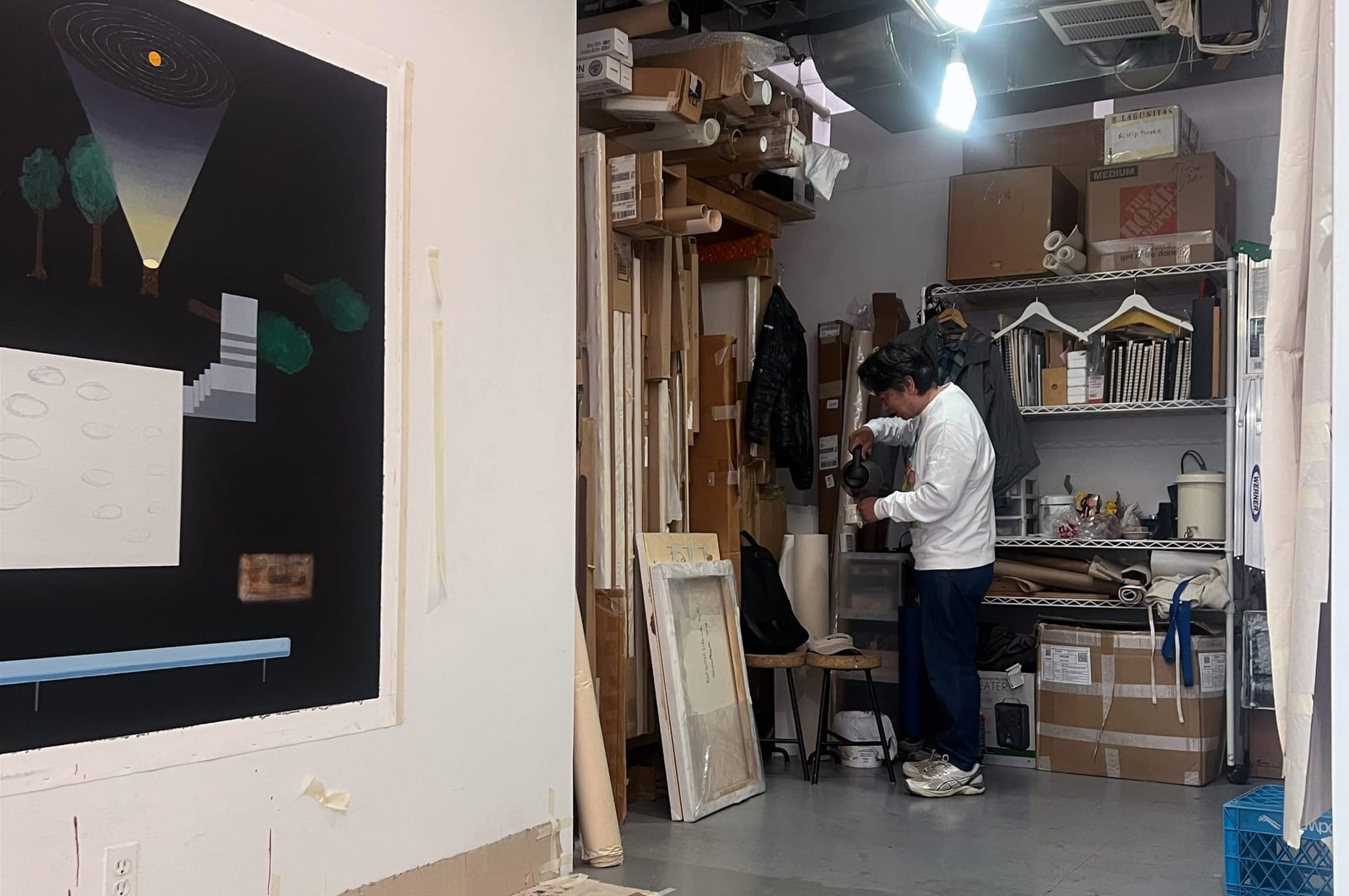
- Early Life: As a child, Ikezoe toyed with the idea of becoming a zoologist, a fascination that persists in his meticulous attention to animal behavior.
- Academic Foundation: He eventually turned his focus toward the arts, enrolling at the Tama Art University in Tokyo.
- The 2010 Pivot: In late 2010, Ikezoe moved to New York. Shortly thereafter, the 2011 Fukushima Daiichi nuclear disaster occurred, an event that significantly colored his perception of the interplay between human infrastructure and the environment.
- Evolution of Style: During his early years in New York, the language barrier pushed him toward a more visual, associative method of communication. He began categorizing objects based on shape rather than meaning—a technique he realized mirrored the origins of ancient folklore, where visual similarity often dictates myth-making.
- The Present: Today, his work is featured in major biennials, and he continues to refine his "visual dictionaries," which aim to explain the world without relying on verbal or written language.
Supporting Data: The Logic of the Sandbox
Ikezoe’s work is governed by an "absurd internal logic." During our conversation, he walked me through a work-in-progress: a geothermal energy plant designed to facilitate a "greening project" in the Sahara Desert. The painting describes a Rube Goldberg-esque cycle: heat from a volcano generates steam, powering streetlights that attract insects; chameleons eat the insects, are then collected by humans who emerge from the humps of camels, and are eventually returned to the earth to facilitate the growth of desert flora.
This is not a chaotic fantasy; it is a meticulously constructed, circular system of exchange. It highlights the "magical mutability" of physical properties that characterizes his work. As Ikezoe explains, "The studio is my playground. People who come here are adults, so I have to explain what I’m making in the sandbox. My work is purely self-entertainment."
His Baby Recipes series (2022) offers another window into his creative process. The series features comic-style cooking guides where babies’ body parts serve as ingredients. When asked if his wife found the work disturbing, he notes that she understood it as an expression of the frustrations and raw, visceral reality of raising a three-year-old.
Official Responses and Conceptual Framework
The art world has responded to Ikezoe’s work with significant interest, precisely because it bridges the gap between high-concept satire and approachable, whimsical imagery. Critics often note that his work functions as a "contemporary mythology." By bypassing linguistic barriers and relying on the universal recognition of shape and form, he creates a narrative space that feels both ancient and futuristic.
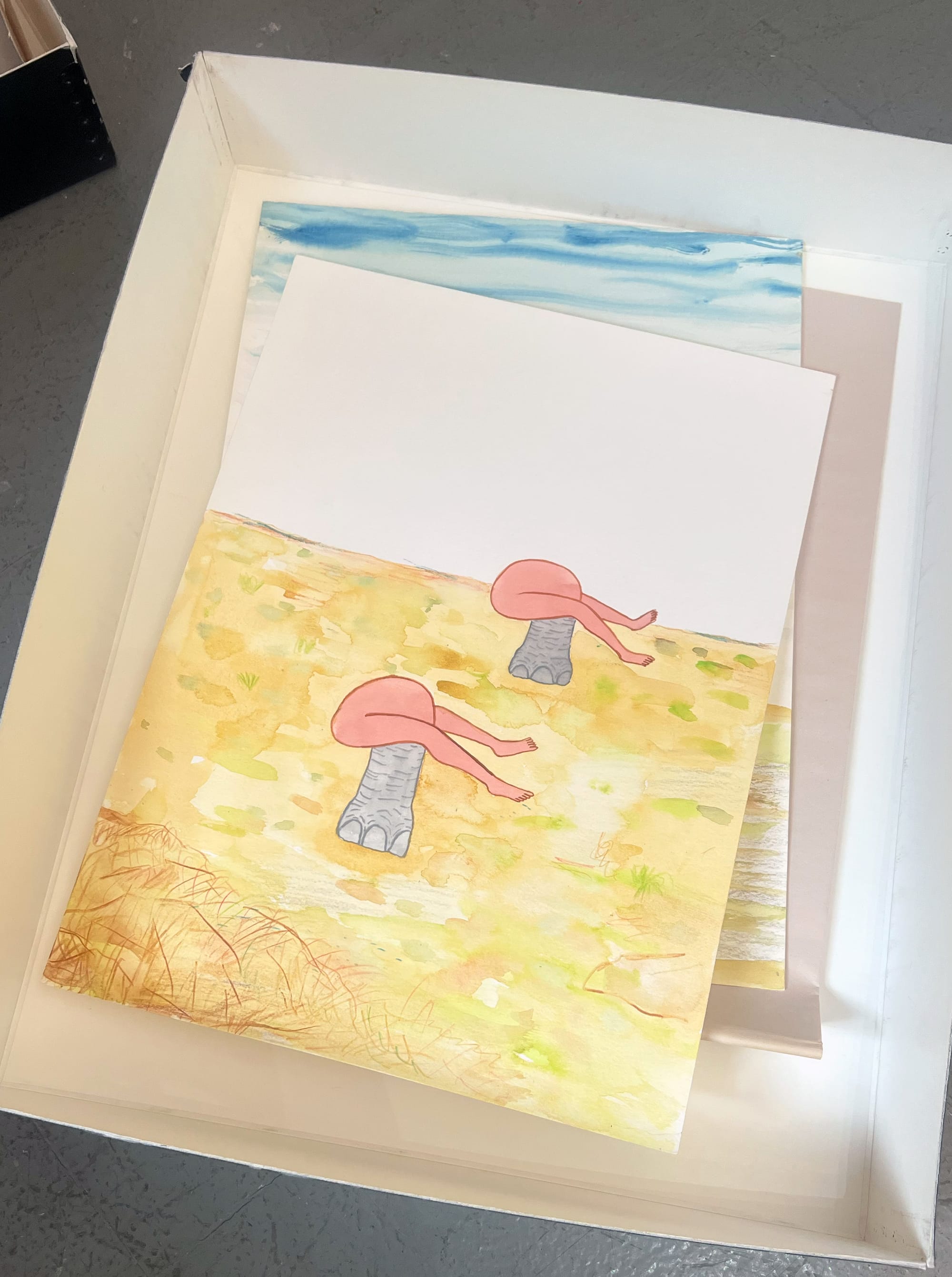
Ikezoe remains frank about the "contradictions" of our era. He acknowledges that while nuclear power is a problematic energy source, he views it as a necessary, if dangerous, reality of our current geopolitical landscape. "Just saying no to nuclear power now feels impossible," he remarks. "We need something to substitute or replace it. Let’s hope technological development offers solutions."
His work is also a critique of the misuse of green technology. He points to the current situation in Japan, where companies are clearing forests to install solar panels—a practice he finds deeply contradictory. He is currently working on a painting that satirizes this, populating a maroon background with figures on massage chairs, all part of a larger, ironically inefficient circulatory system.
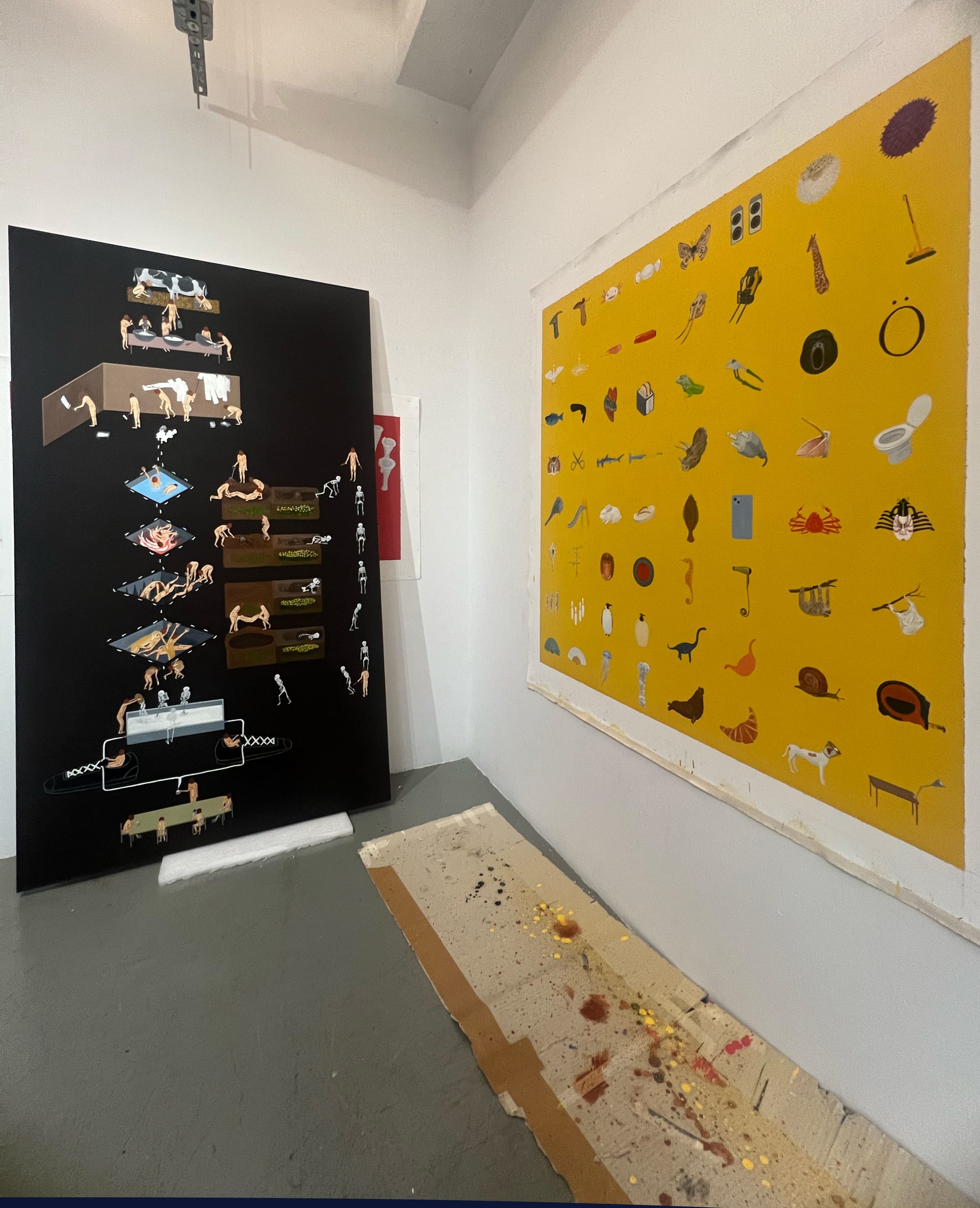
Implications: The Future of Human-Environmental Dialogue
The primary implication of Ikezoe’s work is the dismantling of the human-centric hierarchy. In his paintings, there are no protagonists; the system itself—the flow of energy, the process of decay, the necessity of recycling—is the story.
By viewing his work, the audience is forced to confront the "afterlives" of materials and technologies we would prefer to ignore. He invites us to see death and decomposition not as tragic ends, but as inevitable components of a continual, global transformation.
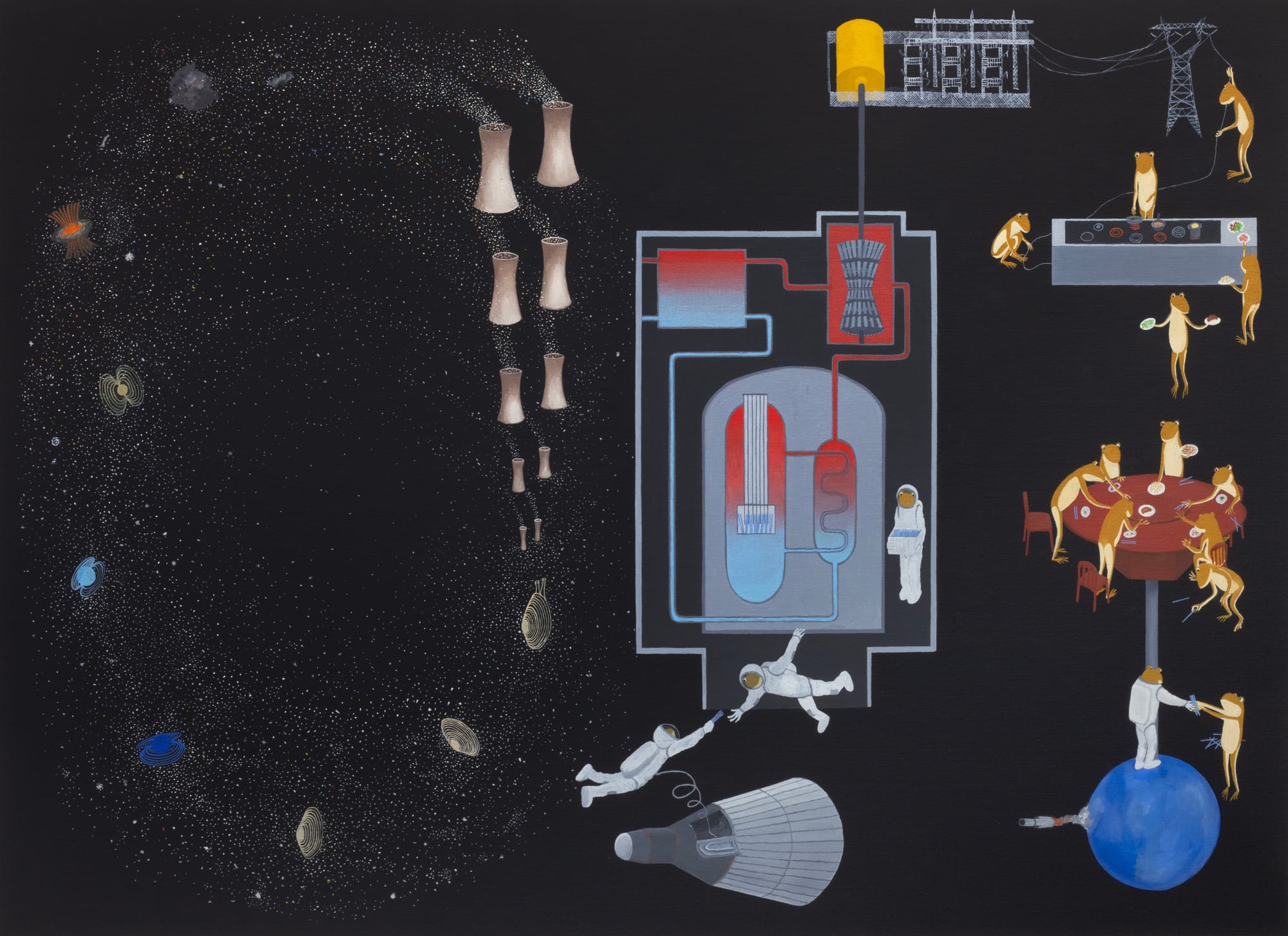
Perhaps the most significant aspect of his work is its pedagogical potential. By speaking with his son about these concepts and incorporating his child’s ideas into his canvases, Ikezoe is cultivating a form of associative thinking that is increasingly rare in adulthood. In a world where we are trained to think in literal, fragmented silos, Ikezoe’s work demands a return to the imaginative, holistic perspective of childhood.
As the 2026 Whitney Biennial continues to draw crowds, the sight of moles eating Chinese food within a closed-loop power grid serves as more than just a visual joke. It is a mirror held up to our own existence—a reflection of a society deeply implicated in complex, self-sustaining, and sometimes absurd systems of survival. Through the brush of Akira Ikezoe, we are reminded that while the catastrophes of the modern world are real, our ability to imagine ourselves out of them—or at least to find meaning within the wreckage—remains one of our most potent tools.
 Asro
Asro
 Jia Lissa
 Nana Wu
